
Donald Trump speaks of a war that is very close to the end. He says if he were to stop now, Iran would need twenty years to recover. It sounds like a conclusion. Like closure. Like the final sentence of a chapter that can be shut.
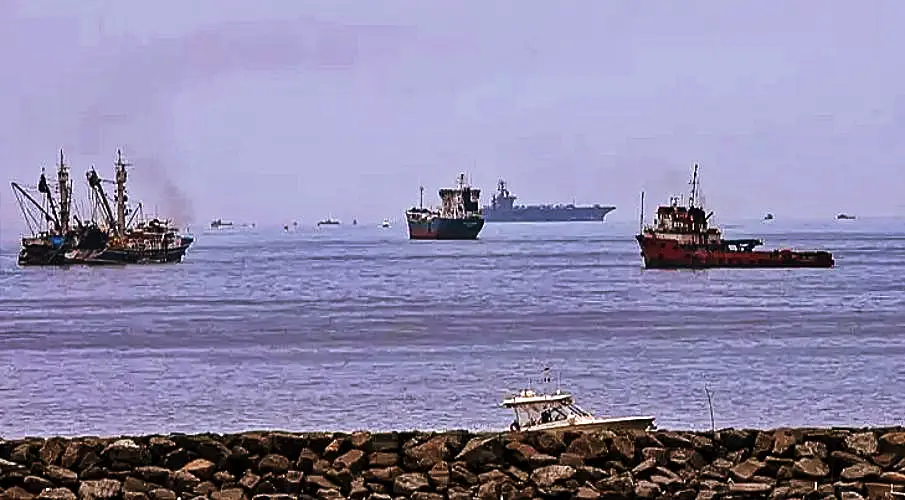
Out on the water, it looks different.
Our investigations clearly show that the US military has not only prepared this blockade, but is already implementing it. The US military will establish a blockade in the Gulf of Oman.

Ships leaving Iranian ports are tracked after passing through the Strait of Hormuz, identified, and deliberately forced to turn back. This is not about selective control, but about systematically disrupting trade flows. A US official describes that not only standard transponder signals are used for this, but additional methods to clearly determine origin and route. Which methods exactly are being used remains unclear. Equally unclear is the decisive question of what happens if a ship refuses to turn around. That is where the next level of escalation begins - because a blockade does not end with observation. It inevitably leads to direct confrontation.

Since Monday, the US military has been blocking all ships leaving Iranian ports in the Gulf of Oman. More than twelve American warships are positioned in international waters. Six commercial vessels have already received radio instructions to turn back - and have turned back. US Central Command says not a single ship has broken through the blockade so far. The Strait of Hormuz, through which more than 120 ships passed daily before the war and through which one fifth of global oil and gas trade flowed, is no longer an open sea route. It is a checkpoint.

What is happening now has a name from another time. Blockade. The word sounds like history, like warships anchored off ports, waiting. But the methods are new. The US military is not only using standard transponder signals to identify ships. It is relying on optical satellites, radar satellites, and radio frequencies. Sometimes also on personal devices of the crews - Fitbits, mobile phones - that transmit data without anyone noticing.

And on the other side, the response is already underway. Ami Daniel, CEO of the maritime data provider Windward, has been observing a new trend since Tuesday. Ships connected to Iran disappear from radar or suddenly reappear with false identities. Zombie identifiers, he calls it. Random numbers that belong to no real vessel. In the weeks after the first US-Israeli attack on Iran at the end of February, Iranian exports continued without disruption. Now, Daniel says, the ships are becoming more cautious.

This technique has not been newly invented. John C.K. Daly of the Central Asia-Caucasus Institute in Washington has spent years tracking Russian shadow fleets that have been circumventing Western sanctions since 2022. Russia has perfected a system using fake ship numbers, false flags, and manipulated transponder data that generates up to one hundred billion dollars per year and finances its war against Ukraine. What Russia refined over years is now apparently being used by ships in the Persian Gulf.
Spoofing is the name of the method. A captain enters a false port of origin, pretends to be another vessel, or simply switches off the transponder - disappears at one point and reappears somewhere else with new data, a new identity, a new story. The Chinese tanker Rich Starry sailed east through the Strait of Hormuz on Tuesday - and then turned around. Analyst Noam Raydan of the Washington Institute for Near East Policy says this can be directly linked to the blockade. Another vessel, the Elpis, also appeared to have passed through the strait. But it was offline. What happened to it afterward, no one knows.
Erik Bethel, partner at the maritime technology fund Mare Liberum, puts it this way: the Strait of Hormuz is currently a contested information space. A blockade is only as strong as the intelligence behind the interception operations. If you cannot clearly identify a ship, you cannot stop it.

Salvatore Mercogliano, maritime historian and lecturer at Campbell University in North Carolina, still does not believe Iranian ships will actually try to get through. They do not want to go out, he says. Not with American warships at the door.
While all this is happening, Pakistan continues working in the background on a thread of dialogue. Finance Minister Muhammad Aurangzeb makes it clear that Islamabad is not giving up and is holding on to a negotiated solution - following the first direct approach between Washington and Tehran in almost fifty years. Diplomacy takes time. The blockade creates facts that cannot simply be undone if talks fail.

Hapag-Lloyd, one of the world’s largest shipping companies, has six ships stuck in the Persian Gulf. Nils Haupt, spokesperson for the German company, says they have received no official communication from the US military. How to pass safely through the strait is unknown. Instead, they rely on media reports. Haupt asks publicly: Is it safe? Have all mines been cleared? Are ships being escorted?
No one answers.
Trump says the war is very close to the end. At sea, a Chinese tanker is turning around right now. Six ships have turned back. Twelve warships are waiting. And a German company is reading the news to understand what is happening to its ships.
This is what the end Trump is talking about looks like. Part of our team is setting out again today. Yesterday, or in some cases the day before yesterday, still on the return journey - today already back on the move.. That is what it takes if you want to stay close - close enough to see what no satellite image shows and no press briefing explains.
Another trip to Tehran is planned, among other things. We have already spent three weeks in the region, as far as Islamabad. What we saw there could not be translated into numbers. Only into faces, into sentences, into moments that are not invented.
A clear picture does not emerge at a desk. It emerges where things actually happen. That is why we are going back.
Updates – Kaizen News Brief
All current curated daily updates can be found in the Kaizen News Brief.
To the Kaizen News Brief In English


Was stimmt nun? Ist der chinesische Tanker „Rich Starry“ wieder umgekehrt oder ist er durchgekommen? Hier eine Pressemeldung von gestern, 14. April:
Trotz einer vom US-Militär verkündeten Seeblockade hat ein von den USA sanktionierter Tanker die Strasse von Hormus durchfahren. Das Schiff «Rich Starry» habe die Meerenge heute Früh durchfahren und verlassen, berichtete die auf Schifffahrt spezialisierte Website Lloyd’s List. Auch laut der Website Marine Traffic war der Öl- und Chemikalientanker heute im Golf von Oman unterwegs. Ob der Tanker iranisches Öl geladen hat, ist unklar.
Der Tanker ist durch, ist ein Originalfoto der Durchfahrt, dann drehte er aber um – man vermutete, er wollte testen, ob die Durchfahrt gelingt, auf jeden Fall ein komisches Verhalten – Tracking-Daten zeigen klar: kein stabiler Durchbruch, sondern ein Testlauf mit anschließendem Rückzug.Ihr Artikel ist vom 14.4.2026. 08:26:58
„…Der chinesische Tanker Rich Starry fuhr am Dienstag durch die Straße von Hormus nach Osten – und drehte dann um…
Vielleicht war es ein Test?
Die USA blockieren die Blockade.
Sicher stehen da Interessen, wie Beteiligung an Durchfahrtsgebühren auch auf der Agenda der USA.
Den Krieg hat Trump schon öfter für fast oder ganz beendet erklärt.
Darauf kann man nichts geben.
Vance redet davon, dass Trump den großen ganzen Deal will und nichts anderes.
Sprich die vollständige Kapitulation.
Der Iran hört diese Worte auch……
Eine sichere Reise für Dich und Dein Team ♥️
Passt auf Euch auf