The ceasefire expires on April 22. Both sides have reportedly agreed in principle to extend it - by at least two weeks, say regional intermediaries and investigations that remain anonymous. Three points of dispute are still on the table: the nuclear program, the Strait of Hormuz, war reparations. And while diplomats work on these questions, the military is creating new realities at sea every day.

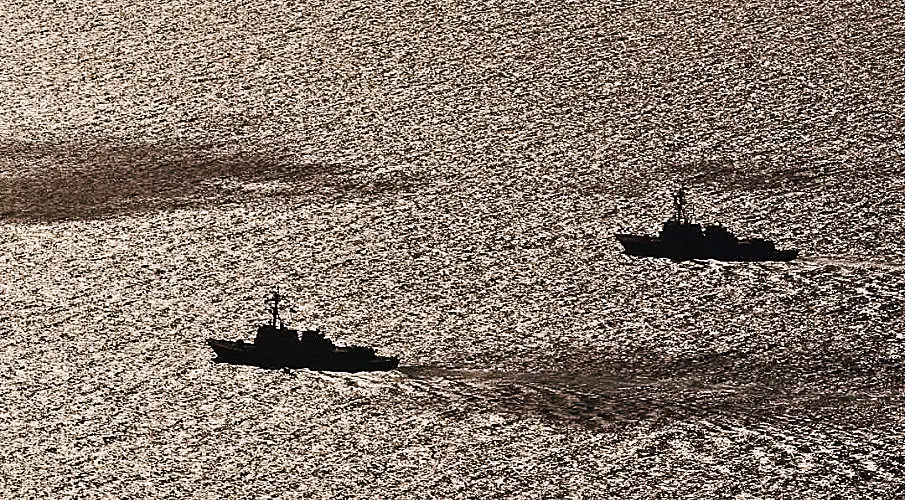
US Central Command has had the blockade of Iranian ports in effect since Monday. More than twelve American warships are positioned in the Gulf of Oman. Six commercial vessels have already received instructions to turn back - and have turned back. Iran responded with a threat. Ali Abdollahi, commander of the Iranian General Staff, said that if the blockade is not lifted, Iran will block all trade in the Persian Gulf, the Arabian Sea and the Red Sea. He called the American blockade a precursor to a violation of the ceasefire.

Meanwhile, Trump writes on his social media platform that China has agreed not to supply weapons to Iran. He says he wrote a letter to Xi Jinping - and Xi responded that he would not do so. China’s Foreign Ministry has been denying any military support for Tehran for days. The fact that Trump publicly links the deal to the opening of the Strait of Hormuz shows how closely these issues are intertwined. Beijing, for its part, praises Pakistan for its mediating role and welcomes a second round of negotiations between Washington and Tehran.

Pakistan is working at full speed. Prime Minister Shehbaz Sharif is traveling this week to Saudi Arabia, Qatar and Turkey - a diplomatic tour intended to secure a second round of talks before the ceasefire expires. Saudi Arabia is simultaneously transferring three billion dollars to the Pakistani central bank, as a sign of stability in a region that is economically straining under the war. Finance Minister Muhammad Aurangzeb is in Washington, at the meetings of the World Bank and the International Monetary Fund.
Russia’s Foreign Minister Sergey Lavrov is in Beijing. He says Iran has the inalienable right to enrich uranium for civilian purposes. Russia is prepared to take enriched uranium from Iran - for further processing or for storage, in whatever form Tehran accepts. Lavrov emphasizes that Moscow and Beijing stand firmly behind the negotiations. Rafael Grossi, Director General of the International Atomic Energy Agency, says in Seoul that any agreement must include very detailed verification mechanisms. Iran has a broad, ambitious nuclear program - that requires IAEA inspectors on the ground.
Iran itself signals limited willingness to engage in talks. Spokesman Esmail Baghaei says Tehran is open to discussing the type and level of uranium enrichment - but the country must be allowed to continue enrichment based on its needs. That is not a no. It is also not a yes. It is the language of a country that is negotiating while it is under fire.

In Tehran, two remotely detonated explosive devices went off early Wednesday morning. Three people were slightly injured, including a member of the Basij militia. A third device was defused. Revolutionary Guards commander Mohammad Balideh said the situation was normal and under control. Nothing unusual, he said. Just a limited explosion on the street.
In Lebanon, Israeli and Lebanese negotiators meet for the first direct talks in decades. At the same time, Israel is carrying out airstrikes on more than 200 Hezbollah targets in the south of the country. The Lebanese population is divided. Mustafa Alaa Al-Din, displaced from a border village and now in Beirut, says these negotiations do not represent him. Mohamed Saad, also in Beirut, says the talks are more in Lebanon’s interest than in Israel’s - because it is Lebanon whose land is being destroyed. Hezbollah lawmaker Hassan Fadlallah calls the talks shameful and demands a referendum on the future of Hezbollah’s weapons. His country’s foreign policy, he says, is now being determined by Israel.
In Kiryat Shmona, the Israeli border town in the north, confidence in the negotiations is low. Eli Mizrahi says Hezbollah is stronger than the Lebanese army. Nothing will come of it. Bruria Danino says she will only feel calm once Hezbollah is eliminated. In the background, sirens are wailing.
Turkish President Recep Tayyip Erdogan warns of an Israeli act of sabotage against the ceasefire. Negotiations cannot be conducted with clenched fists, he says. Weapons must not take over again.
The United Kingdom is holding its position. Prime Minister Keir Starmer says in the House of Commons that he will not change course. He will not give in. It is not in the national interest to join this war. Trump had previously threatened the United Kingdom with terminating the trade agreement - because London refused to take part in his war. Liberal Democrats leader Ed Davey asked Starmer in Parliament how he could send the King to the United States to a man who behaves like a mafia boss. Starmer replied that the visit of King Charles III marks the 250th anniversary of the United States - and the bond between the countries is more important than any individual currently holding office.
Norway is profiting. Export revenues from oil and gas rose in March to just under 200 billion kroner - around 21 billion dollars, an increase of 28 percent compared to the previous year. Jan Olav Rørhus of Statistics Norway says the closure of the Strait of Hormuz has caused a significant supply shock. South Korea has secured 273 million barrels of crude oil and 2.1 million tons of naphtha from Gulf states and Kazakhstan. Part of the shipments is being rerouted via the Red Sea to bypass the Strait of Hormuz. Naphtha shortages threaten the production of plastics and medical products such as IV bags and syringes. Japan is providing ten billion dollars for Southeast Asia to support the region in securing oil supplies. The program is called Power Asia.

Trump says gasoline prices will drop sharply once the war is over. He says he is comfortable with an oil price of 92 dollars per barrel. He says the war could end very soon. The ceasefire expires on April 22. Today is April 15.
Seven days.
Updates – Kaizen News Brief
All current curated daily updates can be found in the Kaizen News Brief.
To the Kaizen News Brief In English


7 Tage
Einerseits eine Chance, andererseits eine kurze Zeit.
Bedenklich finde ich die Aussage Russlands, angereichertes Uran aus dem Iran zu übernehmen (so wie Teheran dem zustimmt).
Einem Aggressor sollte man kein Uran übergeben.
Trump droht weiter und weiter, während Andere versuchen diplomatische Kanäle offen zu halten und Verhandlungen zu führen und Allianzen zu erneuern oder Neue zu schmieden.
Das der Libanon nicht in der Lage ist die Hisbollah zu kontrollieren oder gar zu entwaffnen, ist seit vielen Jahren klar.
Auch hat die Hisbollah einen nicht unerheblichen Rückhalt in der Bevölkerung.
Europa und andere Länder tun gut daran sich nicht in diesen Krieg ziehen zu lassen.
Die Frage, warum King Charles einen Mann besucht, der UK und Starmer permanent beleidigt, habe ich mir schon öfter gestellt.
Es ist schon peinlich, wie Charles Trump den Hintern pudert.
Alle blicken auf die USA und den Iran.
Aber es gibt noch mehr beteiligte Parteien. Israel, Libanon, Hisbollah, die anderen Anrejner…
👍