
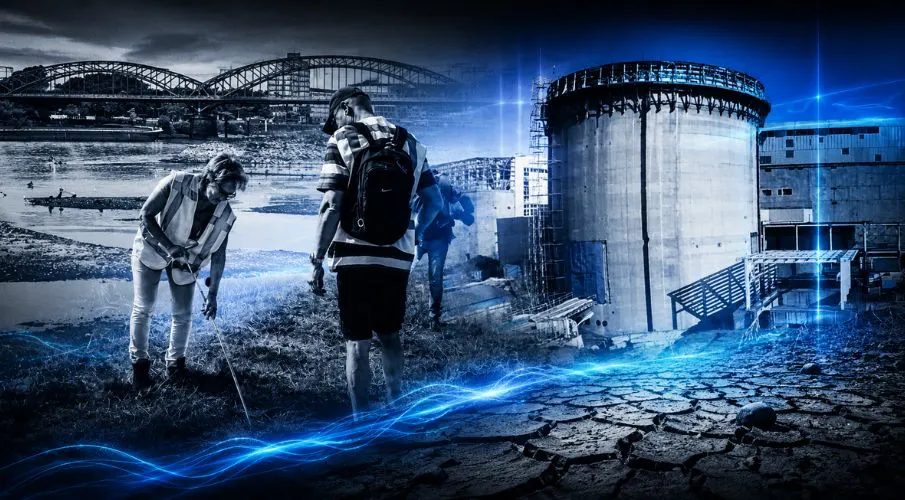
In Waddinxveen, 12 miles northeast of Rotterdam, 140 volunteers are walking along dikes this summer that no longer know water. They push metal rods into ground that has hardened and search for patches of green grass that could reveal a hidden leak. Together they inspect about 62 miles of dikes in a country whose reputation has been built for centuries on holding back the sea. What used to signal flooding now shows up as drought. Many inland dikes are built on peat, which has to stay moist to remain stable. When it dries out, it shrinks and becomes permeable. That is especially dangerous in areas lying 16 feet below sea level. So far, no major damage has been found, but inspections will continue through the fall because cracks often appear only later.

The country is now fighting against its own history. In winter, the goal is to get rid of water as quickly as possible to prevent flooding. In summer, that same water is suddenly missing from fields and canals. Researchers are looking for ways to slow down runoff and help soils retain more moisture. Even hedgerows along riverbanks could slow the flow enough to allow more water to soak into the ground. While inspectors are searching dikes for tiny cracks, a much bigger problem is already unfolding on the Rhine.

In Cologne, the river gauge dropped below the previous record low from October 2018 on Saturday. People are now walking across parts of the dry riverbed while cargo ships are allowed to carry only a fraction of their normal loads. A vessel that would normally transport 2,000 to 2,500 metric tons can now carry only about 400 to 600 tons, depending on its design, without running aground. Moving the same amount of freight now requires multiple ships, rescheduled deliveries, and additional transportation by road and rail. Port operators describe the impact on supply chains as devastating, and the Rhine remains one of Europe's most important transportation corridors for raw materials, chemicals, fuel, and industrial goods. When cargo capacity drops this dramatically, costs rise immediately. In Nijmegen, a rusted bicycle and a shopping cart now sit exposed on the bed of the Waal, the Netherlands' main branch of the Rhine. Houseboats that once floated freely now rest on sand. Residents say low water used to last perhaps a month. Now it stretches through entire summers.
For agriculture, another problem is emerging. In the dry western regions of the Netherlands, saltwater is pushing farther into soils and canals. In some areas, fruit and vegetable growers are no longer allowed to pump water from canals because authorities are trying to preserve the last remaining freshwater reserves. Smaller harvests and higher food prices are no longer concerns for the future. They become more likely with every week that rain fails to arrive. The drought is hitting dikes, shipping, agriculture, and residential areas all at the same time.

Further south, the continent is burning. France and Spain are battling major wildfires, and the cost of this fire season has already surpassed the average for an entire year. According to an investigation, the economic damage caused by fires and extreme heat has already exceeded €3.1 billion this year, counting only the five hardest hit countries: France, Spain, Portugal, Greece, and Romania. The European Commission estimates the average annual damage at €2.5 billion. During the first two months of the wildfire season alone, nearly 500,000 hectares burned. That figure reflects only the cost of restoring burned land to its previous condition, with the price per hectare depending on the type and age of the vegetation that was destroyed. Greece's losses are not yet fully included, and data from several other EU member states are still missing. The real damage, officials say, is therefore significantly higher.

Destroyed homes are not included in that total, nor are agricultural losses. It also excludes the collapse of tourism, interrupted industrial production, healthcare costs caused by wildfire smoke, and rising insurance premiums. In France's Gironde region, aerospace and defense companies were forced to suspend operations, wine production and oyster farming came to a standstill, and tourism collapsed. In Spain, not only forests but also farmland went up in flames. Some economists point out that reconstruction programs can even increase GDP on paper. But that increase is an illusion because it merely replaces what has already gone up in smoke.

The drought is no longer confined to forests. It is now reaching Europe's energy system. Water levels in the Rhine and the Danube have dropped to lows not seen in years, and with the water disappearing, power plants are losing the cooling they depend on. In Romania, Reactor 1 at the Cernavodă Nuclear Power Plant was taken offline in a controlled shutdown at 11:00 a.m. Tuesday because the Danube no longer carried enough water. The plant operator described the move as a precaution based on severe drought protocols and forecasts from the national hydrology institute, warning that Reactor 2 could also follow if water levels continue to fall. River flow had dropped to roughly 1,630 cubic meters per second. The shutdown was intended to protect the plant's three cooling pumps, whose failure could require repairs lasting anywhere from several months to a full year. The reactor is expected to return to service as soon as conditions allow. Prime Minister Ilie Bolojan, who also serves as energy minister, convened the national crisis committee. The ministry expects peak electricity demand of around 7,300 megawatts this week while domestic generation is projected at only 4,000 to 4,300 megawatts. The gap will be covered through electricity imports, while household prices will remain stable because existing contracts are fixed through the end of the year. Authorities also approved permits for an additional 324 megawatts of generating capacity, including 176 megawatts of battery storage and 148 megawatts of solar and wind power. Another 990 megawatts remain in the approval process. In an effort to direct what little water remained toward the plant, Romanian authorities even blasted a rock in the river.
In Hungary, the country's only nuclear power plant is facing its first complete shutdown in more than 40 years. Prime Minister Peter Magyar said on Sunday that the nation was entering what could become the five most critical days it has faced in decades. The Paks Nuclear Power Plant, with a capacity of 2 gigawatts, supplies roughly half of Hungary's electricity. It had recently been operating at just over 10 percent of its normal output after the Danube, which flows from Germany to the Black Sea and provides the cooling water for the plant, dropped to a record low. The national water authority expects the river to fall even further. The plant could stop generating electricity entirely as early as the following day, just as temperatures approaching 104 degrees Fahrenheit were forecast, Magyar said in a video message. He warned that the country's power grid, public services, and the population itself were coming under enormous pressure. The exact timing of a full shutdown would be determined by plant management under strict safety protocols. Paks operates four Russian-designed reactors and could remain offline for weeks. Voluntary electricity savings by households and more than 300 companies have already reduced demand by about 400 megawatts. Energy Minister Istvan Kapitany said participants include the Hungarian energy company MOL, battery manufacturer Samsung SDI, Volkswagen brand Audi, and automotive supplier Denso. The government says mandatory energy restrictions are not necessary for now but reserves the right to impose them beginning Monday. Water consumption has already been restricted in more than 100 cities and towns, including the outskirts of Budapest. According to Mark Radnai of Magyar's Tisza Party, the crisis could cost Hungary between 100 and 200 billion forints, or roughly $315 million to $630 million.
As of August 3, 2026, the AfD continues to explicitly call for a return to nuclear energy and the expansion of nuclear power.
The AfD continues to push for a return to nuclear power, portraying it as affordable, safe, and reliable. Europe is moving in the opposite direction. As the Rhine and the Danube increasingly suffer from low water levels, reactors are forced to reduce output or shut down altogether because there is not enough cooling water. Nuclear electricity is also among the most expensive forms of power generation. Current estimates place the levelized cost of electricity from new nuclear plants at roughly €160 to €250 per megawatt-hour. Onshore wind comes in at around €35 to €75, while utility-scale solar ranges from approximately €30 to €60. Add construction timelines that often exceed ten years and cost overruns like those at France's Flamanville reactor. Yet one issue is almost entirely absent from the party's arguments: the enormous thirst of these plants.

The cooling tower depends on the water flowing through that river. And that water is disappearing from the Rhine and the Danube. The AfD is promoting nuclear power based on an image of reality that no longer exists.
A large nuclear power plant requires hundreds of millions of liters of cooling water every single day. Several reactors together consume billions of liters. At precisely the moment when rivers are shrinking and heat waves are becoming more frequent, the party is promoting a technology whose reliable operation depends on that very resource. Anyone calling for a major expansion of nuclear power today must explain where tomorrow's cooling water is supposed to come from.
Since the end of May, Europe has endured three major heat waves. Preliminary data from just five countries indicate that extreme temperatures have already caused at least 10,000 additional deaths. That number now stands beside the billions in economic losses, and no recovery program can undo it. For a long time, people liked to believe that humanity somehow stood apart from nature rather than obeying the same physical laws that govern everything else. Anyone who builds dikes or places nuclear reactors on riverbanks often behaves as though that principle no longer applies. Peat dikes remain stable only as long as they stay wet. Cooling pumps keep running only as long as the river continues to feed them. Nature does not negotiate. It sets the conditions. This summer, it is presenting Europe with a bill whose final total no one yet knows.
Updates – Kaizen News Brief
All current curated daily updates can be found in the Kaizen News Brief.
To the Kaizen News Brief


Die Gruppe der Klimaleugner ist leider groß und mächtig.
Unterstützt von der Lobby für Öl und Gas.
Mit Trump haben sie den größten und mächtigsten Führsprecher.
Jede rechsgerichtete Partei schlägt in die gleiche Kerbe.
Wasserknappheit und die damit einhergehenden Hungersnöte, werden in den nächsten Jahrzehnten unser größtes Problem sein, wenn nicht endlich ein Umddnken ind vor allem actives handeln geschieht.
Was Dürre bedeutet, zeigt die Geschichte. In afrikanischen Ländern, wie Äthopien zum Beispiel.
Aber das war ja „weit weg“, man hat was für die hungernden Kinder gespendet um sein Gewissen zu beruhigen und das war es dann meist auch.
Es gab auch gute Projekte vor Ort. Aber diese verliefen, im wahrsten Sinne des Wortes, im Sande durch die instabile politische Lage