
Mexico City - There is an old idea that the law does not end where a state's power ends. Hugo Grotius, who first gave it structure 400 years ago, argued that there is a bond between nations that no one can sever unilaterally, and that injustice remains injustice even when it occurs beyond one's own jurisdiction. That is exactly where Mexico is now drawing the line, and it is doing so not with words, but with criminal complaints.

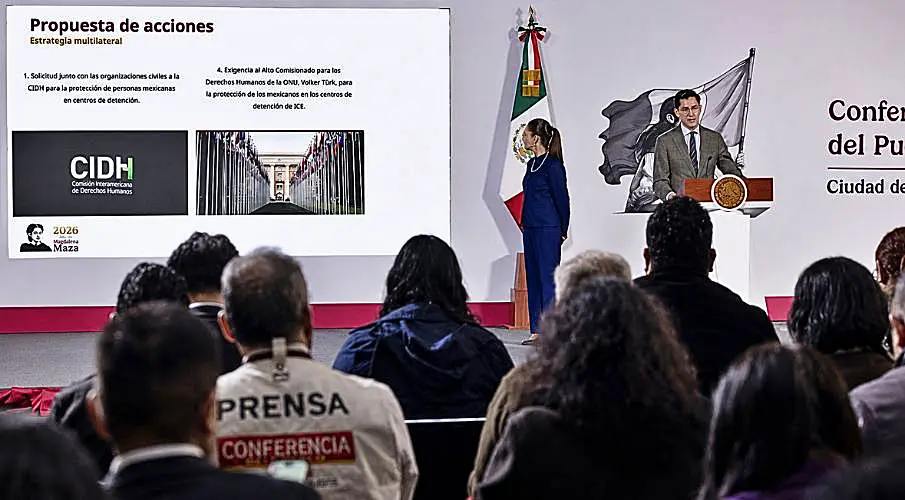
Foreign Affairs Undersecretary Roberto Velasco Álvarez announced that Mexico will file criminal complaints in the United States after an immigration officer in Houston shot and killed a Mexican man who had lived and worked there for decades while fighting to secure his legal status. The complaints will be submitted to state prosecutors and the U.S. Department of Justice, seeking criminal investigations into the deaths of 14 Mexican nationals in immigration detention and 3 others who were killed during enforcement operations under the current administration.
Read also our articles:
“You Tried to Run, Didn’t You?” - The ICE Agent Said as the Man Bled to Death
They Were Looking for Two Guatemalans - They Shot a Construction Contractor From Mexico Instead
Seventeen names, then, behind which stand 17 families. In a statement, the Department of Homeland Security did not dispute the number of deaths but rejected the accusation that the number of people dying in its custody has increased since Trump returned to office. The Department of Justice declined to comment. They do not deny the dead. They deny only that there are more of them. It is the defense of the one who counts the bodies and concludes there are not unusually many.

The case that became the turning point is that of Lorenzo Salgado Araujo, who was killed Tuesday in Houston. Federal authorities claim he used his vehicle as a weapon. To this day, no evidence supporting that claim has emerged. Asked about his death, President Claudia Sheinbaum said Mexico cannot allow its brothers and sisters in the United States to be treated this way. His only offense, she said, was not having immigration papers. That is the sharpest sentence spoken this week, because it is true. A missing document, still being processed, is an administrative matter. It is not a capital crime, yet it ended in death.

Mexican President Claudia Sheinbaum Pardo announced that her government will take legal action to support the families of Mexican nationals who died in detention centers in the United States.
Investigations found that Mexico had already submitted 11 formal requests to the U.S. State Department seeking investigations into the deaths, that it had raised the issue with the United Nations High Commissioner for Human Rights, and that it had asked a regional human rights body to review the cases. The new step goes further. The goal, Sheinbaum said, is to move beyond diplomatic notes. More substantial legal measures are now being prepared.

This must also be read against the backdrop of increasingly strained relations between the two countries. Trump has bombarded Mexico with insults and tariff threats while demanding tougher action against corrupt officials and drug cartels, including threats of military action against criminal organizations. Sheinbaum has pushed back, placing Mexico's sovereignty at the center of the dispute. U.S. prosecutors have indicted 10 current and former Mexican officials, including a sitting governor, and demanded their extradition. Mexico has refused, arguing that the evidence is insufficient.
Here the irony stands in plain sight. The same Washington that demands the extradition of Mexican suspects while invoking cross border law must now explain why its own officers remain beyond accountability when they kill Mexican citizens. A government that extends the reach of law across borders to prosecute can hardly deny that the same law extends across borders to protect. The first path is diplomacy, and that path now appears to be a dead end. Some observers in Mexico fear the effort may ultimately fail because it lacks the legal force to change American policy and because it may further damage relations between the two countries.
And over all of it hangs an image of almost grotesque casualness. This summer, the United States, Mexico, and Canada are jointly hosting the Men's World Cup. At the end of June, while the tournament was reaching its peak, immigration arrests quietly surged across the United States. Flags filled the stadiums. Unmarked vehicles filled the streets. Grotius would have said that the bond between nations is not broken by a single gunshot, but it is tested by whether anyone is willing to hold the shooter accountable.
Updates – Kaizen News Brief
All current curated daily updates can be found in the Kaizen News Brief.
To the Kaizen News Brief In English


Das ICE die WM nutzen wird um mehr Menschen fest zu nehmen, war von vornhetein klar.
Die WM ist einerseits eine gute Ablenkung, andererseits sind viele Menschen interwegs.
Ich fürchte, dass die Klagen entweder nicht angenommen werden oder im Sande verlaufen.
Aber natürlich erst nach der WM.
So lange wird die US Regierung schweigen, bzw die falschen Narrative verbreiten.
Für MAGA sind diese Menschen alle Schwerkriminelle 😞