
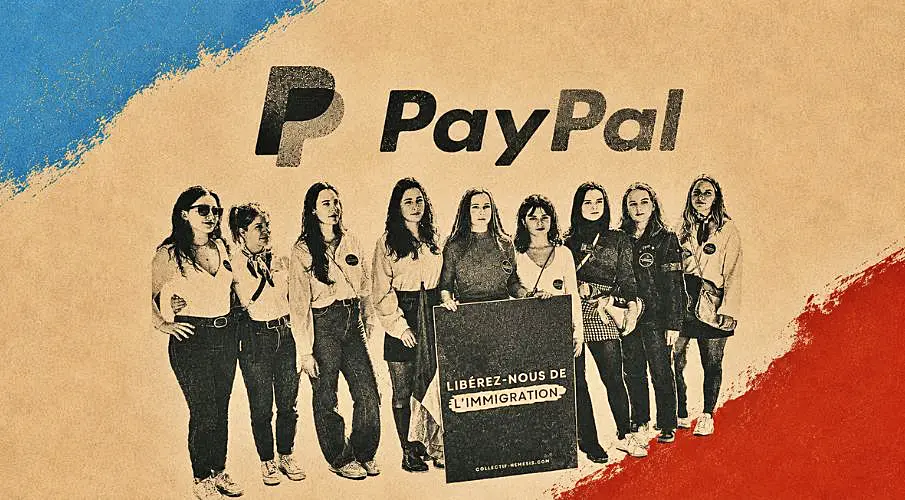
For $12, you can buy a mug printed in large block letters declaring that foreign rapists should be thrown out. For $29, you can order a pink T-shirt reading "I'm a feminist against everything woke," modeled by two young, smiling white women. There are socks, posters, and a cap that borrows Trump's famous slogan by calling to make feminism great again. All of it is sold through the online store of Collectif Némésis, a French far right women's organization that claims to fight gender based violence while maintaining ties to neo-Nazi groups, infiltrating feminist marches, and spreading hatred against immigrants and Muslims. Every purchase can be paid for through PayPal.

Collectif Némésis: "Free us from immigration."
Our reporting shows that Némésis, which is also active in Switzerland, Italy, and Belgium, is not an isolated case. We identified nine so called femonationalist organizations using the payment platform to sell merchandise and collect donations. The term, coined by a sociologist, describes nationalists who exploit feminist issues to advance xenophobic, racist, or reactionary politics. Merchandise cleanses the public image of these groups while simultaneously financing their cause. And all of this happens even though PayPal's own rules prohibit transactions that promote hatred, violence, or discrimination.
This is where the real story begins, and it is less about the fanatics than about the machine serving them. Max Weber described modern bureaucracy as rule through instrumental rationality, in which the official no longer asks whether something is right but only whether it can be processed according to procedure. Responsibility, Weber argued, is transferred to the rule itself, freeing the individual from personal judgment. That very transformation of conscience into procedure is described by three former PayPal employees who requested anonymity. They accuse the company of deliberately looking the other way.
"PayPal is extremely sales driven," said one former employee whom we call Pascal. Even with smaller merchants, PayPal ultimately earns its fee on every payment, even when those merchants are doing something harmful. The approach literally pays off. Last year PayPal reported net revenue of $33.2 billion, an increase of 4 percent over 2024. Every mug calling for expulsions generates a small fee, and enough small fees become a very large number.

Pascal's job was to assess merchants for financial and reputational risk, from the smallest sellers to multimillion dollar businesses, while also supervising other reviewers. When a seller displayed extreme political affiliations, it triggered internal discussions. But according to his account, those discussions focused on managing the risk, not removing the seller. The goal was to keep the customer. For an event, PayPal might refuse to process ticket sales while continuing to handle donations for the very same organization. A senior reviewer with more than 10 years at the company and another risk analyst confirmed this account. The senior reviewer said he left because a culture had taken hold that valued getting things done quickly over getting them done correctly, and because people spoke less openly than they once had. PayPal did not directly respond to those accounts.
Those statements must be heard in all their coldness. Hatred is not rejected. It is administered. An account remains active, only subject to conditions. This is Weber's bureaucrat in its purest form, no longer deciding whether something should exist, only how it can be managed without losing the processing fee. Publicly, the company tells a different story. Through its communications director, PayPal said it invests substantial resources worldwide to combat illegal and unauthorized activity, acts immediately when violations are detected, and cooperates with authorities while remaining free from outside influence. Asked to provide evidence supporting those claims, the company supplied none. In 2021, PayPal announced a partnership with a Jewish civil rights organization to expose and disrupt the financial networks of extremist movements. That partnership ended in 2024. The organization did not respond to requests for comment.
Why extremists continue slipping through the cracks becomes clear once you look at how the system is built. Anyone wishing to become a merchant goes through an automated process because PayPal manages 439 million active accounts, far too many for individual human review. Fraud detection software cannot recognize extremism, and the details of how those systems operate remain opaque. Extremists, one attorney specializing in these cases explained, use coded language, while external online stores often fail to trigger any warning at all. These systems contain enormous blind spots. Back in 2015, PayPal paid a $7.7 million settlement to the U.S. Treasury over potential sanctions violations, including transactions allegedly linked to weapons of mass destruction. The company acknowledged at the time that its automated filtering system had failed.
The problem is compounded by the fact that the transactions are small. The amounts involved are too low to trigger internal risk reviews. Yet the merchandise spreads exclusionary and racist content, including material promoting so called remigration, meaning ethnic cleansing, deportation, and hostility toward vulnerable communities. How, one former employee asked, could anyone prove that a $500 donation in euros, pounds, or dollars to one of these accounts ultimately financed an attack on a migrant shelter? They could not. An expert in trade based money laundering added that PayPal replaced experienced European specialists with lower paid staff abroad, losing much of the expertise needed to recognize the subtle warning signs such merchants present.
The most disturbing part is that much of this is perfectly legal. As long as an organization is not designated as terrorist and has not been banned, it has broken no law. Governments are also reluctant to give payment companies too much power to decide who deserves access to financial services because the same authority could one day be used against democratic, human rights, or environmental organizations. Payment providers therefore find themselves trapped between two equally troubling paths, allowing hatred to flourish or arbitrarily deciding who may participate in public life.
Némésis itself, which a Socialist member of the French Parliament has already asked authorities to examine for a possible ban, responded without embarrassment. The organization denied any ties to neo-Nazis, confirmed that merchandise sales finance its activities, and said it did not care whether people viewed those sales as laundering its ideology.
The ideological conflict between the anti immigration group Némésis and counter protesters has escalated time and again.
Now the company's new chief executive is planning major layoffs while pouring billions into artificial intelligence. Replacing human review with machines incapable of recognizing hatred only makes administration cheaper and scrutiny even rarer. Weber saw the end of that road in what he called the iron cage of servitude, where purpose has consumed meaning itself. A $12 mug, a processing fee, an account with conditions attached. Hatred has learned how to be booked into the system, and the cash register never asks what it is collecting money for.
Updates – Kaizen News Brief
All current curated daily updates can be found in the Kaizen News Brief.
To the Kaizen News Brief In English


Ja, da geht es um Verwaltung vom zerstörerischem Handel. Dieser wiederum ,scheibechenweise am Anfang ,unseren Zusammenhalt und Demokratie zerstören. Was wird dem Mamon nicht alles geopfert. Wir sind in der Entscheidung frei aber nie von deren Konsequenzen. Es wird uns alle teuer zu stehen kommen
Da zeigt sich das Dilemma.
Hass kann verbreitet werden, sofern die Organisation oder der Shop dahinter nicht verboten sind.
Da bleibt es „nur“ moralisch verwerflich, aber nicht illegal.
Moral verliert immer mehr an Stellenwert.
Letztlich kann nur der Vetbraucher reagieren und solche Produkte nicht kaufen.
Dazu bedarf es viel Aufklärung. Denn ich bin mir sicher, dass Vielen nicht bewusst ist, wer hinter dem Shop steht.
BTW, ich verstehe ohnehin nicht, wie Frauen sich für Faschisten hergeben.
Das Frauenbild der Faschisten?? Am Herd, Kinder bekommen, dem Mann gehorchen, keine eigenen Rechte haben.