
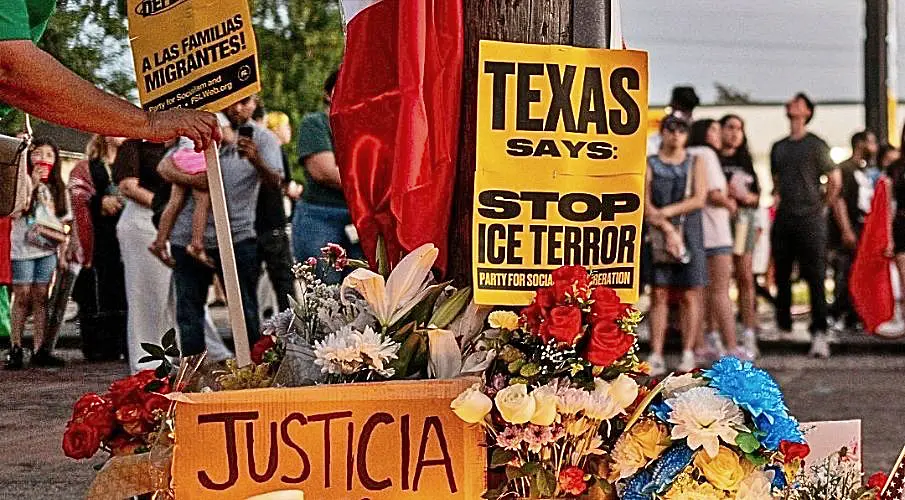
Houston, Texas - Just hours after a man bled to death in Houston, the Department of Homeland Security released its statement. It claimed that Lorenzo Salgado Araujo had rammed a government vehicle and used his white work van as a weapon in an attempt to run over an Immigration and Customs Enforcement officer. The statement came quickly. It came faster than anything else in this case. Faster than the release of images, faster than answers, and faster than the evidence that remains locked away under federal control.

Three men were inside that van. All three survived. All three are now being held in immigration detention, separated from one another, and all three tell the same story. Jose Trinidad Rojas, fifty-one years old, wrote it by hand on a legal pad. "That is a lie," he wrote. "It is impossible to claim we tried to run anyone over. There was no officer standing in front of the vehicle, and none behind it. They were on the sides."
Their attorney, Hugo Balderas-Ibarra, was finally able to speak with Rojas, with Daniel Tirado Pantoja, forty-three, and with Victor Salgado, forty-four, the younger brother of the man who was killed. He interviewed each of them separately. None of them had any opportunity to coordinate their accounts. Every one of them said the same thing. No officer ever stood in front of the van. The officers approached from the sides, and the shots came from the sides.
Read also our article: They Were Looking for Two Guatemalans - They Shot a Construction Contractor From Mexico Instead
Once again, deadly gunfire by federal immigration officers brings back memories of Minneapolis, where, during a wave of enforcement operations, American citizens Renée Good and Alex Pretti were killed in two separate incidents. The statement issued in Houston follows the same pattern as those released after other shootings involving migrants and American citizens. In multiple cases, later investigations, video evidence, and witness testimony contradicted the government's original account, showing that the officers had not been in danger. In some of those cases, it was the officers who initiated the violence.

This time, there is no video. A government official, who insisted on remaining anonymous, confirmed that the officers were not wearing body cameras. What remains are the voices of the survivors against the written account of a government agency, and one question. In a constitutional democracy, whose account should be believed first - that of an agency investigating itself, or that of three men who have nothing to gain and everything to lose?
ICE is not telling the truth. A lie is not defined by getting a fact wrong. A lie begins with the intent to deceive. Someone who makes an honest mistake and says something untrue is not lying. Someone who knowingly tells an untruth in order to prevail is lying even if, by coincidence, the statement turns out to be correct. That distinction defines what happened in Houston. An officer may make a mistake in a split second. A written statement produced hours later at a desk, declaring a dead man to have been the aggressor, is no longer making a mistake. It is trying to accomplish something.
Tuesday began like any other day. Around 6:30 in the morning, the four men were driving along Wayside Drive toward the highway. They had bought ice and water and were on their way to the construction site. They stopped at a traffic light. Behind them, an unmarked vehicle pulled in and began following them. When the light turned green and the van moved forward, that vehicle accelerated along the shoulder, cut in front of Salgado Araujo, and tapped its brakes.

That was when he turned around. And only at that moment, the three men say, did the officers activate their emergency light.
You have to read that sequence twice to understand what it means. First came the pursuit by an unmarked vehicle. Then came the attempt to force the van off its path. Then came the turn made by a man who did not know who was chasing him. Only after that came the signal identifying law enforcement. Reverse that sequence, and a frightened man becomes a fleeing suspect. That is precisely the reversal contained in the government's version of events.


The video footage captures the beginning of the pursuit. Lorenzo Salgado Araujo turns left in his white work van. The black Immigration and Customs Enforcement vehicle is already visible, traveling at high speed, but it continues straight ahead. Only afterward does it make a U-turn and begin pursuing the van. Why that particular vehicle was selected remains unanswered. White work vans are part of everyday life on American roads. Anyone looking for one will find them on almost every corner.
On Canal Street, they barely moved. The road was torn up, and construction work was everywhere. The three men said they were traveling no faster than five miles per hour. The video footage confirms that the vehicle was moving very slowly down the street. By that point, Lorenzo Salgado Araujo understood that it was an Immigration and Customs Enforcement vehicle. According to the survivors, it was the government vehicles that rammed the van. The van never struck them.

"Lorenzo thought we had gotten away from them," Rojas wrote on the notepad. "Then suddenly they had us surrounded."
One officer jumped out, ran toward the van from the side, and shouted for them to stop. From the passenger side, he opened fire, striking Salgado Araujo in the abdomen. His brother was sitting in the front passenger seat. He later testified that he felt the force of the weapon as the officer aimed at the driver. When the officer fired at his brother, the gun was directly in front of his face. Despite being shot, Salgado Araujo managed to bring the van to a stop and shift it into park. Then more shots were fired, from both sides, into a vehicle that was no longer moving. The officers pulled him out of the driver's seat and threw him onto the ground. They handcuffed the men and shackled their feet. His brother heard Lorenzo crying out for help as he bled to death. "It all happened so fast," he told the attorney. The three men lay handcuffed beside the dying man.
And then came the sentence for which this agency will have to answer before history. "You tried to run, didn't you?" one officer said to Victor Salgado in a mocking tone while his brother was bleeding to death on the pavement.
Salgado Araujo died from his injuries. Our reporting found that he arrived at Ben Taub Hospital without identification and was initially listed as an unidentified deceased person. The man who had spent thirty-five years working in this country and had built hundreds of homes lay unnamed in the emergency department because he had never been allowed to obtain identification.

A representative of Immigration and Customs Enforcement again confirmed that Salgado Araujo had not been the target of the stop. He was the father of three sons, owned his own construction business, and had never been convicted of a crime. The three surviving men have also lived in the United States without legal status for more than twenty years, and none of them has a criminal record. Two of them have American citizen children whom they support. Their attorney, Hugo Balderas-Ibarra, who represents Rojas and Tirado, is handling the case without charging a fee. He is demanding an independent investigation and their release. They are decent men who did not deserve this, he said. They cooperated and offered no resistance. He says the officers are lying.
While in detention, the men watched on television as the government's version of events spread through the news, while they remained behind bars with no one hearing their account. The neighborhood where the street was sealed off is home primarily to people of Mexican descent.
Not only must cases like this never go unseen, they must be fully investigated. But they reveal something more. They show how necessary it is to oppose a government like this by every lawful means available, and they lead back to that single piece of paper that most people consider the weakest tool of all.
They were the largest group in the country, larger than any political base. Donald Trump won just over seventy-seven million votes. Kamala Harris received about seventy-five million. The remarkable discipline with which Trump's supporters turned out suggests that relatively few committed supporters were among those who stayed home. People who do not vote are disproportionately young, poor, politically exhausted, feel represented by no party, or disappointed by all of them.
That is the quiet arithmetic of every democracy. A vote that is never cast does not disappear. It moves. It strengthens whoever succeeds in bringing their supporters to the polls, and that is almost always the side with the most determined voters, regardless of which side of the tracks they stand on.
Choosing not to vote is not neutrality. It is a decision to let someone else decide for you. Anyone who believes they can stay out of it has already become part of it, only in favor of the person they least wanted to help.
It is built into the very design of this system that it locks away its witnesses, diminishing the value of their testimony before it is ever heard. Anyone sitting in immigration detention while facing deportation is treated as inherently less credible because they are assumed to have a personal interest. The officer who fired the shots, whose own agency now conducts the investigation, is presumed credible simply because he holds public office. That is not called lying. It is called jurisdiction.

Three men interviewed separately, whose accounts match one another, and one official statement without images, without body camera footage, and without independent witnesses. Augustine would have asked who, in this story, intends to deceive. The answer is written by hand on a legal pad inside a detention facility in Texas.
Updates – Kaizen News Brief
All current curated daily updates can be found in the Kaizen News Brief.
To the Kaizen News Brief In English


Klar Position zu beziehen ist angesagt…!
…absolut und das überall
Leider wird es von MAGA wieder politisch verwertet.
Die bösen Illegalen, die die Strassen unsicher machen.
Die, die Strassen derzeit unsicher machen, sind die Schlägertruppen von ICE.
Ich möchte nicht wissen, wie viele von Den Faschisten Aufmarsch in DC bei ICe arbeiten.
So viel Hass, so viel Menschenverachtung.
Diese Personen sollte ohne Masken der Öffentlichkeit gezeigt werden.
Sie sollte für Mord verurteilt werden.
Nicht vom Staatsapparat geschützt werden.