
There are days that resemble one another like drops of water, and yet each carries a different current. On Friday, Donald Trump once again declared the interim agreement with Iran to be over in a social media post, writing in all capital letters, while at the same time announcing that negotiations would continue toward a permanent end to the war. Over and still open, in the very same breath. Heraclitus would have recognized his ancient principle in it: no one steps into the same river twice because the water is always different, while the riverbed remains the same. This war is the riverbed. The statements are the water.
Investigations revealed that Washington is now demanding a public declaration from Tehran stating that the Strait of Hormuz is open and that ships will no longer be attacked there. Senior American officials attributed this week's renewed strikes to a rogue group of Iranian hardliners that, they said, had attempted to sabotage the ceasefire. Tehran's leadership had even informed the United States that the attacks on commercial shipping had been a mistake and hoped negotiations could nevertheless continue. Trump, however, was unmoved by the argument that the attacks had come from a splinter faction. He responded with stronger retaliatory strikes to demonstrate that there would be consequences, regardless of who was responsible.

Moments before the American side presented that account, Iran's ambassador to the United Nations declared that every activity within the strait, including keeping it open and clearing naval mines, fell exclusively under Iran's authority. Any outside attempt to impose order there, he said, violated the agreement. Iran now claims exclusive control over the strait and demands transit fees from passing ships, even though the world has regarded it as international waters for decades. Before the war, roughly one fifth of all globally traded oil and gas passed through this narrow passage. Oil prices, which had climbed as high as $120 per barrel during the fighting, have since fallen significantly.

This reveals the true value of a ceasefire that both sides interpret in completely opposite ways. One side demands a public declaration. The other declares the exact opposite to be a precondition. They are no longer negotiating a dispute. They are negotiating the description of reality itself, and as long as those descriptions exclude one another, no word carries binding force. Any agreement on Iran's nuclear program, officials continued, would require Tehran to surrender its highly enriched uranium. If no agreement were reached, they said, military means remained available to keep it buried underground forever. According to Washington, the material has remained buried since last summer's American strikes. Iran insists its nuclear program is peaceful. There will never be a nuclear agreement, the administration said, as long as Iran violates the ceasefire and continues attacks on commercial shipping.
The starting point reaches back to late February. It was then that Trump abandoned negotiations over Iran's nuclear program and launched the military campaign because, as he argued, Tehran had resumed expanding its nuclear program and was developing long range missiles. The war began on February 28. At home, Trump now faces growing pressure to bring it to an end and avoid the prolonged Middle East entanglement he once campaigned against. During the opening strikes, Iran's longtime supreme leader, Ayatollah Ali Khamenei, was killed. Since then, a struggle for power has been unfolding in Tehran that makes every commitment fragile almost as soon as it is made.

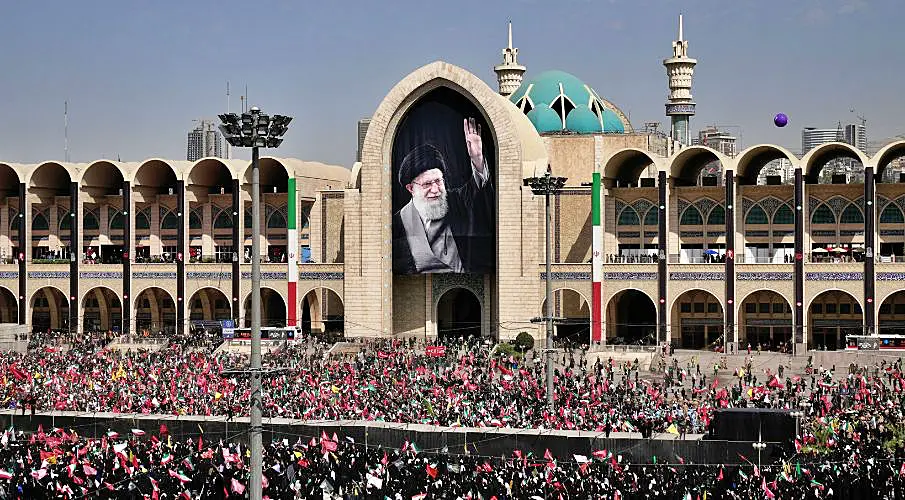
On Friday, Iranian territory was struck by missiles once again, and no one claimed responsibility. U.S. Central Command stated that it had no information about any new operations. Israel, which participated in the war, did not claim responsibility for the latest strikes. It therefore remains unclear who besides the known participants continues to target the country. An Iranian member of the parliamentary security committee, himself a former commander of the Revolutionary Guard, warned the United Arab Emirates that they would pay a price for cooperating with the United States and accused them of playing a covert role in the attacks. Thursday's strikes hit southern Iran just as the country was preparing to bury Khamenei. Iran responded with a broader missile barrage across the Middle East, targeting Bahrain, Jordan, Kuwait, and Qatar. In Kuwait, one person was reportedly injured when air defenses intercepted incoming missiles.
And while the bombs were falling, the mediators were traveling. Iran's foreign minister was scheduled to meet his Omani counterpart on Saturday to discuss the strait. Turkey expressed confidence that Iran and Oman could reach a solution over the weekend. The United States continues to advise mariners to travel south through Omani waters. Following Iran's attack, the ruler of the United Arab Emirates immediately traveled to Kuwait to meet its emir. Qatar and Pakistan are mediating between Tehran and Washington. On Friday, Pakistan's prime minister spoke with Iran's president and the emir of Qatar, urging both sides to exercise restraint. The night before, Israel's prime minister had spoken by telephone with Trump, who briefed him on American operations in the Gulf. Israel's defense minister repeated that his country remained prepared to confront Iran and warned that if it had to return, it would return with even greater force.
War once again appears to be the father of all things in 2026, making some masters and others servants. Whoever begins a war believes he will remain its father. But this one has long since produced children of its own - nameless splinter groups, bombs without a sender, a strait whose meaning of being open is spelled differently by everyone involved. On Friday it was over, and on Saturday the mediators were traveling. Tomorrow someone will declare that it remains open. And once again, Groundhog Day returns - the same war every day, only the water has changed.
Updates – Kaizen News Brief
All current curated daily updates can be found in the Kaizen News Brief.
To the Kaizen News Brief In English


Das Schlimme an diesem ewigen Hin und Her?
Did Menschen wollen es nicht mehr hören.
Es wird zur Randnotiz, weil es sich in Dauerschleife wiederholt.
Trumps Drohungen.
Iran pocht auf die Strasse von Hormus.
Das Atomprogramm ist zur Nebensächlichkeit verkommen. Obwohl es ja der (virgeschobene) Grund für den Angriffskrieg war.
Hunderte Raketen und viele tote Menschen später ist die Lage im Nahen Osten fragile denn je.
Die Strasse von Hormus geschlossen, mit enirmen Ayswirkungen auf die Weltwirtschaft.
Dazu die Umweltschäden.
Das passiert, wenn ein dummer Narzisst der Oberbefehlshaber einer der größten Armeen der Welt ist.
Und nach Laune, nicht nach Diplomatie, handelt.
Und die Weltengemeinschaft lässt ihn machen.😞