
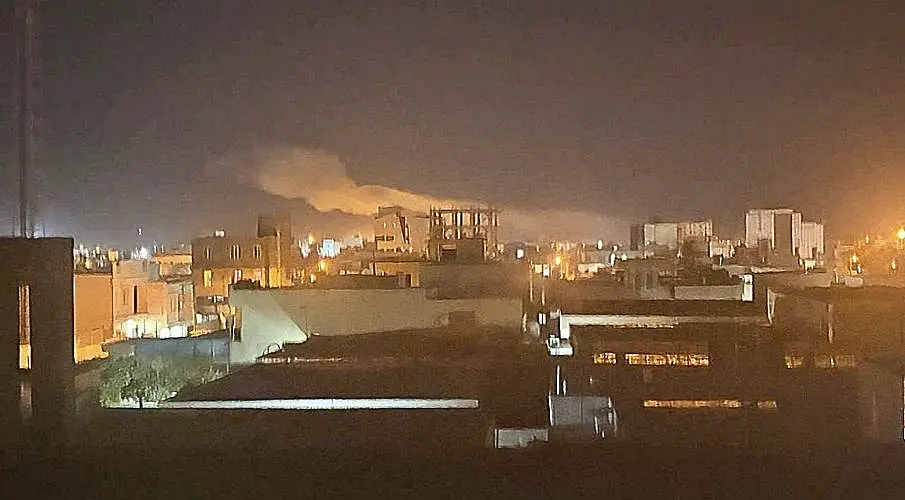
On Saturday, the U.S. military announced its third wave of strikes against Iran within a single week. The trigger was a single ship. According to U.S. Central Command, the Islamic Revolutionary Guard Corps attacked the Cyprus flagged container ship GFS Galaxy as it attempted to transit the Strait of Hormuz. One civilian crew member is missing, while a fire on board and severe damage to the engine room crippled the vessel. For that damage, for a burning engine room and one missing sailor, Washington launched missiles at a country it had attacked months earlier over its nuclear program.

And that is precisely the real story unfolding these days, the one that is easy to overlook because the strikes are louder than the question of what purpose they serve. Carl von Clausewitz called war the continuation of politics by other means, adding that war naturally drives toward extremes unless restrained by its political purpose. But once that purpose disappears, all that remains is the motion of war itself, pure violence igniting from whatever event the next day happens to provide. That is exactly where Iran and the United States now stand. Trump's declared war aim, ending Iran's nuclear program, no longer matters. It has been replaced by a waterway.

Shortly before the American announcement, the Revolutionary Guard declared the Strait of Hormuz closed until further notice and accused the United States of interfering in the waterway. It claimed to have fired a warning shot at a vessel that had attempted to use an unauthorized route. U.S. Central Command, meanwhile, described the operation as the third round of strikes, stating that Iran had been given another opportunity to comply with a declaration of intent after being held accountable for previous attacks, and had failed once again. The United States would now impose a heavy cost while reducing Iran's ability to attack sailors and commercial vessels lawfully transiting the strait. That is the language of a bureaucracy using the vocabulary of agreements while carrying out the actions of war.
In the just over 3 weeks since the first peace agreement, Tehran has turned the Strait of Hormuz into the central point of confrontation, refusing to allow maritime traffic to pass without Iranian approval. Our reporting found that senior American officials expected Iran to publicly declare within days that every shipping channel through the strait remained open and that no further shots would be fired at commercial vessels. Washington explicitly demands such a declaration. At the same time, those very same officials had described the earlier attacks as the work of a rogue Revolutionary Guard unit, a claim that has not calmed the situation but made it worse. Because a state that refuses responsibility for its own weapons is not a negotiating partner. It is a weather system.

The week before, Trump escalated his rhetoric. He said talks with Iran would continue but no longer described them as part of a ceasefire. In a late night statement, he declared that 1,000 missiles were loaded and aimed at Iran should its government attempt to assassinate him. The orders had been given, the military was prepared, and Iran could be destroyed for at least 1 year. On that same day, he said Iran had requested the resumption of negotiations, that the United States had agreed, yet added in capital letters that the ceasefire was over. Diplomacy and threats of annihilation in the same breath, that is the new order in which both exist at once and neither binds anyone.
The origin of all this goes back to late February, when American and Israeli strikes killed Iran's Supreme Leader, Ayatollah Ali Khamenei. His son and successor, Mojtaba Khamenei, vowed on Saturday to avenge the criminals who had murdered the Leader and the people during the two previous wars. With that, the final element has entered the conflict, the one that makes a war impossible to extinguish, blood revenge at the very top of the state. Where one side counts 1,000 missiles and the other swears vengeance, there is no longer any room for the purpose for which all of this began.
That same Saturday, the foreign ministers of Iran and Oman met in Muscat for talks on the Strait of Hormuz. No concrete outcome was announced. Both sides said they had agreed to continue discussions at both the technical and political levels in order to reach the necessary agreements in accordance with international law. It is the cautious language of mediation, barely audible beside the far louder language of missiles.

Clausewitz understood that war is a chameleon, constantly changing its color, and that it becomes most dangerous when no one can any longer explain what it is being fought for. A nuclear program was the trigger, a strait has become the pretext, and a burning cargo ship the latest spark. What unites all three is violence itself, which no longer requires a purpose because it has become its own. Somewhere in the waters of Hormuz, a missing sailor is drifting. He is the most accurate balance sheet of a war that has forgotten why it began and now remembers only that it cannot stop.
Updates – Kaizen News Brief
All current curated daily updates can be found in the Kaizen News Brief.
To the Kaizen News Brief In English


Die Überschrift „Und täglich grüßt das Murmeltier“ beschreibt es perfekt
Iran stoppt ein Schiff, USA antworten mit massive Angriffen und Drohungen.
Trump erklärt die Feuerpause als beendet, lässt die Gespräche aber weiter laufen, weil der Iran darum gebettelt hat.
Dann folgt wieder eine Vernichtungsdrogung.
Und wieder und wieder und wieder 😞
Und keiner der westlichen Staatsoberhäupter „stört“ sich daran.
Es ist eine Schlagzeile in den Nachrichten und mehr nicht. 😞