
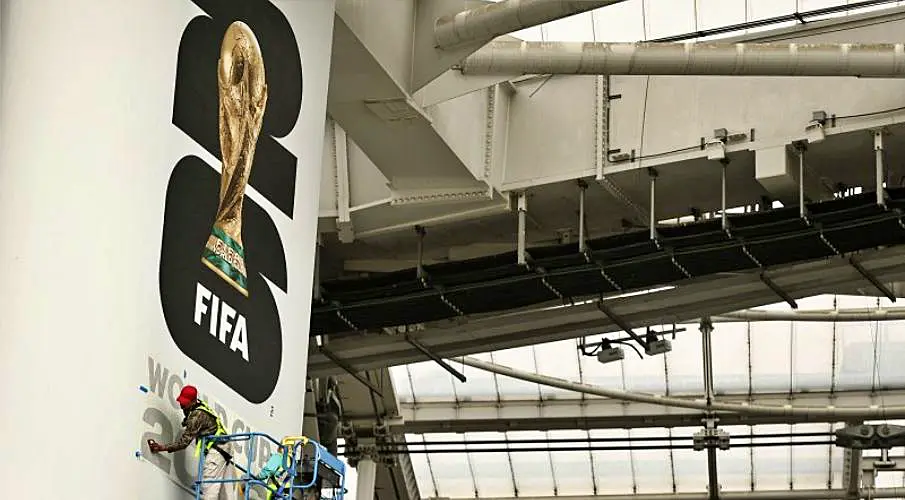
A framework is not protection: Just days before kickoff, FIFA has adopted a general safeguarding policy, but according to several organizations the child protection concept promised for the 2026 tournament across all host cities is still missing!
In just a few days, on June 11, the FIFA World Cup will begin in the United States, Canada, and Mexico, likely becoming the largest and most profitable sporting event ever held. Millions of visitors are expected, and among them, around them, and in the communities hosting the tournament, children live and travel. Whether FIFA and the host countries are adequately protecting them remains, to this day, June 4, 2026, without a clear answer.
The dangers children face in connection with such major events have long been known and documented. Human Rights Watch lists human trafficking, sexual exploitation, child labor, and family separation among them, alongside other forms of violence and abuse. These are not distant concerns but lessons drawn from previous tournaments, and anyone bringing millions of people into sixteen cities across three countries for weeks creates the conditions under which such dangers can emerge. Children cannot advocate for themselves, they do not choose the host locations, and they negotiate no contracts. The responsibility to protect them therefore falls entirely on those who organize the event and profit from it.
FIFA imposed this responsibility upon itself and benefited from it. When the governing body awarded the 2026 World Cup to the United States, Canada, and Mexico in 2018, it did so in part because of a new requirement under which bidding countries had to commit to a human rights strategy. That strategy explicitly promised to "develop and implement child safeguarding frameworks." The promise was therefore part of what secured the hosting rights. Such a framework would need to address risks to children as well as weaknesses in domestic law and coordination across sixteen cities in three countries.

Gianni Infantino
Anyone who stands at the head of an institution entrusted with the game is not measured by the size of what he manages but by the smallest thing he is capable of protecting within it. Infantino oversees the largest and most profitable tournament ever played and leaves precisely the protection of children as the one unfinished matter. That is where the disgrace for the sport lies, because it has turned the highest office in the game into an office of calculation rather than one of care. And that is where the human failure lies, because a person reveals himself through what he places beneath something else, and whoever places the defenseless beneath spectacle and profit has already made his decision about himself.
In April 2025, seven years after the hosting rights were awarded, an investigation measured this promise against reality. The report Keeping the Game Safe, produced by the Human Rights Clinic at the University of Miami School of Law and the Centre for Sport and Human Rights, documented risks to children at major sporting events and presented FIFA and the 2026 hosts with concrete recommendations. Organizers were urged to introduce mandatory training, establish binding safeguarding standards, appoint trained and experienced safeguarding officers at every venue and in every host city, and create a central reporting system. The venues themselves should be designed to protect children and equipped with strict safeguards against child labor. Above all, according to the recommendation, FIFA must establish a unified child protection framework applying across all host cities in the United States, Mexico, and Canada, one that reflects economic and legal realities as well as the needs of communities and vulnerable children and is developed with the participation of affected groups and local and national experts. Katherine La Puente and Minky Worden of Human Rights Watch urged that protecting children who travel to, attend, watch, and live in communities hosting the tournament must not fall behind business interests.
More than a year has passed since that report and kickoff is now approaching. We reviewed and verified the current status again over the past days and the result is troubling.
Today’s conclusion must be framed more precisely than the original accusation. It is no longer accurate to say FIFA has no safeguarding rules at all. In March 2026, the FIFA Council adopted a new general safeguarding policy intended to formally regulate protection against abuse and harassment in football and which the organization describes as an institution wide framework with clear roles, responsibilities, and safeguarding obligations. That is more than nothing and omitting it would be unfair. But a general framework is not the dedicated, publicly available child protection concept that was promised specifically for the 2026 World Cup. Evidence that FIFA has publicly presented such a tournament specific and unified concept across all host cities still cannot be found. Programs, reporting channels, and guidance documents exist, but the concrete safeguarding architecture promised during the bid process for this tournament must still be regarded as unmet. When children walk onto the field holding players’ hands for promotional purposes, that is not an act of affection but a display. The image of innocence is shown because it sells, and it sells precisely to the audience that mistakes emotion for protection. Here the child is not protected but used, turned into a means for creating an impression the organizers want and their actions contradict. An institution that lacks a concept to protect children from harm allows those same children to represent love for children in front of rolling cameras. What appears to be tenderness is an imitation of care that does not exist. In this way hypocrisy exposes itself, because anyone who turns the defenseless into decoration for business has reversed the meaning of protection into its opposite.
That shifts the accusation without reducing it. The issue is no longer the claim that no protection exists but the difference between a rule that exists and protection that actually reaches an individual child at the stadium entrance and in the surrounding community. A framework on paper reassures the organization and the public, but it protects no one as long as trained safeguarding officers, binding standards, and a centralized reporting system are not present in all sixteen locations. A general commitment is the cheaper half of the obligation. The more expensive and difficult half is implementing specific protections, and that appears to be precisely what remains missing.
That leaves the question attached to every promise made in order to gain something. What does someone owe once the prize secured through that promise is safely theirs? FIFA received hosting rights in part because it promised to protect children. Just days before kickoff, that promised and specific form of protection is still not publicly visible, and that is no longer a question of time but of will. A tournament generating billions in revenue can afford safeguarding officers, training, and reporting systems. That they still appear absent says less about capability than about the order of priorities inside this organization.
Updates – Kaizen News Brief
All current curated daily updates can be found in the Kaizen News Brief.
To the Kaizen News Brief In English


