
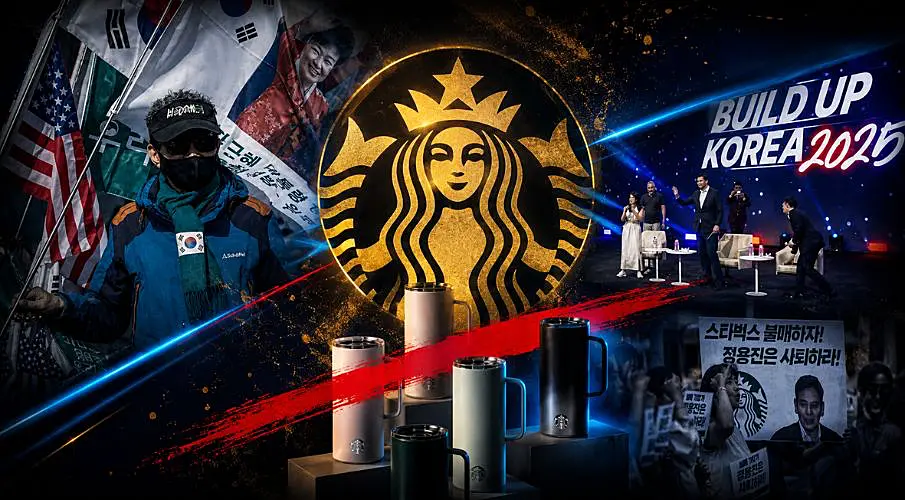
Sometimes a single word tells the whole story. On May 18, Starbucks Korea put a new insulated mug on its shelves and called it Tank, with the launch event labeled Tank Day. A mug is as harmless as kitchenware, but the date turns that piece of kitchenware into a weapon. In South Korea, May 18 is no ordinary day. It marks the beginning of the Gwangju Uprising, those 10 days in 1980 when citizens rose against the military dictatorship and tanks rolled through the streets of the southwestern city until resistance was crushed beneath their tracks. Anyone who names a product Tank on that day knows exactly what they are doing. Coincidences do not stumble this precisely into the bull's-eye.

The man behind that cup is Chung Yong-jin. He not only owns Starbucks Korea but also Shinsegae, the country's largest retail empire. He is a longtime friend of Donald Trump Jr. and a right wing businessman who has never hidden his political views. Public outrage over the Tank mug grew so quickly that on June 21, more than 2,000 Starbucks stores closed early so 24,000 employees could receive education about their country's history. The company lost 2.1 billion won, about $1.4 million, in missed sales. They paid it the way people pay a fine that is cheaper than facing the truth.

But the mug is only what people can see. Underneath it, money flows, and it flows to a young woman named Mina Kim. Educated in the United States, conservative, Christian, she founded Build Up Korea in 2023, a Korean version of Charlie Kirk's Turning Point USA, right down to the jokes. During Kirk's visit in September 2025, she laughingly asked whether he planned to sue her for copying him. Kirk laughed too. He was the keynote speaker at her annual conference, supplied with endless coffee donated by Chung's company. Just weeks later, Kirk was dead, murdered, and Kim built him a memorial of flowers and candles in the middle of Seoul. That is how quickly a role model becomes a martyr, and a martyr carries a movement farther than any speaker ever could.

Mina Kim and Mino Kim are the leading faces of the movement Build Up Korea, which has been described as part of the far right, and they organize the conferences together. Charlie Kirk attended as an international keynote speaker.

Kim also sells diapers. The brand EveryLife, whose stated mission is to bring more babies into the world, belongs to a business network involving Donald Trump Jr. In the United States it barely makes a ripple in online retail. In Korea it sits on Chung's shelves inside a company generating $20 billion in annual revenue. Think about that for a moment. The son of the American president profits from diapers sold in South Korea, and the same hand selling those diapers is pulling the country's youth further to the right. Rarely has an ideology been so honest about the products it sells. It begins at birth and does not end at the ballot box.

Mina Kim and Mino Kim are the leading faces of the movement Build Up Korea, which has been described as part of the far right, and they organize the conferences together. Charlie Kirk attended as an international keynote speaker.
Why the movement attracts followers comes down to a fracture running through South Korea's younger generation. The country educates its people like almost no other nation on earth. Seventy seven percent of women and 63 percent of men between the ages of 25 and 34 have college degrees. Yet 13 percent of those young men are unemployed and have stopped looking for work because the promise education made to them has vanished into thin air. A person who was promised a place but never given one starts looking somewhere else, and misogynistic online communities are waiting with open arms, a Korean echo of America's incel culture. Frustrated expectations turn into anger, anger turns into loyalty. That is how the rank and file of a movement is built, not from conviction but from disappointment.

On May 18, South Korea's national day of remembrance for the Gwangju Massacre, Starbucks Korea came under fire after one of its stores promoted a "Tank Day" campaign, a phrase widely interpreted as mocking the military's use of tanks against civilians. President Lee Jae-myung and senior Democratic Party leaders publicly criticized the company, prompting the CEO to apologize and announce disciplinary action. At the same time, far right groups declared Starbucks a "patriotic brand" and urged supporters to buy its products, further escalating the political conflict ahead of the upcoming local elections.
Disappointment needed only a spark, and the country's own president provided it. On December 3, 2024, Yoon Suk-yeol declared martial law in an attempt to stay in power, claiming communist and Chinese infiltration. Citizens flooded the streets, Parliament overturned the coup attempt, Yoon was indicted, and a liberal was elected president. It looked like democracy had won, but that turned out to be an illusion. The failed coup did not bury the right. It woke it up. In January 2025, Yoon's supporters stormed a courthouse in Seoul and injured 40 police officers. A defeat that felt more like an opening act.

What came next was spoken in English. Stop the Steal echoed through the streets of Seoul. CCP Out followed. The slogans of the American right translated into another time zone. At CPAC, an American commentator defended Yoon's attempted coup, while a former South Korean prime minister claimed the election had been stolen by the left, North Korea, and China. Pastor Son Hyun-bo, founder of the Save Korea movement, gained the attention of Vice President JD Vance, who personally raised concerns about Son's detention with the South Korean government. Shortly afterward, Son was released. According to Son, his two sons were invited to the White House twice during his imprisonment, and an American conservative legal fund contributed $15,000 toward his defense. You do not have to be suspicious to recognize the pattern anymore. It no longer hides itself.

They call it MAGA, and even the name tells a small lie. Make America Great Again sounds like something that stays home, inside its own borders, inside its own nation. But what echoes across Seoul's streets in English came from somewhere else, and it will keep moving. The anger itself does not travel. Every country grows its own. What travels are the tools that harvest it, along with the preachers who never saw the world as foreign territory but as fertile ground. A movement that dreams of one nation while reaching halfway around the globe is no contradiction. Faith never recognized borders. Now anger doesn't either.
And that is the moment the mug stops being a Korean story. What happens in Seoul is happening in São Paulo, in Budapest, in Dresden, following the same script, repeating the same slogans, carried by the same networks exporting both belief and anger. This ideology travels well because everywhere it goes it finds the same resentment waiting to attach itself to. The tank from Gwangju now rolls forward disguised as a coffee mug with a smile printed on it, and anyone who picks it up is holding a piece of a movement that no longer recognizes borders. It does not arrive wearing boots. It arrives with a meme and a coffee cup, and that is exactly what makes it more dangerous.
Updates – Kaizen News Brief
All current curated daily updates can be found in the Kaizen News Brief.
To the Kaizen News Brief In English


Donald Trump Jr. klüngelt mit dem rechtspopulistischen Eigentûmer von Starbucks Südkorea.
Welch „Überraschung“.
Der Tank Becher war eine Geschmacklosigkeit sondersgleichen.
Damit wurde die Militärdiktatur geehrt.
Wahrscheinlich der Traum der Rechten in Südkorea.
Ich verstehe, gerade in Südkorea, diesen Rechtspopulismus bicht.
Sie haben Nordkorea vor der Tür und sehrn, wie schlecht es dem Volk und einigen wenigen Anderen sehr gut geht.
Glauben sie, dass sie dann die „oberen 10.000 bilden werden“?
Im Reichtum schwelgen und das eigene Volk unterdrücken, so wie es Suk-Yeol versuchte?
Wer mit Turning Point USA und Incel Gruppen in engem Kontakt steht, ist eine Gefahr für die Demokratie.
Die Rechten vernetzen sich immer mehr und besser, über Landesgrenzen hinaus.
Es gibt mehr autoritäre Länder weltweit, als Demokratische. Tendenz steigend.
Wie soll man dagegen boch ankommen.
Ja natürlich nicht AfD wählen.
Aber was ist mit unseren Nachbarländern, der EU, der NATO?
Darauf haben wir keinen Einfluss.
Und wenn ich sehe, was derzeit weltweit passiert, sehe ich schwarz.