
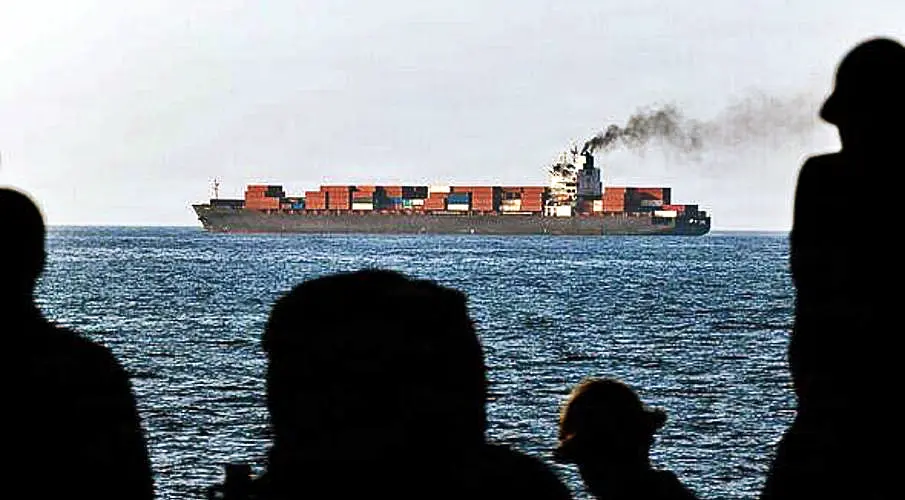
Bandar Abbas - The Strait of Hormuz is only 21 miles wide. At its narrowest point, it appears almost insignificant on maps. A thin strip of water between Iran and Oman, curved like an elbow. Yet it is there that the future of not only the war between the United States and Iran is now being decided, but also the stability of the global economy. For weeks, tankers, container ships and cargo vessels have been piling up inside the Persian Gulf. Some drift nearly motionless at anchor, others wait for new orders and still others desperately search for safe routes. While Washington and Tehran discuss a possible agreement, 1,550 ships from 87 countries are now stranded in the region.

The numbers show how deeply this war is already reaching into the daily lives of countries far away. Before the war, roughly 100 to 130 ships passed through the strait each day. Around one fifth of the world’s traded oil moved through Hormuz, along with enormous quantities of natural gas, fertilizer and other petrochemical products. Since the fighting began at the end of February, that traffic has nearly collapsed. According to Lloyd’s List Intelligence, only 542 ships managed to pass through the strait between the beginning of the war and May 6. Under normal conditions, the number during the same period would have ranged between 6,500 and 8,450.

An LNG tanker crossed Hormuz on Sunday. The liquefied natural gas, critical for power generation, was transported by QatarEnergy’s “Al Kharaitiyat,” which was traveling from Ras Laffan to the Pakistani port of Port Qasim. Investigations revealed that the passage occurred after talks between Iran, Pakistan and Qatar.
The reason lies in a power struggle that continues intensifying. After the United States and Israel attacked Iran on February 28, Tehran gradually began expanding its control over Hormuz. At the same time, the American naval blockade of Iranian ports further escalated the situation. Weeks of heavy airstrikes and military operations have so far failed to break Iran’s influence over the waterway. Iranian leadership has made clear that Hormuz will only fully reopen once the war ends and the American blockade is lifted. Donald Trump, meanwhile, continues demanding further concessions, including restrictions on Iran’s nuclear program.
The economic consequences are now hitting large parts of the world. In the United States, average gasoline prices have risen roughly fifty percent since the war began. A gallon recently averaged between $4.50 - $4.56. Jet fuel prices have nearly doubled as well. The crisis is no longer affecting only private households. Airlines are coming under pressure, supply chains are becoming more expensive, companies are recalculating costs and shipping firms are demanding enormous surcharges.

The insurance situation has become especially dramatic. Before the war, insurance costs for ships in the region often amounted to roughly one percent of cargo value. According to experts, insurers are now demanding as much as ten percent in some cases. For many shipping companies, passage through the strait is therefore becoming economically unsustainable. Some vessels now prefer waiting for days outside the waterway rather than accepting the risk.
While Western capitals focus mainly on oil prices, other consequences are increasingly disappearing into the background. The United Nations World Food Programme is now warning that up to 45 million people could face hunger if Hormuz is not fully reopened soon. Regions in Asia and Africa are considered especially vulnerable. Rising prices for fuel, fertilizer and food could push many people there to the edge of survival.

The crisis has also become a humanitarian disaster for seafarers. According to the International Maritime Organization, ten sailors have been killed since the beginning of the war. Thirty-two ships have come under fire or been attacked. Around 22,500 seafarers are currently stranded aboard immobilized ships, many of them from South and Southeast Asia. Weeks of waiting in confined spaces, uncertainty about the security situation and constant fear of attack now define daily life for them. The environmental consequences of the war have also become devastating. Near Iran’s Kharg Island, a massive oil slick is now drifting through the Persian Gulf. Satellite images show a contaminated area covering roughly 71 square kilometers. The spill was first detected earlier this week and continues spreading. Kharg is considered Iran’s most important export terminal for crude oil and lies directly inside the region where American and Iranian forces have been confronting one another militarily for days. The source of the oil remains unclear.

At the same time, the limits of American control in the region are becoming increasingly visible. Trump had announced “Project Freedom” with enormous fanfare. The goal was to escort stranded ships through Hormuz under military protection. The United States deployed roughly 15,000 troops and around 100 aircraft for the operation. But reality has proven sobering. The program was suspended just two days after its public launch. According to American officials, only two ships were successfully escorted through the strait.

Images from Bandar Abbas now show a region in a state of emergency. Off the Iranian coast, tankers lie anchored side by side in dense clusters. Patrol boats move between the ships. Crews wait for new instructions while the threat of further attacks constantly hangs above them. In Tehran, government supporters wave Iranian flags beneath giant posters depicting Donald Trump with his mouth sewn shut. The conflict has long expanded far beyond military objectives. It has become a global pressure point.

The strategic importance of Hormuz has always been enormous. But rarely before has it been so visible how dependent the world truly is on this narrow waterway. A passage only 21 miles wide is now deciding whether fuel prices explode, supply chains collapse, millions of people face hunger or entire trade routes grind to a halt.

Government-aligned campaign in central Tehran, Iran, showing the Strait of Hormuz alongside the sewn-shut lips of U.S. President Donald Trump.
At the same time, the danger of further military escalation continues growing. Iranian attacks on ships near the strait have intensified the uncertainty even further. Every new explosion, every damaged vessel and every additional confrontation between American and Iranian units increases the risk that the fragile ceasefire could collapse entirely.

Iranian Foreign Minister Abbas Araghchi accused the United States after the overnight clashes in the Strait of Hormuz of pursuing a “reckless military adventure” instead of diplomacy.
Washington and Tehran are currently discussing a possible agreement to end the war. But as long as both sides continue viewing Hormuz as leverage, the situation remains extremely unstable. Iran uses control over the waterway as leverage against sanctions and military pressure. At the same time, the United States is trying to project strength and push back Tehran’s influence. Caught in between are thousands of stranded sailors while the global economy sinks deeper into crisis.
The numbers make clear that this war no longer concerns only the Middle East. When only a fraction of the usual ships pass through Hormuz, when oil prices rise by fifty percent and millions of people are threatened with hunger, this is no longer a regional conflict. A single waterway is now holding a large part of the global economy hostage.
Updates – Kaizen News Brief
All current curated daily updates can be found in the Kaizen News Brief.
To the Kaizen News Brief In English


Irre alte Männer mit ihren übergroßen Egos stürzen die Welt ins Verderben. 😞
Wieder hervorragend recherchiert.