
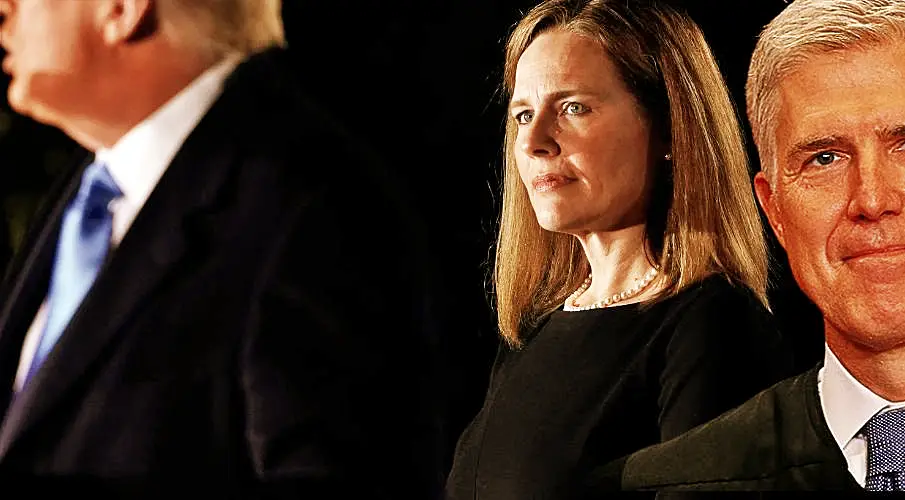
Donald Trump once again demonstrated overnight just how far the political system of the United States has now drifted away from any normal democratic order. On Truth Social, the president attacked two Supreme Court justices he personally nominated - Neil Gorsuch and Amy Coney Barrett. The reason: both opposed his tariff policy. What once would have been a political dispute over trade issues is increasingly evolving under Trump into a direct assault on judicial independence.

The president initially wrote that he “loves” Neil Gorsuch. He described him as a smart and good man. But immediately afterward came the actual core of the message. Gorsuch, Trump said, had voted “against him” and against the country. Trump described the tariff ruling as “devastating” and declared that it was severely harming the United States. He then attacked Amy Coney Barrett as well. He had always respected her, Trump wrote, but she too had inflicted serious damage on the country.

What is especially alarming is not only the content of the outburst, but the corrupt logic behind it. Trump is openly arguing that judges should be loyal to him because he appointed them. At that point, the statement crosses a line that functioning democracies normally consider self-evident. Supreme Court justices are specifically not supposed to be loyal to the president who nominated them. Their role is to rule independently. Trump is now openly questioning that principle.

The president claimed the court’s decision would cost the United States $159 billion. That money, he said, would now have to be repaid to “enemies,” companies and countries that have supposedly been “ripping off” America for years. Trump then declared that the Court could have solved the entire problem with a single sentence. Nobody, he argued, should have to repay money already paid to the United States. He said he could hardly believe the justices had failed to do that.
Reality: Mr. Trump is destroying America in every conceivable way.
Then came one of the most remarkable lines in the entire post. Trump stated that he should actually be the one wanting to “expand” the Supreme Court. In doing so, he directly invoked the years-long debate over “court packing” - the political expansion of the Supreme Court through additional seats. Republicans spent years describing the idea under Democrats as an attack on democracy. Now Trump himself is floating the same idea because he dislikes a court decision.

The message became even more drastic in the next sentence. Trump declared that it is “really okay” for judges to feel loyalty toward the person who placed them in “almost the highest position in the country.” Buried inside that statement is an openly authoritarian understanding of power that goes far beyond ordinary political pressure. Trump no longer describes judges as independent constitutional actors, but essentially as people who owe him political gratitude.
At the end of the post, Trump seemingly attempted to soften the attack again. Maybe Neil and Amy simply had a “really bad day.” But immediately afterward came another warning. The country, he claimed, can survive only a limited number of such decisions before it “collapses” and “cracks.”
The remarks come during a period in which Trump continues escalating the language of state power. Only days ago, the introduction to the new American anti-terror strategy already triggered massive criticism. The document carries Trump’s signature and was released directly by the White House. In it, Trump describes the United States as a nation that, after years of “weakness, failure, surrender and humiliation,” is now showing strength again. At the same time, he announces a new uncompromising line against alleged enemies at home and abroad. Particularly striking is the wording. The document literally states: “If you harm Americans or plan to harm Americans, we will find you and we will kill you.” The sentence is not part of an improvised speech or a spontaneous rally performance. It appears in black and white inside an official government document outlining American anti-terror strategy.

The introduction increasingly merges domestic opponents, cartels, armed groups and foreign governments into a single enemy framework. Trump states, among other things, that his administration has begun removing “illegal criminal aliens and jihadist sympathizers” from the country. He also praises military operations against Iran and speaks of “devastating strikes” against the “world’s largest state sponsor of terror.” At the same time, he describes cartels and armed groups as enemies against whom the full power of the American military will be deployed. In the same statement, Trump additionally claims that his administration captured Nicolás Maduro and brought him before American justice.

The language of the document clearly demonstrates how dramatically Trump’s rhetoric has changed. Military threats no longer sit at the margins of political communication, but directly at the center of official government strategy. At the same time, Trump now regularly describes political opponents, judges and the media as dangers to the country. The boundaries between foreign enemies, domestic opposition and state power are increasingly dissolving.
Particularly remarkable is the development surrounding Amy Coney Barrett. Only a few years ago, she was considered a legal icon in conservative circles. Trump himself celebrated her appointment in 2020 as a historic victory over liberals and promised his supporters a conservative majority on the Supreme Court lasting for decades. Now a single major ruling against him is enough for Barrett herself to come under public attack.
Neil Gorsuch finds himself in a similar position. He too was presented by Trump as a conservative guarantee. But the moment judges fail to rule exactly in the president’s favor, loyalty suddenly becomes betrayal. That exact pattern now runs through almost every area of Trump’s politics. Cabinet officials, judges, military leaders and party allies are considered “good” only as long as they fully support his position. The moment disagreement appears, public attacks, threats or loyalty demands follow.
The tariff ruling itself hits Trump politically at a sensitive moment. A federal court halted central elements of his global tariff strategy and argued that the president had exceeded his legal authority. For Trump, this represents not merely a legal defeat, but an attack on one of his central political projects. His entire economic rhetoric has for years relied on the promise of pressuring other countries through punitive tariffs and bringing American industrial jobs back home.
That is why he is no longer merely criticizing individual rulings. He is directly attacking the legitimacy of judicial independence itself. When a president publicly declares that judges should feel loyal toward him because he appointed them, the relationship between the executive branch and the judiciary fundamentally changes. That is where the real danger of these statements lies.
The wording also reveals how strongly Trump now thinks in personal categories. Supreme Court decisions no longer appear in his eyes as independent legal judgments, but as personal questions of loyalty. Anyone who does not follow him is supposedly harming the country. Anyone who criticizes him is working against America. Anyone who resists him becomes the target of public attack.
As a result, the pressure continues mounting on institutions that are supposed to function independently. For decades, the Supreme Court was viewed as one of the most stable centers of power in the United States. But now even conservative justices come under attack whenever they fail to fully align themselves with Trump. The idea that a president would publicly scold judges for not being loyal enough would have been politically unimaginable in earlier decades.
Now it is happening openly and without restraint - directly from the president of the United States himself.
Updates – Kaizen News Brief
All current curated daily updates can be found in the Kaizen News Brief.
To the Kaizen News Brief In English


Es war wieder Wochenende… Trump hat seine Pillen nicht genommen und dreht wieder am Rad.
Der Marionetten Supreme Court hat bis auf das Zollurteil immer in seinem Sinne entschieden.
Ihm den Weg zur Abschaffung der Demokratie geebnet.
Richter legen ihren Eid auf die Verfassung ab.
Sie küssen bicht Trumps Füße…. obwohl man beim Supreme Court ständig den Eindruck hat.
Hoffentlich macht es bei den beiden Richtern Click.
Dass sie sich auf die Verfassung und Gesetze berufen, nicht auf Trumps Irrsinn.
Aber ich fürchte, sie werden eher wieder auf Linie sein. 😞