
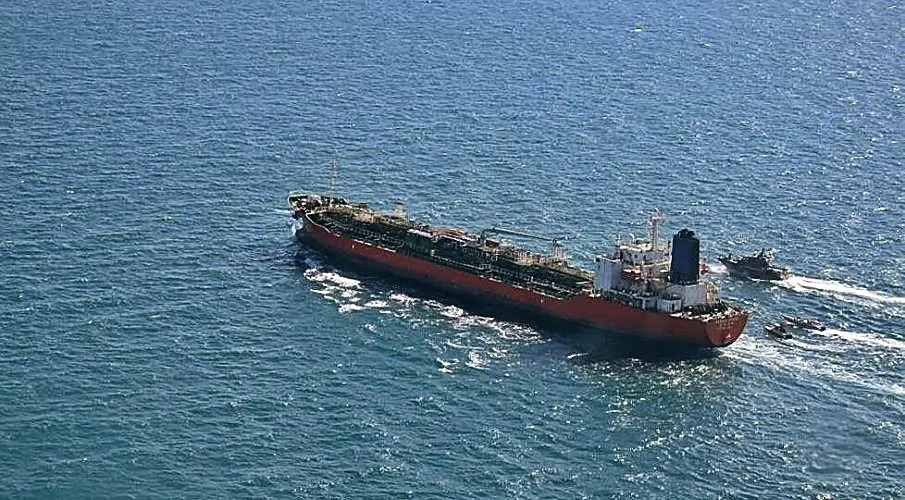
The number is on the table, and it changes everything. It could take up to six months to clear the Strait of Hormuz of naval mines. This assessment was delivered to Congress in a confidential Pentagon briefing. It makes clear that the economic consequences of this war could extend far beyond any potential end of active fighting. Even if an agreement is reached, risks remain that could keep the global energy market under pressure for a long time. The assessment was presented to members of the House Armed Services Committee. Several people familiar with the briefing report that both Democrats and Republicans reacted with frustration to the timeline. The prospect that the situation could drag on for months means gasoline and oil prices could remain high even after a ceasefire.
The political effect in the United States is already noticeable. Donald Trump began the war while repeatedly promising to keep the United States out of military entanglements abroad. Recent polls show that this decision is meeting resistance among the public. At the same time, his political base is divided as the midterm elections in November approach. According to the Department of Defense, Iran has placed at least twenty mines in and around the strait. Some were reportedly deployed using GPS guidance, others laid by small boats. This combination makes detection significantly more difficult, as some mines are hard to track during deployment. There are also indications that Iran itself may no longer be able to locate all of the mines it has placed.

The Strait of Hormuz is one of the most important transit routes in the world. Before the war, about twenty percent of global oil trade passed through this corridor. Countries such as Japan, South Korea, and China depend directly on it. Insurance companies, shipping firms, and captains are already reacting with caution. The mere possibility that mines are present is enough to severely restrict traffic. The military response to this situation is complex. A full clearance would require helicopters, drones, and specialized diving units. Such operations are time consuming and risky, and they are usually only initiated once active combat has ended. As long as attacks remain possible, any clearance effort is at risk.

At the same time, public statements contradict one another. Donald Trump said Iran had begun removing mines with support from the United States. The Pentagon assessment paints a different picture and assumes a long and uncertain process. This gap shows how wide the distance is between political messaging and military evaluation. At the same time, the Strait of Hormuz has become a sustained flashpoint. Iran declared the passage closed and repeatedly attacked ships. During a brief ceasefire, some cargo vessels moved through the strait, but after renewed attacks, traffic came to a halt again.
The conflict is closely tied to the demands of both sides. Donald Trump demands that Iran end its nuclear program, hand over enriched uranium, and fully reopen the passage. At the same time, he threatens further military action. Tehran, in turn, demands an end to the US blockade targeting its oil sector as a condition for new talks. Military pressure has also increased. The United States has targeted Iranian vessels suspected of laying mines. Defense Secretary, or as he likes to call himself, War Secretary, Pete Hegseth said publicly that these targets are being destroyed with the highest precision and that the United States will not allow the Strait of Hormuz to fall under the control of armed groups. Statements from Hegseth should generally be treated with caution.
On the Iranian side, Deputy Foreign Minister Majid Takht Ravanchi rejects the accusations. He denies that Iran has laid mines. At the same time, US sources report that some of the mines already deployed may no longer be locatable. This uncertainty further increases the risks. For the global market, this means continued pressure. It must also be noted that the mere possibility of mines is enough to deter insurers and shipping companies. A complete blockade is not required to disrupt traffic. If parts of the route can no longer be used, bottlenecks arise with global consequences.
An additional risk area is now coming into focus that has received little attention so far. The Tasnim news agency, close to the Revolutionary Guard, openly raises the possibility that undersea cables in the Strait of Hormuz could also become targets. Several key data links run through this passage and are essential for communication and economic coordination in the region. A simultaneous failure of multiple cables, whether through accidents or deliberate damage, could digitally isolate large parts of the Persian Gulf. Comparable incidents in the Red Sea have already shown how vulnerable this infrastructure is. The Houthis in Yemen have also threatened attacks on undersea cables in the past.
This creates a second layer of the conflict that unfolds below the surface yet has immediate effects. Alongside the physical blockade of shipping routes, the stability of digital connections is now also at stake. In the end, this is a conflict that will not disappear with an agreement. Even if the weapons fall silent, the uncertainty remains. The Strait of Hormuz is therefore not only a military theater but a persistent risk for energy supply, trade, and global infrastructure.
Updates – Kaizen News Brief
All current curated daily updates can be found in the Kaizen News Brief.
To the Kaizen News Brief In English


Unser Lügenbaron Trump
„…Donald Trump erklärte, Iran habe mit Unterstützung der USA damit begonnen, Minen zu entfernen…“
Und Hegseth haut in die gleiche Kerbe.
Nicht umsonst schreibst Du „bei Aussagen von Hegseth ist Vorsicht geboten“
Jede Seite beschuldigt die Andere.
Vertrauen besteht auf Keiner Seite.
Und im Iran, der ganzen Welt spürt man die Folgen dieses Krieges.
Und das für lange Zeit.😞