
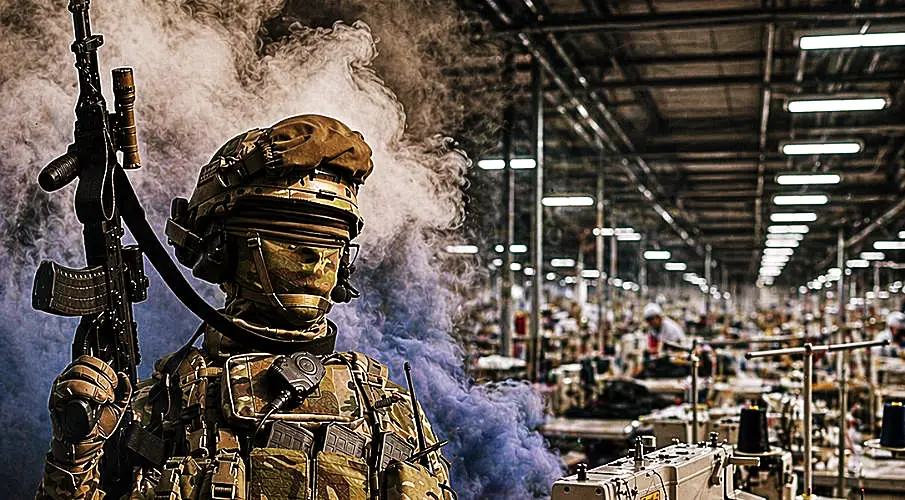
Research reveals something that only makes sense if you do not look at a single purchase, but at what emerges when you add them all together. The structure Triada-TKO, part of the Kalashnikov Group, acquired stakes in at least ten textile companies in central Russia between March and April of this year. The purchases are spread across the regions of Moscow, Vladimir, Tula, and Ivanovo. The stakes range from 21 to 100 percent. No single acquisition stands out. Together, they speak loudly enough.
Triada-TKO develops and produces equipment for military and civilian purposes. With the new factories, the company secures the ability to manufacture exactly these products itself in the future - without external supply chains, without dependencies, without the vulnerabilities that war exposes in any system not fully under its own control. That is the core of this expansion. Not growth for the sake of growth, but the quiet, methodical elimination of every bottleneck that could one day become a problem.

One example is the company Eco-Tex, with locations in Shatura and Moscow, in which the Kalashnikov structure has taken a 50 percent stake. It produces clothing and accessories under license for the football club Spartak, among other things. A civilian facade behind which military interests have now taken their place, without the machines stopping for a single day and without anyone on the street noticing. One of Vladimir’s oldest textile factories also now belongs to this growing network. A place with history, now integrated into a function its founders could never have imagined.
This expansion did not begin in March. Between late 2024 and March 2025, Triada-TKO had already acquired a stake in the historic knitwear factory Parizhskaya Kommuna near Tver - a first step that went largely unnoticed at the time and now reads like the beginning of a sentence whose ending is only becoming clear. In April of last year, it was also reported that the subsidiary Bulawa intended to take over the production of Gloria Jeans in the Rostov region. Step by step, factory by factory, region by region, a structure is growing that extends from design to manufacturing and is built to sustain itself no matter what happens outside.
The background is an industry that has collapsed under the weight of recent years. Traditional clothing production without military linkage is now barely profitable in Russia. Rising costs, declining demand, and economic uncertainty have forced business owners to shut down with no alternatives left. For Kalashnikov, this is precisely the opportunity. Whoever buys factories no one else wants pays the price of departure and receives capacities that would be invaluable in a different context.
The group is part of the state corporation Rostec and is known globally as a manufacturer of automatic weapons and sniper rifles. That it now operates looms, maintains sewing machines, and fills warehouses with materials is not a reinvention. It is the logical continuation of a wartime principle: dependence is vulnerability. Self sufficiency is not. The textile factories are not a diversion from the core business. They are the core business, just in a different material.
What these acquisitions ultimately create is not a fashion company and not a success story of a Russian brand reinventing itself. It is a supply apparatus assembling itself, quietly, without announcement, stake by stake, in a silence that weighs more than any press release. Those who look only at the individual pieces see investments in a struggling sector. Those who see the whole understand that this is not about fabric. It is about structure. And those who build structures like this are not planning for a time after the war. They are planning for the war itself.
Updates – Kaizen News Brief
All current curated daily updates can be found in the Kaizen News Brief.
To the Kaizen News Brief In English


Erstaunlich mit welcher Präzision hier fast unbemerkt ein Umbau statt findet.
Diese Recherche war sicher schwierig.
In Russland fließen Informationen nur spärlich und gefährlich.