
Trump had said he would never extend it. Then Pakistan’s field marshal Asim Munir called. And Trump extended it anyway. The ceasefire, whose expiration he had accompanied for days with threats of bombing, lives on - officially at Islamabad’s request, while America waits for a unified proposal from Tehran. Pakistan’s Prime Minister Shehbaz Sharif thanks Trump personally on X and on behalf of Field Marshal Munir for his gracious approval. A sentence that sounds like courtesy and tastes like relief.
Iran rejected the extension as a unilateral declaration it does not recognize. And then Tehran behaved as if it still applied. The Revolutionary Guards are not firing. Ships are moving along coordinated routes. The blockade remains in place. Everyone is acting as if there is a ceasefire, while Iran officially says there is none. That is not a contradiction. That is diplomacy in its most honest form - you do what is necessary, and you say what you have to say.
Vance stays, the market trembles

JD Vance is not traveling to Islamabad. The White House says that in light of the president’s decision to extend the ceasefire and wait for an Iranian proposal, the American delegation will not travel for now. Steve Witkoff and Jared Kushner return to Washington to discuss how to proceed. The markets register this immediately. The S&P 500 turns negative, losing 0.6 percent after having risen by 400 points earlier. The Dow Jones falls by 293 points. The Brent oil price fluctuates between under 95 and just under 100 dollars before settling at 98.48 dollars. A rise of 3.1 percent in a single day that shows how tightly the world is tied to this war and how little it takes to shake it.
What Trump admits without saying it out loud
As the official reason for the extension, Trump says the Iranian leadership is seriously divided, something he calls not unexpected. A sentence that contains more than it reveals. The United States is explicitly acknowledging that the representatives who might come to the negotiating table in Islamabad may not speak for those who control the weapons in Tehran. That is exactly what we described days ago - and now it is part of the official American reasoning for extending a ceasefire the other side never agreed to.
Iran’s leadership has functioned differently since the death of Supreme Leader Ali Khamenei, who was killed by Israeli strikes on the first day of the war. His son Mojtaba Khamenei succeeded him, but he is injured, in hiding, has not appeared publicly, and how he makes decisions and issues orders remains unclear to outsiders. What remains is the Supreme National Security Council, a body of civilian and military representatives that has divided power among itself like an inheritance where no one is entirely sure what belongs to whom.
Ghalibaf, the man in the middle

Mohammad Bagher Ghalibaf, nicknamed "the butcher of Tehran," has become the face of this body and Iran’s chief negotiator with the United States. He is 64 years old, holds a doctorate in political geography, a former Revolutionary Guard general, a former police chief, and for twelve years mayor of Tehran. A man with connections in every corner of the system and therefore perhaps the only one who could bring a deal home without the system collapsing above him. He had a trip to Islamabad on his agenda, but miscalculated without the Revolutionary Guard. Ali Vaez of the International Crisis Group says Iran’s leadership has survived because it has multiple centers of power with overlapping responsibilities - factionalism is built into the DNA of this system. Ghalibaf has political capital among conservatives, but also support from reformists and centrist political forces. Reformist Ali Rabie called him in a newspaper column the representative of the country and the regime. That is not flattery. It is a political assignment of function.
Ghalibaf said on Iranian state television that Iran wants a comprehensive agreement that would bring lasting peace and ensure that the United States does not attack the country again. This dangerous cycle must be broken, he said. The Revolutionary Guard saw it differently: weakness, as they call it, a loss of face. The United States attacked Iran twice during ongoing negotiations - once in the twelve day war in June, then again in the current conflict. That is not paranoia. That is experience. That is how they frame it.
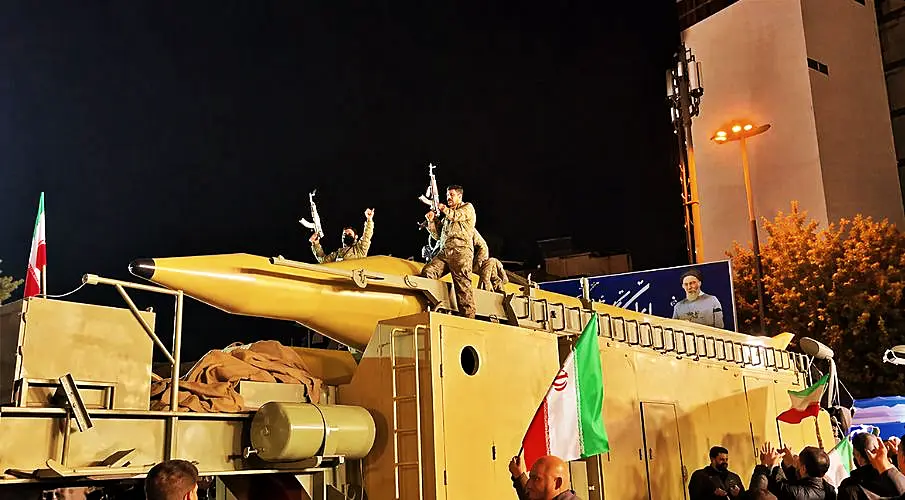
While talks in Islamabad stall, different arguments roll through the streets of Tehran. Hardliners from the Revolutionary Guard gather at night, and what they bring needs no explanation. Iranian state television shows a Qadr missile on a mobile launcher, men with Kalashnikovs sitting on it as if it were the most normal sight in the world. The Qadr can fire cluster munitions - the same used by Iran in the war against Israel. What rolls through Tehran’s streets here is not a celebration. It is a sentence without words, addressed to anyone who still believes diplomacy is the only conversation taking place.
The Strait of Hormuz, the weekend, and the fractures

What happened over the weekend around the Strait of Hormuz gave a glimpse into the fault lines Ghalibaf is supposed to hold together. Foreign Minister Abbas Araghchi announced on X that Iran was opening the strait for commercial traffic as part of the ceasefire agreement. Hours later, Trump said the blockade would remain. The next morning, Iran’s military closed the strait again in retaliation for the blockade. Iranian media close to the Revolutionary Guard criticized Araghchi, saying his statement created the impression that Iran was showing weakness. The Tasnim news agency wrote that the position on the strait should have come from the National Security Council itself, not the Foreign Ministry. Araghchi’s office rejected that and said the Foreign Ministry does not act without coordination with higher authorities. Ghalibaf tried on Sunday to patch over the fractures, emphasizing that everyone in the leadership agrees on Iran’s strategy. Anyone who has to emphasize that knows it is not true.
Tehran strikes back, New York brings charges

Iran turned to the UN Security Council on Tuesday and demanded a clear condemnation of the American seizure of an Iranian cargo ship. Iran’s UN ambassador Amir Saeid Iravani called the blockade a violation of the ceasefire and said that once Washington lifts the blockade, the next round of talks in Islamabad will take place. He also said his country has received signals that the United States might be willing to end the blockade. A cautious formulation, but not a meaningless one. Araghchi called the seizure of an Iranian oil tanker on Tuesday an act of war and added that Iran knows how to neutralize restrictions, defend its interests, and resist intimidation. General Majid Mousavi, head of the Revolutionary Guard aerospace force, went further and warned that if neighboring countries allow the United States to use their facilities for attacks on Iran, they should say goodbye to their oil production.
What the UN says, and what Rafael Grossi thinks
UN Secretary General Antonio Guterres welcomes the extension as an important step toward de escalation and says it creates critical space for diplomacy and confidence building. Rafael Grossi, head of the International Atomic Energy Agency, warns both sides that any peace deal must include the IAEA from the beginning in order to enforce oversight of Iran’s nuclear program. Otherwise, he says, there will be an illusion of an agreement. A sentence that lands. Grossi is also running for the position of UN Secretary General, which gives his words additional attention.
Nine women, one tweet, and a remark that is not one


Bita Hemmati, sentenced to death for her participation in the January protests. Mahboubeh Shabani, arrested in Mashhad, charged with enmity against God, an offense punishable by death. Diana Taher Abadi and Ghazal Ghalandari, both 16 years old, arrested in different cities. Venus Hossein Nejad, a member of the Bahai minority, forced into a confession on state television, accused of being part of a satanic network under Israeli influence. Golnar Naraqi, 37 years old, an emergency physician, arrested in Tehran. Iranian state television denied that the women are to be executed and said some have already been released. Which ones, it did not say.

Human rights organizations and reporting come to a different conclusion: at least two of the women are facing charges that carry the death penalty. Trump called their possible release a great opening move for the negotiations. A sentence that sits somewhere between concern and negotiation tactic, without it being clear which dominates. It leaves one speechless.
Diplomacy in the haze
This is the veil of diplomacy, not the fog of war. And that shows where things stand. Trump extends a ceasefire he never wanted to extend. Iran rejects the extension and still adheres to it. Vance stays in Washington. Pakistan’s prime minister gives thanks. The bombs are silent. The blockade remains. And somewhere between all these contradictions, talks are taking place that no one confirms and that are still happening. As we have reported for days - both sides are already at the table. Just not where the cameras are.
Shortly after the extension, Trump writes on Truth Social that Iran does not want to keep the Strait of Hormuz closed, but open - to sell its oil. If he allows that, there will never be a deal, unless the rest of the country and its leadership are destroyed. A combative closing to a day that actually looked like de escalation. How things will proceed in Islamabad, no one knows right now. That too is an answer.
What Remains

We will leave Islamabad on Thursday. We will wait through Wednesday. A return to Iran is out of the question - we spent three weeks there, and the situation for journalists has become too extreme to justify it.

The biggest losers of this war are not sitting in Islamabad and not in Washington. They are sitting in Tehran, in European living rooms, at kitchen tables around the world, where mothers calculate gasoline prices, fathers read the news, and children grow into a future designed for them by men in closed rooms. They are sitting among our readers. The reckless attack by the United States and Israel did not weaken the Revolutionary Guard. It strengthened it - and it is expanding its repression against its own population as if the war were a blank check for what was already unjustifiable before.
The talks that officially do not exist will continue. Human rights abuses will increase. This war has only losers - unless you belong to the circle of those who profit from insider deals while others die. 2026 - a year of those in power and the cowards. And the people pay the bill that none of them signed.
Updates – Kaizen News Brief
All current curated daily updates can be found in the Kaizen News Brief.
To the Kaizen News Brief In English


Danke für diesen auch sehr emotionalen Bericht.
Man spürt, wie sehr ihr vor Ort mit leidet.
Euch fragt, will uns Trump alle veräppeln?
„…Trump verlängert einen Waffenstillstand, den er nie verlängern wollte. Iran lehnt die Verlängerung ab und hält sie trotzdem ein. Vance bleibt in Washington. Pakistans Premierminister bedankt sich…“
Der letzte Absatz von Euch fasst es auf den Punkt gebracht zusammen.
„…Die Gespräche, die es offiziell nicht gibt, werden weitergehen. Die Menschenrechtsverstöße werden zunehmen. Dieser Krieg hat nur Verlierer – außer man gehört zum Club derer, die an Insidergeschäften verdienen, während andere sterben. 2026 – Ein Jahr der Machthaber und der Feiglinge. Und das Volk zahlt die Rechnung, die niemand von ihnen unterschrieben hat….“