
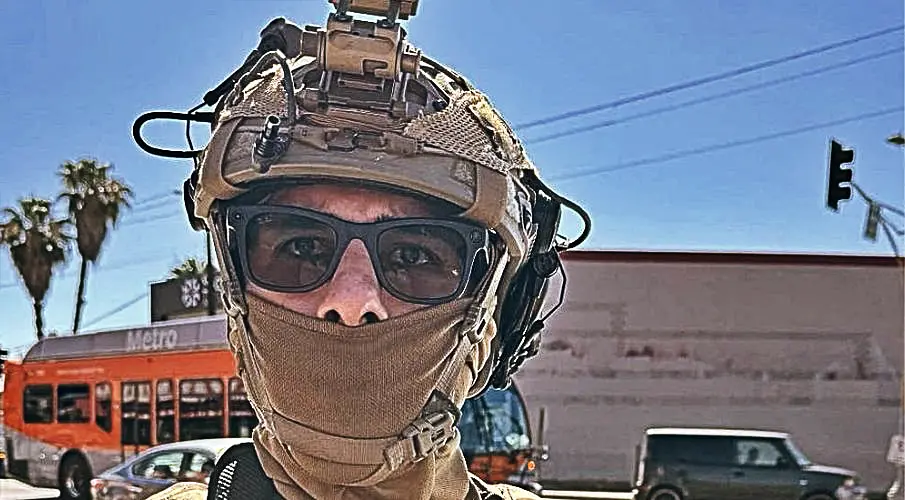
The Department of Homeland Security is working on a system whose impact can hardly be downplayed anymore. "ICE Glasses" is the internal name for the project, and they are intended to allow federal agents to identify people on the street in real time. Not based on behavior. Not based on suspicion. But based on data. The glasses access biometric systems that have been built over the past two decades. Facial recognition, gait, iris, voice. Everything that makes a person identifiable is compared. In seconds. Directly in an agent’s field of vision. Anyone standing in front of them can become a file without even realizing it.
An employee of the Department of Homeland Security says what has long been clear internally. Officially, the goal is to identify "illegal immigrants." In practice, it affects everyone. Especially people who protest. The technology does not distinguish based on political views. It records what it sees. The glasses are not theoretical. Agents have already been seen using such devices in six states. Some are using models from Meta Platforms that analyze what the wearer sees via voice command. They can record video, take photos, and transmit the material directly online. What happens to it is not decided by the person being recorded.

The US Department of Homeland Security is planning new technologies for 2027 to tighten migration control. These include "smart glasses" that are intended to give officers real time access to data and biometric identification. The goal is to make arrests, detention, and deportations more efficient, as well as to improve data analysis and cooperation between agencies.
The real weight lies in the background. The databases already exist. The civilian system ABIS now contains around 75 million biometric records. It can process tens of thousands of new entries per day. In parallel, the military developed a system that not only identifies people but classifies them. Once recorded, a person can appear again at any time at a checkpoint, during a routine stop, in a crowd.
This technology has a history. In Iraq and Afghanistan, soldiers carried devices that captured fingerprints, iris scans, and faces. Every contact could be stored. Anyone who stood out ended up on a list. A scan became a hit. A hit became a target. Now this principle is being miniaturized and shifted inward. What was once tested in war zones is meant to function on American streets. Even without consent. Internal documents refer to "non cooperative biometrics" - data is collected without the person even knowing.

The Federal Bureau of Investigation has already set the direction. Director Kash Patel said the biometric collection program abroad has been massively expanded. At the same time, analysis within the country has been intensified. More hits, more data, more connections. In Congress, there is striking silence. Bennie Thompson, Rand Paul, Andrew Garbarino, and Gary Peters have taken note of the project. Public assessment is absent.
At the same time, the situation on the ground is escalating. Border protection and immigration authorities arrested nearly 400,000 people last year. Violent clashes with protesters occurred. The technology now being introduced is emerging in exactly this environment.
Mark Zuckerberg experienced the impact of these devices himself when he appeared in court. The judge made it clear that recordings made with such glasses must be deleted in the courtroom. Some of Zuckerberg’s associates had been photographed with similar devices. Even in places where law is administered, distrust is growing.
An officer said during an operation in Maine that they had "a nice little database." That was not a joke. The question is no longer whether these systems are being used. They already are. The question is how far they will go. And who still believes they stand outside this field of vision.
Updates – Kaizen News Brief
All current curated daily updates can be found in the Kaizen News Brief.
To the Kaizen News Brief In English


Gruselig, fast moechte man ploetzlich mit Ganzkoerperverschleierung rumlaufen… Statt Menschen zu verdaechtigen, start Angst und Misstrauen zu saehen, sollten Resourcen fuer ganz andere Dinge verwendet werden, und der Fokus soll auf friedlichem und menschlichem Zusammenleben in Zeiten des Klimawandels liegen.
@Barbara Buckley Nicht mehr unter diesem Regime, ich schreibe mit Absicht nicht Regierung! Dieses Regime hat Vorbilder, die Angst regiert. Was wir uns niemals hätten vorstellen können, wird zur Normalität und Niemand kann das aufhalten
Das ist erschreckend und untergräbt fast alle demokratischen Rechte. Wie in China, dahin ist es nicht mehr weit. Eine Waffe für jede Diktatur aus der es scheints keinen Ausweg gibt. Ein Albtraum für jetzt und die nächste Generation
Komplette staatliche Überwachung .
Niemand ist mehr sicher.
„Person of Interest“, George Orwell …. alles scheint gerade wahr zu werden.
Dieser Gedanke ist extrem furchteinflössend.
Und Keiner hält es auf….