
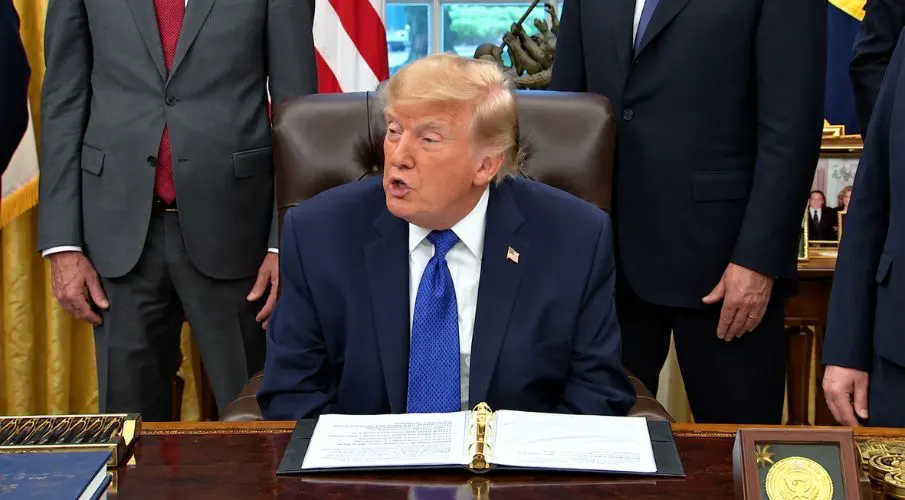
A journalist is standing in the Oval Office, back from a war, with evidence in her hands. The most powerful man in the world listens to her and asks about a disease. Hariana Verás, an Angolan correspondent and the first African journalist accredited at the White House, wanted to know what Donald Trump was doing about the killing in the Democratic Republic of Congo. She got a question back and then the door slammed in her face.

The occasion was something else. Trump had just announced the construction of a huge steel mill in Iowa, the biggest of its kind in history, as he stressed, and then took questions. Even before Verás spoke, he introduced her like a curiosity. “She loves Africa, she always asks about Africa. She talks about nothing else,” he said. “Good job. Go ahead.” Praise with a patronizing taste to it. Between a factory in Iowa and a war in Central Africa, his interest was clearly much closer to the factory. Verás stayed polite. “You are the only one who started ending the 30-year war in Congo,” she said, referring to the 2025 peace agreement between Congo and Rwanda brokered at the White House. The east of the country is rich in minerals and poor in peace, and has been for decades. The peace exists on paper, nowhere else.
The agreement is signed, barely implemented. The government in Kinshasa accuses neighboring Rwanda of backing the M23 rebels, and in the east the shooting keeps going, round after round. More than 7 million people have been displaced. Verás said Rwanda is still violating the agreement and asked whether Trump was prepared to act. A dead agreement, a live war, one carries his name, the other his indifference.
“We’re going to stop it if we know of a violation,” he replied. “We ended the war, both of them signed. I only heard about it very recently, if there’s a problem, we’ll take care of it.” About an agreement he celebrates as his own work, he knows nothing of the breach.
She had not come to praise him, she had come to warn him. “I just came back from Congo. I was there a month ago and I saw Rwanda continuing to kill Congolese people,” she said. “And I have evidence.” Trump did not address that. “How is Ebola?” he cut in. “How’s it going with Ebola?” An eyewitness to the killing is standing in the Oval Office, and the president changes the subject.
“Ebola is under control,” she replied, “the country needs help with that, but the biggest problem is the war.” He would not accept that either. “I make sure it works. That’s what I do. I make sure things work.” 3 sentences, not a single piece of substance.
The question about the disease was not absent-mindedness, it was systematic evasion. Talking about an illness saves him from answering about a massacre. Power that does not want to answer asks a question.
The numbers are not material for a casual question. The United Nations counts 8,067 confirmed cases and 3,901 deaths in recent months. The outbreak became known in May, and shortly afterward Democrats in the House of Representatives accused the president, in a statement titled “Trump Created the Perfect Storm for Ebola to Spread Rapidly,” of helping fuel the disaster. His administration dismantled the development agency USAID and cut aid to the region. Specialists in health programs lost their jobs.
Rosa DeLauro, the top Democrat on the House Appropriations Committee, found the words for it. “This is not efficiency, this is dangerous neglect,” she said. For years, America built laboratories and teams on the ground to stop deadly diseases at the source, DeLauro said, and this administration tore apart what had been built. First you tear down what protects people, then you politely ask about the disease.
Updates – Kaizen News Brief
Alle aktuellen ausgesuchten Tagesmeldungen findet ihr in den Kaizen Kurznachrichten.
To the Kaizen News Brief In English


