
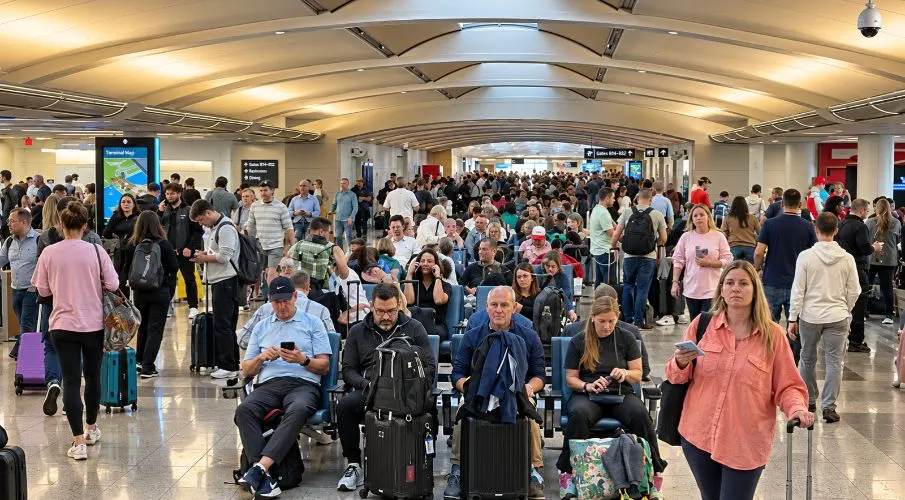
On Friday, November 13, 2026, it took neither a hostile attack nor a natural disaster to bring American air traffic to a standstill. A few overloaded devices in a decades-old computer system were enough. At around 3:36 p.m. local time, communications between air traffic controllers and aircraft began to fail. Radar data temporarily disappeared. Shortly afterward, the Federal Aviation Administration (FAA) imposed a nationwide ground stop. Thousands of planes remained on the ground, and airports turned into enormous waiting rooms. Of all places, the country that likes to treat its technological superiority as a national given was brought down by its own aging infrastructure. Modern aviation suddenly depended on technology whose best years were already long gone before many of the stranded passengers had even been born.

The sweeping ground stop lasted five hours. More than 8,200 flights had been canceled by late Friday evening, accounting for over 31 percent of all flights scheduled within the United States that day. Millions of people were potentially affected. For the period after 4 p.m. Eastern Time alone, roughly 11,000 departures carrying more than 1.5 million passengers had originally been scheduled. Even after flights were cleared to resume that evening, the chaos continued. Aircraft were stuck at the wrong airports, and crews couldn't reach their next assignments. By early Saturday, more than five percent of scheduled flights had already been canceled. Airlines expect it to take several days before operations return to normal.
Transportation Secretary Sean Duffy appeared before reporters at the White House on Friday evening alongside Homeland Security Secretary Markwayne Mullin. What they revealed about the technical condition of America's air traffic control system was a sobering assessment. Outdated routers had collapsed under the load. New technology had overwhelmed existing systems, Mullin explained. Duffy, meanwhile, emphasized that the equipment already upgraded had worked. Only components of the old infrastructure had failed. Two cabinet secretaries, the same technical breakdown, and different explanations for why upgrading an outdated system had managed to overwhelm that very system.

The consequences were substantial. More than 3,500 aircraft were already in the air when the ground stop was imposed. Over 3,000 planes landed safely. At least 827 flights had to change their planned routes. Of those, 670 returned to their original departure airports, while another 157 were diverted to other airports. Air traffic controllers temporarily lost the ability to communicate reliably with flight crews. Contact, however, never broke down completely. Radio communications and radar information remained partially available. Duffy confirmed that the disruptions had been intermittent. The decision to prohibit further takeoffs was intended to prevent additional aircraft from entering airspace that could no longer be monitored without restrictions.
Mullin insisted there was no evidence whatsoever of a cyberattack. There were no indications of hostile activity, and the cause appeared to be technical. The investigations, however, had not yet been completed. Duffy also ruled out any connection to the FAA's new artificial intelligence-powered monitoring system. That system had not even been connected to the equipment that failed. The cause, then, lay in technology that had been expected to function reliably for decades and whose continued operation had increasingly become a matter of luck.
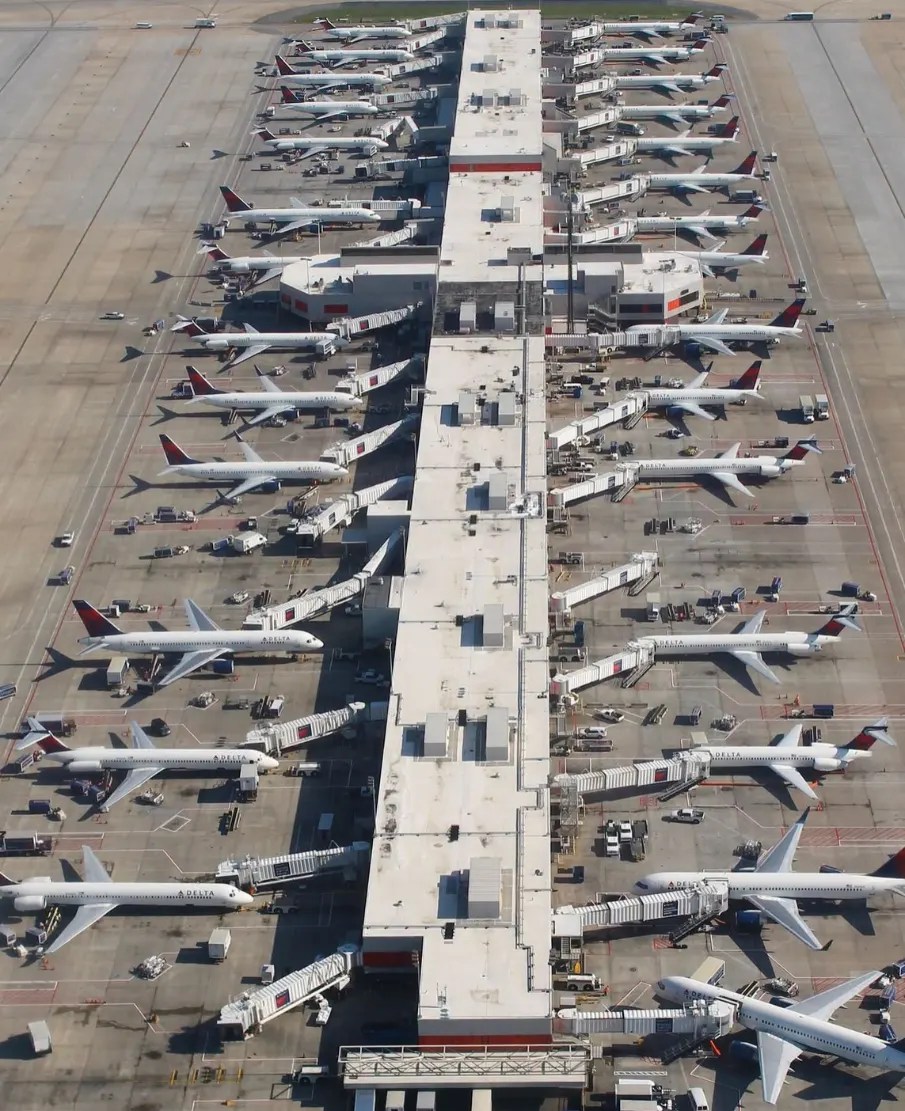
Duffy's description of the existing equipment was particularly revealing. America's air traffic control system was still using copper wires from the 1980s, outdated switches, and routers. Just last week, the FAA had announced that it was beginning to phase out floppy disks. While American companies proclaim artificial intelligence the next great technological revolution, the nation's air traffic control system is struggling with the leftovers of an era when home computers were only beginning to find their way into people's living rooms. Progress apparently has a remarkable ability to pass certain places by completely.
The system hasn't exactly been left untouched by modernization. Congress approved $12.5 billion last year to overhaul air traffic control. Thousands of old copper wires were replaced with fiber-optic cables, and hundreds of radio systems were upgraded. The work has been underway since 2025. According to Duffy, facilities that had already been fully modernized survived the breakdown without comparable failures. The problem lies in connecting new technology to an old overall system whose various components still have to work together. Every upgrade essentially takes place while the system is running. After all, an entire nation can't simply close its skies for several months so technicians can work without interruption.

But hardly had the first planes taken off again when the political battle over responsibility began in Washington. Duffy sharply attacked Congress. Lawmakers had failed to provide sufficient funding for modernization. For months, the transportation secretary has been demanding another $30 billion. On Friday evening, he raised that demand to $50 billion, which he wanted approved before the end of the year. This was an emergency, he declared. How many more times did such a breakdown have to happen before Congress provided the money needed to fix it? The fact that $12.5 billion had already been approved did little to soften his demands.
DUFFY: "How many times does this have to happen before Congress gives the money to fix it?"
REPORTER: "You've been in office almost two years now. Republicans controlled both chambers of Congress and still do."
DUFFY: "What network are you from?"
House Democratic Leader Hakeem Jeffries wasn't about to let that accusation go unanswered. The unprecedented breakdown was the latest in a series of unacceptable incidents involving American air travel under the failed leadership of the Trump administration. American travelers deserved immediate answers about the causes and assurances that their air travel system would remain safe and functional. The Republican-controlled Congress had yet to approve the additional billions. Following the midterm elections, control of Congress will shift to the Democrats, who are also expected to scrutinize how the money already provided has been spent. Washington was already fighting over billions more while people at airports were still waiting for their planes.
In Chicago, travelers learned about the nationwide disruptions by looking up at airport departure boards. Amber McQuilkin, a 27-year-old software engineer from Seattle, feared she would miss a trip to New York for the League of Legends World Championship finals. She had received almost no information. At one point, she considered driving the entire distance but eventually abandoned the idea because of how far it was. At Los Angeles International Airport, Ruth Coles was still stuck on a plane five hours after arriving from Newark. Even after the ground stop was lifted, her aircraft continued waiting for an available gate. The pilot repeatedly announced that they were next in line. The hours kept passing anyway.
American sports were also caught up in the breakdown. NBA and NHL teams were stranded, along with numerous college teams. The University of Texas football team initially had to abandon its planned trip to Louisiana. Other teams switched to buses. For Purdue University's team, that meant a roughly 330-mile drive to Iowa. Duffy announced that flights carrying college teams would receive priority ahead of upcoming games. While ordinary travelers waited for information, the transportation secretary was already dealing with the question of how to make sure the weekend's football games could go ahead.
Even cargo shipments weren't spared. Package delivery company FedEx prepared contingency measures. American airlines transport around 55,340 metric tons of goods to more than 220 countries every day. Every canceled flight therefore has consequences far beyond the airport involved. Deliveries are left sitting, connecting flights are missed. A broken technical connection in air traffic control eventually reaches people who have never even heard of a malfunctioning router in Washington.

Friday was particularly bitter for numerous Democrats who had gathered in Denver for a political conference. Among those stranded was former Transportation Secretary Pete Buttigieg. Virginia Governor Abigail Spanberger and New Jersey Governor Mikie Sherrill were also stuck. Senator Raphael Warnock searched for information through his contacts. Buttigieg watched his successor Duffy's news conference from a hotel bar. His reaction was remarkably brief: He had questions. The scene carried a certain unintended comedy. Politicians who normally make decisions about how the country functions suddenly couldn't even organize their own trips home.
There had been warnings. In September, a damaged fiber-optic cable had seriously disrupted air traffic across the northeastern United States. Last year, outdated equipment had already caused brief radar outages at Newark Airport. Friday's nationwide ground stop was the first since January 2023, when a crucial system providing information to pilots malfunctioned. Since the September 11, 2001 terrorist attacks, this was only the second shutdown of such magnitude. This time, however, aircraft already in the air were not ordered to land immediately. The remaining communications systems were sufficient to keep air traffic moving in the skies.
Duffy acknowledged that further outages should be expected. Operations were supposed to stabilize again by the Thanksgiving travel rush. He could not, however, guarantee that another such breakdown wouldn't happen. A remarkable admission from the transportation secretary of a country with one of the world's largest aviation markets. The United States can send spacecraft to distant planets and equip its fighter jets with highly advanced electronics. On Friday, its civilian air traffic was brought down by overloaded computers. America's skies reopened after five hours. Confidence in the technology beneath them had taken considerably longer to be shaken in the first place.
Updates – Kaizen News Brief
Alle aktuellen ausgesuchten Tagesmeldungen findet ihr in den Kaizen Kurznachrichten.
To the Kaizen News Brief In English


