
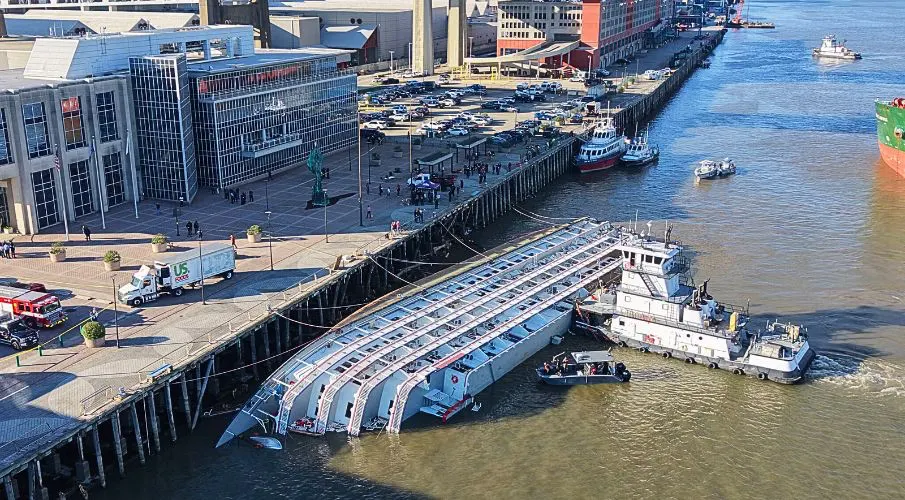
A massive steel ship pushes its way along the Mississippi, then slams into the side of a docked paddlewheel riverboat. Metal tears apart, windows shatter. Minutes later, the five-deck paddlewheel riverboat is lying on its side, with people floating among the wreckage in the river. New Orleans witnessed a maritime disaster Friday afternoon whose outcome hardly seems possible when you look at the footage. Every passenger and crew member survived. 32 people were taken to the hospital. Louisiana Governor Jeff Landry called it a "literal miracle on the Mississippi."
At around 12:30 p.m. local time, the roughly 525-foot-long tanker Atlantic Asphalt rammed the paddlewheel riverboat American Heritage at the Port of New Orleans. The historic paddlewheeler had been docked for about two hours at Port of New Orleans Place. Passengers were preparing to finish their eight-day river cruise through Louisiana and Mississippi. Then came the tanker. Footage shows the much larger vessel crashing into the side of the passenger ship. The collision destroyed parts of its upper structure. Water poured in, and the riverboat began to list. While rescuers were still getting people off the ship, the American Heritage rolled completely onto its side.

The graphic shows how the collision unfolded in three stages: The tanker Atlantic Asphalt initially approached the dock on the Mississippi. It then turned left and ended up sideways to its original direction of travel. Moving at low speed, it continued toward the docked American Heritage. Finally, the tanker's bow struck the paddlewheel riverboat, which had remained stationary at the dock throughout the entire accident. Why the tanker veered off course remains unclear. The Coast Guard is investigating a possible steering failure.
According to information we've obtained, there were 147 passengers and 50 crew members aboard. Other reports put the total at 180 people, while initial port reports listed just 129 passengers plus crew. The conflicting numbers had not yet been fully resolved. What mattered was another number: zero missing. Mayor Helena Moreno announced it at a news conference, as rescuers erupted in cheers. No one was still missing. A statement that sounded almost unreal with a five-deck ship lying on its side.

Within moments, the disaster turned the harbor into a scene of desperate rescue efforts. Passengers clung to railings, while others floated in the roughly 66-degree waters of the Mississippi, holding on to orange life rings. Tugboat crews and dockworkers rushed to help. Police officers joined the rescue efforts, and at least two of them later had to be pulled from the water themselves. Among barges and pieces of wreckage, rescuers struggled to pull people aboard nearby vessels. The harbor descended into complete chaos. Ships everywhere were helping while people were still in the water.
The rescue of 19-year-old Leelah Hager was especially harrowing. She worked in housekeeping aboard the cruise ship and initially sent her father, Wayne Hager III, a message about the collision. Then contact was lost. Later, he received a video call. His daughter was in the Mississippi, kept afloat by an orange life jacket. She was crying in fear. Pieces of metal floated around her. The connection dropped again. When her father called back, all he could hear was screaming. Only another call finally brought relief: Leelah had been rescued. While in the water, she had helped a friend whose life jacket had not been put on properly. Also aboard was Tamara Carrasco, 65, a retired elementary school teacher from Atlanta. She was in the dining room on the first deck of the paddlewheel riverboat in New Orleans when she spotted the tanker careening toward them. The tanker dropped its anchor. She could see its crew running around like ants on the deck.

Jamie Holford was standing about 40 yards from the accident scene when he heard an enormous crash. The technician was supposed to inspect the ship ahead of a planned kitchen renovation. He didn't see the actual impact, but he did see the damaged dock and the slowly capsizing riverboat. The noise, he said, sounded like someone crushing a giant soda can. After about ten minutes, the passenger ship began to roll completely onto its side. For the people aboard, the short distance between the ship and the safety of shore became a life-threatening stretch of water.

32 injured people were taken to hospitals. While Mayor Moreno said no one was in critical condition, another statement from the city described one person's injuries as serious. Survivors were gathered in a nearby building and checked against a passenger list. Numerous passengers had lost their IDs or car keys. Some no longer had working phones. The city had to arrange hotel rooms and transportation so that people who had just been fighting for their lives could at least get in touch with their families.
The U.S. Coast Guard is now investigating why the tanker went out of control. Capt. Melanie Burnham reported indications of a possible steering failure. The exact cause had not yet been established. Maritime law expert Martin Davies of Tulane University suspected a catastrophic mechanical failure based on the footage. Particularly striking, he said, was that the tanker had been traveling upriver and had already successfully navigated the difficult bend at Algiers Point. A collision under those circumstances indicated that something must have gone terribly wrong.

The tanker's ownership also deserves attention. The Atlantic Asphalt sails under the flag of the Marshall Islands and belongs to Nave Shipping SA, a company registered in Liberia. Through its corporate ties, it falls under the umbrella of the Chinese state-owned China State Shipbuilding Corporation, one of the world's largest shipbuilders, which also builds warships. The tanker is designed to transport asphalt and bitumen. Whether it was carrying any cargo at the time of the collision, and if so what kind, remained unclear.
The National Transportation Safety Board announced an investigation. In an extraordinary twist, a nationwide flight stoppage caused by communications problems at U.S. air traffic control centers initially prevented its investigators from reaching New Orleans. They were expected on Saturday. As the damaged American Heritage lay in the harbor waters, authorities were left with an investigation, while survivors were left with memories of those minutes when an ordinary Friday on the Mississippi nearly turned into a catastrophe with numerous fatalities. The river had swallowed the ship. It gave its people back.
Updates – Kaizen News Brief
Alle aktuellen ausgesuchten Tagesmeldungen findet ihr in den Kaizen Kurznachrichten.
To the Kaizen News Brief In English


