
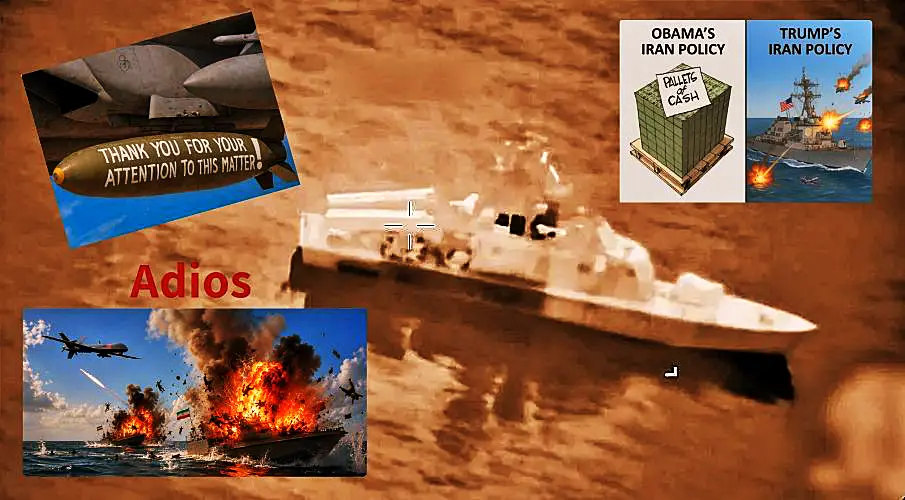
While Donald Trump stated in Washington that talks with Iran were progressing well and negotiations were moving in the right direction, missiles once again struck southern Iran. There is no longer any recognizable logic behind it. The American military confirmed strikes on Iranian missile positions as well as on boats that, according to US Central Command, had deployed mines in strategic waterways. Officially, the operations were described as acts of self defense. American forces, according to military statements, had responded to threats against their own troops and had exercised restraint despite the existing ceasefire. Yet this contradiction alone shows how fragile the situation has become. While peace negotiations are discussed publicly, military operations continue.
According to American military officials, the strikes targeted positions near Bandar Abbas among other locations. The port city carries particular importance for Iran. It hosts not only a major Iranian naval base but also one of the key points at the entrance to the Strait of Hormuz. One of the world's most sensitive trade routes passes through that area. Before the war, roughly one fifth of global oil and gas traffic moved through this narrow passage. Iran still maintains significant influence there. For weeks, the consequences have continued generating uncertainty in energy markets and international trade.
Iranian media reported explosions around Bandar Abbas. The news outlet Tabnak reported the deaths of four members of the Revolutionary Guards who, according to those reports, were killed during American attacks on boats. An official statement from Tehran did not immediately follow. At the same time, Iranian Parliament Speaker Mohammad Bagher Qalibaf traveled to Qatar, where discussions regarding a possible end to the war are taking place. Qatar plays a particular role in these developments. The country maintains close relationships with various sides while also controlling billions of dollars in frozen Iranian assets.
The new attacks strike an already unstable ceasefire. Smaller incidents have repeatedly occurred for weeks. But this latest event comes at a particularly sensitive moment. Donald Trump had only recently stated that the United States and Iran might be approaching an agreement. At the same time, doubts are emerging within his own party regarding whether such an agreement would be sustainable at all.
Additional questions arise from assessments by American intelligence agencies. Internal analyses reportedly concluded that despite American and Israeli attacks, Iran has managed to preserve a large portion of its military capabilities. According to these assessments, Iran still possesses approximately seventy percent of its mobile missile launchers and a similar percentage of its prewar missile inventory. Another issue appears particularly concerning, according to several individuals familiar with these assessments. Iran reportedly restored operational capabilities at roughly thirty of its thirty three missile positions along the Strait of Hormuz.
The consequences extend far beyond military questions. American warships, including two carrier strike groups and numerous support vessels, remain stationed in the Gulf of Oman and the Arabian Sea. According to a senior military official, Iranian air defense systems were at times directed toward American ships. Meanwhile, another concern appears to be growing within the American military itself. Reports indicate that supplies of long range missiles and heavy munitions are becoming increasingly limited. Those are precisely the weapons that would be required to permanently disable heavily fortified Iranian installations.
Read also our article: While Doha Negotiates, the War Keeps Striking - New US Attacks on Iran Shake the Talks
The conflict is also expanding politically. Donald Trump once again raised the issue of the Abraham Accords and stated that countries such as Saudi Arabia, Qatar, and Pakistan should participate. The agreements established during his first administration were designed to create diplomatic normalization between Israel and several countries. The responses, however, remain cautious. Saudi Arabia has attached conditions for years to any potential normalization with Israel. Pakistan still does not recognize Israel diplomatically and continues maintaining its position in support of Palestinian statehood.
Mojtaba Khamenei, who assumed leadership of Iran following the death of his father, also responded strongly. He stated that the events of the war had demonstrated that American military bases in the Middle East could no longer be considered secure. Countries throughout the region, he said, would no longer serve as shields for American facilities.

Amid all these statements, a situation is emerging that becomes increasingly difficult to grasp. On one side, negotiators sit in Qatar discussing possible solutions. On the other side, ships are moving, missile positions are being attacked, and new demands continue appearing on the table. In Washington, people speak of peace. In Bandar Abbas, explosions can be heard. That is where the real uncertainty now lies. The question is no longer simply whether an agreement will be reached. The question is whether all sides involved even still share the same understanding of what peace is supposed to look like.

The question increasingly becomes what any of this is actually supposed to accomplish. A president who posts one image after another online, burning Iranian boats, a bomb with the words "thank you for your attention" written across it, a meme comparing Obama's Iran policy with his own, and who somehow manages to present himself amid all these explosions as a bringer of peace. As someone who apparently deserves the Nobel Peace Prize at least once a week. I will not start wars, I will end wars, the man says. I am the first president in decades who did not begin a new war. I am the president of peace. They are the words of a man who keeps the world in a state of unrest while repeating the word peace until it disintegrates inside his own mouth.
Updates – Kaizen News Brief
All current curated daily updates can be found in the Kaizen News Brief.
To the Kaizen News Brief In English


Wahre Worte in dieser Analyse.
Die Welt schweigt quasi seit Beginn.
Selbst der mahnende Zeigefinger ist sehr verhalten.
Man lässt Trump gewähren.
In den USA mûsste der Umbruch beginnen.
Mehr, die sich gegen ihn stellen.
Mehr Demonstrationen.
So lange die US Bürger schweigen (zumeist), denken sich Bürger anderer Länder „was kann ich schon machen“
Das sieht man beim Ukraine-Krieg.
Wieviel Unterstützung gab es von den Bürgern anderer Länder?
Ich meine keine Spenden hier und da.
Ich meine sichtbare Unterstützung.
Das ist wohl das Problem unserer Zeit.😞