
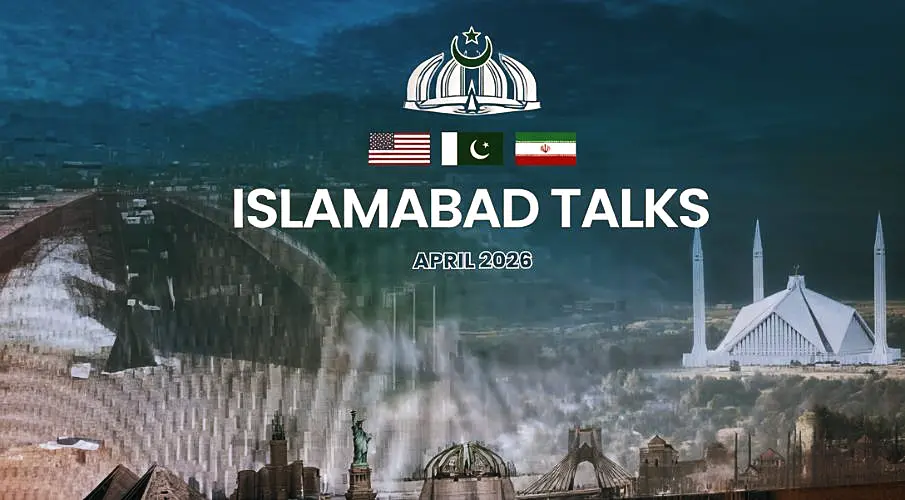
Islamabad - Preparations are underway in Islamabad for talks that could determine whether the war continues or pauses. JD Vance is in Pakistan to lead the American delegation. At the same time, an Iranian delegation led by Mohammad Bagher Ghalibaf is arriving. Both sides speak of negotiations, but even before they begin, conditions are already on the table. Tehran has made it clear that talks will only take place if Israel’s attacks in Lebanon stop and blocked Iranian funds are released.

Hybrid dialogue format: Saturday’s talks are expected to combine direct discussions with Pakistan-facilitated sessions. The Serena Hotel has been reserved for the delegations, with military forces securing and restricting access within a three-kilometer perimeter.
While negotiations are supposed to take place in Islamabad, the situation in Beirut continues to escalate. Israel has struck the Lebanese capital with heavy airstrikes, killing more than 300 people in a single day. Two days later, residents are still searching through the rubble of their homes. At the same time, further strikes are hitting. In Nabatieh, security forces were targeted, and 13 officers were killed. Israel says it attacked rocket positions.

Donald Trump is trying to apply pressure while at the same time enabling negotiations. He said Iran has little leverage except for disrupting shipping. In his words, Iran has “no cards, except short-term blackmail of the world through international waterways.” At the same time, he expressed the expectation that the Strait of Hormuz would soon reopen, if necessary even without Tehran’s consent.


That is precisely where the leverage lies. Iran controls the Strait of Hormuz and has severely restricted traffic. Before the war, more than 100 ships passed through the strait each day, now it is only a few. The consequences are tangible. Oil prices have risen significantly, markets are reacting nervously, and supply chains are coming under pressure. This bottleneck shapes the dynamics of the talks more than any military assessment.

Beyond Iran and Israel, the conflict is spreading. Kuwait reports drone attacks, which Tehran denies. At the same time, Lebanon’s Hezbollah continues its shelling. Naim Qassem warned the Lebanese government against making concessions, but did not clearly address possible direct talks with Israel.

At the same time, new channels of dialogue are opening. Benjamin Netanyahu has approved direct negotiations with Lebanon. Joseph Aoun confirmed talks in Washington. The goal is to disarm Hezbollah and stabilize the situation in the long term. But here as well, everything depends on one condition. Without calm in southern Lebanon, there will be no viable solution.
The number of victims continues to rise. In Iran, more than 3,000 people are reported to have been killed. In Lebanon, the number is close to 2,000, with more than one million people displaced. Civilians have been killed in Israel as well, as in the Gulf states and the West Bank. American soldiers have also been killed.
While the delegations prepare for talks, the situation remains open. Words are being formulated, positions defined, conditions set. At the same time, bombs continue to fall. The outcome of these talks will not be decided at the negotiating table alone, but also where the war has not yet stopped.
Updates – Kaizen News Brief
All current curated daily updates can be found in the Kaizen News Brief.
To the Kaizen News Brief In English


Israel wird bomben, so lange es „möglich“ ist.
Israel hat Gaza monatelang bombardiert um die Hamas zu eleminieren.
Die Hamas ist immer noch nicht entwaffnet und wird sich wahrscheinlich neu strukturieren.
Libanon hat es bis heute nicht geschafft die Hisbollah zu entwaffnen.
Man hat sie mehr oder weniger kritiklos gewähren lassen.
Auch die jetzigen Angriffe Israel’s treffen vor allem Zivilisten 😞
Die Hisbollah wird sich genau so wenig entwaffnen (lassen), wie die Hamas.
Die Angriffe Israel’s schüren nur mehr Hass in dieser fragilen Region.
Waffenruhe/Frieden zwischen zwei Akteuren wird die Region nicht dauerhaft befrieden.
Aber Trump geht es ohnehin nur um Öl, Uran und die Strasse von Hormus (vielleicht bei der möglichen Maut mit abkassieren)
Und darum zu zeigdn, dass er jedes Land in die knie zwingen kann.
Man darf gespannt sein.
Worst Case?
Ein Anschlag auf den Ort der Friedensverhandlungen mit vielen hochrangigen Toten.