
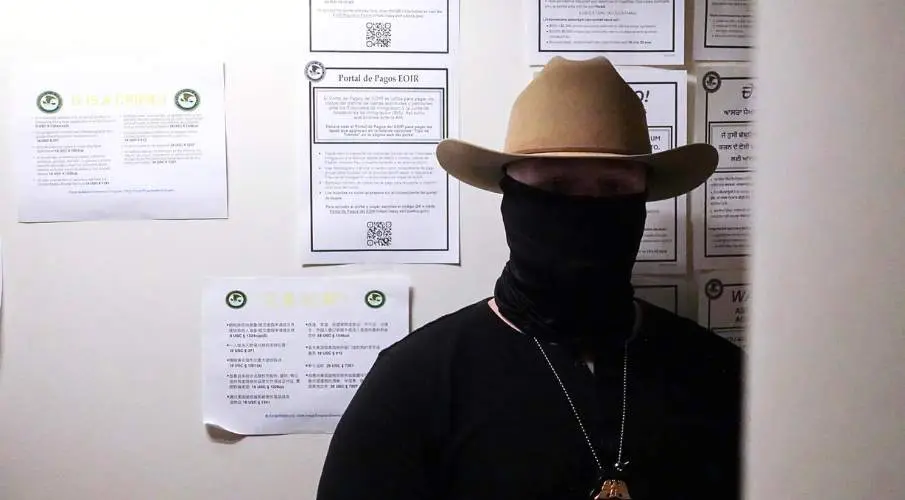
There are moments when one has to stop and fully grasp what is actually happening. In New York, federal agents with Immigration and Customs Enforcement arrested three men last week. Not on the street, not at the border, but inside the hallways of the very courthouses where they had appeared because the law required them to do so. On Thursday, one man from Ecuador was arrested inside 26 Federal Plaza. Another man from the Dominican Republic was arrested at 290 Broadway. On Monday, a third man, originally from Guatemala, was also arrested at 290 Broadway. All three appeared for hearings they had been ordered to attend. They did exactly what the rule of law required of them. And it was there, inside the courthouse itself, that they were taken into custody.

What is outrageous here is not simply the arrests themselves. What is outrageous is that ICE appears to have violated a clear order issued by a federal judge. On May 18, Judge Kevin Castel ruled that arrests at Manhattan immigration courts were prohibited except under a narrow set of clearly defined exceptions. The agency was ordered to return to its 2021 policy, under which arrests inside courthouses required prior approval and were permitted only in narrowly defined circumstances, such as an immediate threat to national security or public safety connected to the active pursuit of a suspect, or when an arrest could not reasonably be carried out anywhere else. On June 23, a federal court in California issued a similar nationwide order. Two federal court rulings, both establishing the limits within which any law enforcement agency operating under the rule of law is required to act.

ICE appears to have chosen to cross that line. In court filings, attorneys for the nonprofit organization Make the Road New York accuse the agency not only of violating their clients' right to due process, but of openly disregarding the judge's order. Democratic Congressman Dan Goldman of New York described the actions as a blatant violation of the law. ICE, he said, continues arresting immigrants who appear for mandatory court hearings even though a federal court specifically prohibited that practice. His office is working to secure the release of all three men. Murad Awawdeh, executive director of the New York Immigration Coalition, used equally direct language. He said they were witnessing an agency once again operating outside the law while ignoring a federal court order. The United States claims to be a nation governed by law, he said, and the courts have ruled that this agency must stop acting unlawfully. Yet exactly the opposite continues to happen.
ICE spokesman Marie Ferguson insisted that the agency had violated no court orders. She did not explain how the arrests fit within the narrow exceptions permitted by the court. Instead, she pointed to the Dominican man's trespassing conviction and to a 2025 disorderly conduct conviction involving the Ecuadorian. Anyone attempting to justify bypassing a federal court order with offenses of that magnitude reveals far more about their own view of the rule of law than about the men involved.
The men have since been transferred out of New York. The Dominican man is being held at Delaney Hall Detention Facility in Newark, New Jersey. The Ecuadorian is being held at the D. Ray James ICE Processing Center in Folkston, Georgia. The Guatemalan has been transferred to the Orange County Detention Facility in upstate New York. Three names, three locations, three people who appeared for their hearings and never returned home. According to their attorneys, both the Dominican and the Ecuadorian had fled persecution in their home countries, reached the United States, were initially detained, and later released while their immigration proceedings remained pending. They appeared for their scheduled hearings because the law required them to do so. That very act of compliance became their downfall.
This is the contradiction at the heart of the matter. Anyone who fails to appear in court forfeits nearly every chance of remaining in the country legally. Anyone who does appear risks being taken directly from the courtroom to an immigration detention center. In this way, the rule of law becomes a trap for those who obey it. Benjamin Remy, supervising attorney for the Immigration Protection Unit at the New York Legal Assistance Group, described it plainly. He said it is no longer unusual to meet people entering the courthouse already in tears early in the morning. These arrests discourage people from pursuing the legal process, undermine the fundamental constitutional right to due process, and deprive individuals of their opportunity to have their day in court.
Between May 18 and last week, there had been only two arrests at Manhattan's immigration courts. In both cases, the individuals were quickly released after attorneys and civil rights organizations invoked Judge Castel's order. That pattern has now been broken. The three men arrested last week have not been released. They have been transferred to facilities far from their families, their attorneys, and their courts. Between May 2025 and May 2026, arrests at New York's three immigration courts - 26 Federal Plaza, 290 Broadway, and 201 Varick Street - had become routine. Hundreds of people were arrested by masked ICE agents after appearing for scheduled hearings. Investigations show that more than half of all arrests at immigration courts nationwide took place in New York.
The trap of New York City at 26 Federal Plaza on the corner of Broadway and Franklin, plastered - just one block away from the place where migrants line up to attend routine hearings and risk being attacked by ICE agents and separated from their families.
What is emerging here is more than the result of a hardline immigration policy. It is the visible transformation of a government agency that increasingly appears to regard itself as an independent center of power, operating regardless of the court orders to which it is supposed to be subject. Remy expressed it in language that is both legally restrained and morally profound. He said they had witnessed ICE maintaining a flexible and adaptable relationship with truth and facts, with compliance with court orders, and, frankly, with the rule of law itself. It is the kind of statement that, in a functioning constitutional democracy, no attorney should ever have to make about a federal agency.
And yet it describes the situation precisely. Since Trump's return to the White House and the unleashing of ICE as part of his mass deportation program, the agency has repeatedly collided with court orders. According to attorneys and court records, those violations have become increasingly frequent in recent months. It is a gradual process. Not one single violation that is publicly condemned and followed by consequences, but countless smaller violations, one after another, documented, processed, and filed away until they ultimately form a picture in which the rule of law still formally exists, but can no longer be effectively enforced in essential areas. Perhaps that is the true philosophical dimension of what is happening. A constitutional democracy does not live because it writes laws. It lives because its own institutions obey them. When a federal agency carries out an arrest inside a courthouse after a federal judge has explicitly prohibited exactly that, it is not merely a rule that has been broken. It is a silent abandonment of a principle the state once imposed upon itself - the principle that it would be bound by the same rules it imposes upon everyone else.

What remains is an image that is difficult to forget. Three men who appeared because they were ordered to do so. A federal judge who ruled that this must not happen. And an agency that acted anyway, as though the judge had said nothing at all. Perhaps that is the quiet story behind these events. A country beginning to stop taking its own court orders seriously. The paper remains. Its force gradually disappears. Anyone who walks into a hearing in New York today is no longer simply entering a courtroom. They are stepping into a machine that presents only two choices. If I appear, I risk everything. If I fail to appear, I lose everything. That is no longer a choice. It is a test of faith in a government that is slowly dismantling that faith itself, piece by piece.
We are working alongside those seeking the release of these three men, and we will continue down that path for as long as it leads us. Judge Kevin Castel's order exists. It is clear. What is missing is its enforcement, and that is precisely what this is now about. We are doing what we can because it must be done. Nothing more and nothing less.
Updates – Kaizen News Brief
All current curated daily updates can be found in the Kaizen News Brief.
To the Kaizen News Brief In English


Diese ICM Agenten handeln genau wie Trump. Gerichte und Rechtsstaat interessieren nicht, weniger noch Menschenrechte. Empathie – nie gekannt. Diktatur des Stärkeren brutal. Wie lange geht dieser Krug noch zum Brunnen bis er bricht?? Damit ist die ganze Mafia gemeint nicht nur Trump
…er wird berechen
Das kann man nur hoffen.
Davon hat man hier, wieder einmal, nichts gehört.
Dabei sind es genau diese Menschen, die zeigen, wo sich die USA befinden.
Auf direktem Weg in eine faschistische Diktatur.
In ein Land, in dem Urteile nur dann befolgt werden, wenn sie nutzen.
Ansonsten werden sie schlicht ignoriert.
Die Konsequenzen für die Typen von ICE? Gar keine.
Für die Spitze von ICE? Absolut keine Konsequenz.
Für die 3 Männer?
Ein Trauma für den Rest ihres Lebens.
Ich hoffe sehr, dass sie frei kommen.
Die Gestapo hat, bevor der Regierungsumbau vollzogen und die Demokratie beerdigt war, genau so gehabdelt.
Über dem Gesetz stehend