
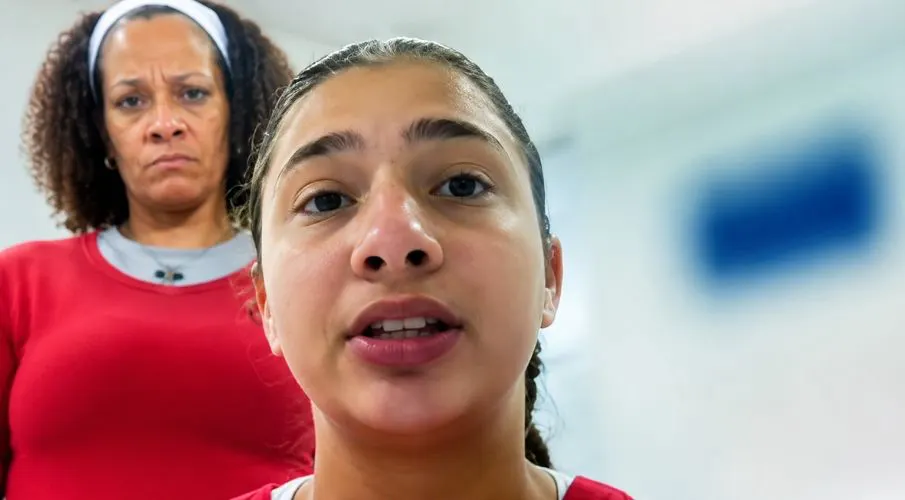
Women inside the detention center in Basile, Louisiana, crowded around a detention tablet to create a record before the authorities could take away their ability to speak. A woman named Larina leads the recording, identifies the facility as the South Louisiana ICE Processing Center and describes what the women around her say they have endured. The same tablet preserving their statements can be taken away by the prison at any time, and that is exactly what they warn about again and again.
Larina says ICE separated her from her 5-month-old daughter after she called the police because her husband was beating her. Instead of receiving protection as a victim of domestic violence, she says she was arrested and placed in immigration detention. "Even though I was the victim, I was the one who got arrested," she says. Other mothers in Basile do not know where their children are because authorities took them away and refused to provide any information. The separation goes far beyond physical distance. Whether a mother can find her child, hear their voice or comfort them is decided by the authorities. When calls and tablets can be taken away as punishment, contact with a child itself becomes part of detention. Larina says she has long since been ordered deported and is still being held after 3 months. One Cuban woman even remained in detention after winning her case because the Department of Homeland Security appealed. The government calls Basile a processing center, the women call it a prison with no end in sight.
Because of ongoing legal reviews and the attorneys and ACLU already involved, we are showing only parts of the material and some of the people in the material we have.
The South Louisiana ICE Processing Center is operated by GEO Group under contract with ICE, a facility with 1,000 beds. ICE provides the detention authority, GEO runs the daily confinement under contract. Together they control movement and food, work and access to doctors. The connection to the outside world is also entirely in their hands.
Kelly, a Venezuelan woman, says she has only one kidney left and that it is now failing. She shows records from her surgery and says the facility is denying her tests and medication. The specialist treatment she needs is also being withheld. She says she suffers from painful urination and fluid retention and wakes up every morning on a hard mattress with pain around her remaining kidney. The frozen food is not suitable for her condition, she says, and she gets no clean water, "nothing at all." She says she has filed complaints without success and fears something will happen to her in detention.

ICE detention standards require access to medical care, including emergency treatment. Dental care and mental health services are explicitly included. A federal inspection of the facility recorded 15 findings in general detention operations and 20 in the medical area. The failures were therefore already known while the women continued reporting untreated illness.
The women identify Nancy, an Ecuadorian woman who was 3 months pregnant and who they say miscarried in her bed without anyone helping her. At the time of the recording, 3 pregnant women were being held in the unit, one of them 6 months pregnant, all without the care they needed. Then Brisa steps in front of the camera, a Mexican woman with 2 children in the United States. She shows an amputation and says she does not understand why the procedure was performed. The women around her attribute the disability to inadequate medical care, and Brisa wants to go home to Mexico, to a doctor she trusts. Even though she is awaiting deportation, ICE continues to hold her after the procedure. They owe her an explanation of what happened to her body.
Another woman, identified as Honduran, shows bruises all over her body. She says she was beaten and placed in solitary confinement. She was cut off from her family while the injuries faded. The place where she was held without contact with the outside world is called "the moon" by the women. Another woman says an officer grabbed her by the arm while pulling her out of a vehicle and left marks. If a woman fights back or complains, she is threatened with "the moon" or having her tablet taken away, and injured women are cut off so that no photo and no phone call can preserve what happened.
The women also report sexual abuse by staff. Such contact cannot be treated as an ordinary private relationship because staff control housing and punishment. Medical care and contact with the outside world are also in their hands. Basile already has a history. A civil rights complaint from 2025 listed sexual abuse and physical violence. It also included forced labor and medical neglect, and reports about those abuses were allegedly ignored or punished. ICE and GEO had therefore already been warned.
The women say they are forced to work shifts of more than 6 hours for 1 dollar. Kelly says staff asked whether they wanted to work and, after they refused, threatened to withhold medication. Work is not voluntary when the employer is also the jailer and controls medicine and food. A woman who cannot leave and cannot seek her own treatment does not negotiate with GEO as an equal worker.
Women who speak only Spanish are mocked. Larina says staff in the dining hall claim they do not speak Spanish and rush the women out after only a few minutes. Their lack of English is mocked. Without translation, none of them can understand a medical decision or report an assault. There are also pests and scabies. Dirty mattresses and the lack of cleaning supplies allowed illnesses to spread, and one Cuban woman repeatedly asked for help with a skin condition without ever receiving a diagnosis.
ICE and GEO owe answers. About the violence against the women with bruises and the treatment being denied to Kelly. About the miscarriage Nancy endured alone and the procedure that left Brisa with an amputation. And about those who remain detained despite deportation orders or having won their cases.
Finally, Larina asks the public to become their voice. If the tablets disappear because the women complained, people outside need to know why. They did not wait for a media outlet or an approved investigation. They documented the prison themselves, with their injuries and medical emergencies as evidence, and every one of them is owed protection from retaliation. If the tablet disappears after these statements, the silence does not erase the record. It becomes the final part of what they documented.
On August 3 came the next serious blow. The women were placed in solitary confinement after the video was published. Words from inside the facility were said to have reached the outside. There is still no independent confirmation of this retaliatory measure. If it is confirmed, it would mean that exactly what the women warned about in their July 29 recording had happened. We are currently doing everything we can to help the women. Part of our team is now on the ground.
Updates – Kaizen News Brief
All current curated daily updates can be found in the Kaizen News Brief.
To the Kaizen News Brief


