
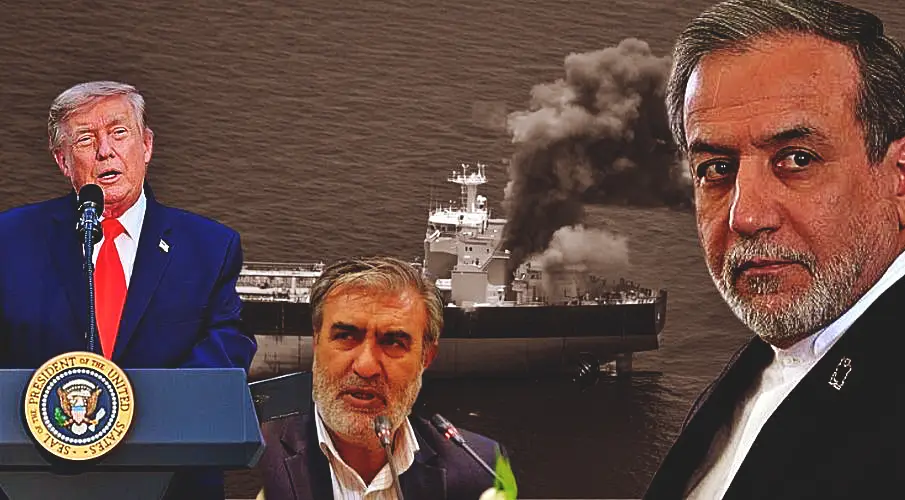
On Thursday, June 25, 2026, Donald Trump stood before a microphone and spoke about business opportunities for American farmers. Iran, he said, would become a new market. "A beautiful place." The United States would take Iranian money, spend it in America, and use it to buy wheat, soybeans, and corn. "A lot of it. It's going to be tremendous." On that same day, at an hour Trump apparently neither knew about nor chose to acknowledge, Iran's Revolutionary Guard attacked the container ship Ever Lovely in the Strait of Hormuz. Four drones. One struck the upper deck. The ship was damaged but remained able to continue its voyage. America's new dream trading partner had just attacked a section of the main shipping route through which that future grain trade would have had to pass.

Trump also said that same day: "Iran very much wants to make a deal with us. We're probably going to do it. I think we're going to do it. The Strait of Hormuz is open."
The strait was not open at that moment. International shipping traffic dropped sharply after the attack on the Ever Lovely. According to shipping analytics firm Kpler, vessel traffic fell from 73 ships on Wednesday to 54 on Thursday. The International Maritime Organization suspended its evacuation operation for hundreds of vessels stranded in the Persian Gulf. At least two tankers turned around. The ceasefire that Trump had celebrated as a success on June 14 was eleven days old.
On Friday, June 26, the U.S. military struck back.
Six American fighter jets - F-35s and F-16s - attacked four Iranian targets along the Strait of Hormuz and on Qeshm Island. The targets included missile and drone storage facilities as well as coastal radar installations. The operation lasted approximately 90 minutes. U.S. Central Command described it as a "powerful response" to the Iranian attack the previous day. The extent of the damage was not immediately known. Shortly beforehand, when asked in the Oval Office whether the United States would respond, Trump had said: "You'll find out."
The Revolutionary Guard declared the American strikes a violation of the ceasefire and warned that any repetition would trigger an Iranian response that would be "more extensive." At the same time, Iranian security forces claimed they had already responded against American military positions in the region. The U.S. military did not confirm that claim. Conservative Iranian lawmaker Ebrahim Azizi, chairman of the parliamentary National Security Committee, called the U.S. strikes a "reckless violation of the ceasefire" and said they showed that Trump had "no commitment to the principles of negotiation." Azizi is considered a hardliner and does not speak for the Iranian government, but he articulated a sentiment that is widely shared in Tehran.

So simple as Azizi makes it sound, however, the story is not. Iran presents itself here as the innocent victim of American aggression, and that is demonstrably false. The facts are straightforward: First came the Iranian drone attack on a civilian merchant vessel traveling along a toll free route through international waters. Only afterward did the American response target Iranian military sites. One may consider the war Trump began in February unjustified in its entirety. One may criticize America's willingness to escalate. One may ask whether six fighter jets were a proportionate response to a damaged ship's bridge. None of that changes the sequence of events. Azizi's portrayal of Iran as merely the recipient of American violence is, in this case, as far removed from reality as the merchant ship was from port.
Vice President JD Vance wrote on social media that the United States had "complied with the ceasefire" but would respond to Iranian aggression. "If they have disagreements about how the Memorandum of Understanding should be applied, they can pick up the phone. But violence will be met with violence."

The Memorandum of Understanding, officially signed on June 17 - eight days before the attack on the Ever Lovely - is now the document both sides claim supports their position. It provides for free passage through the Strait of Hormuz and establishes a sixty day ceasefire. What it does not define is who controls the strait, whose shipping routes are binding, or what happens when both sides interpret the same document differently. On Friday, Iran's Foreign Ministry cited a section of the agreement that it says authorizes Tehran to administer shipping through the strait, an interpretation Washington rejects. The United States maintains that international waterways belong to no nation. Iran argues that the strait lies within Iranian and Omani waters.

Both sides are reading the same agreement. Both signed it. And in the days since, each has done precisely the opposite of what the other believes the agreement permits.
The first warning did not come without notice. On Thursday morning, hours before the attack on the Ever Lovely, the Revolutionary Guard issued a statement warning all vessels that the route along Oman's coastline - the corridor Oman had offered as a toll free alternative and the one the Ever Lovely was using - was "unacceptable and extremely dangerous." All ships, the statement said, were required to coordinate with the Revolutionary Guard Navy. Those who failed to do so would face consequences. Hours later, the Ever Lovely was struck.
Oman now occupies a position somewhere between tragic and absurd. It offered the corridor as a compromise - coordinated with the International Maritime Organization, toll free, and running along Oman's own coastline. The goal was to make possible what the ceasefire had promised: reopening the strait. Iran interpreted that corridor as an attack on its control over the waterway and responded by launching a drone strike against a vessel using it. Oman has no way to provide security guarantees unless Iran cooperates. Iran has no intention of cooperating except on its own terms.
Before the war, 130 or more ships passed through the Strait of Hormuz every day. On Wednesday, the busiest day since March 1, there were 73. On Thursday, after the attack, there were 54. Since May, the U.S. military has escorted more than 500 vessels and 250 million barrels of crude oil through the strait. Brent crude rose by more than two percent after the attack on the Ever Lovely to around $75 per barrel, then fell back to prewar levels on Friday before news broke of the U.S. military strikes, which came after markets had closed.

What is unfolding in the Strait of Hormuz is not the collapse of peace. It is the consequence of an agreement that declared a war over without resolving the very issue that helped ignite it: whose rules govern one of the world's most important waterways. Through the agreement, Trump gave Iran a seat at the table governing the Strait of Hormuz while simultaneously declaring that the waterway was open and belonged to no nation. Iran took that seat and immediately used it to demonstrate the opposite. The attack on the Ever Lovely was not an escalation in the traditional sense. It was a declaration of authority.
Bellum omnium contra omnes (the war of all against all) - In the study of human rights, international law, and international criminal law, the concept of the state of nature rests on a simple insight: where no commonly recognized authority exists, the rule of the stronger prevails, and every actor becomes both judge and enforcer in its own cause. That is precisely what is missing in the Strait of Hormuz: a commonly recognized authority. Both sides claim to be complying with the agreement. Both insist that the other side violated it. Under such conditions, every action becomes both self defense and escalation, depending on whose interpretation one accepts.
On Thursday, Trump invited American farmers to imagine Iran as a future export market. "The beautiful country of Iran." Wheat, soybeans, corn. On that very day, American vessels were attacked by Iranian drones in the waterway through which that trade was supposed to flow. The next day, American F-35s flew over Iranian territory. The Memorandum of Understanding, now only days old, lies in ruins - or does it? Vance says the United States honored it. Iran says the United States broke it. Both agree on one thing: the other side is the problem.
The ceasefire has not failed. It is exactly what it always was: a document declaring a war over without resolving who actually won. Documents like that do not end conflicts. They invite the next round.
American farmers are still waiting for the first order from Tehran. They will keep waiting.


So ist das bei dem größten Dealmaker aller Zeiten.
Wenn die Gegenseite nicht durch Drohung und Erpressung einknickt, kommt die Eskalation.
Und gleichzeitig reset man sich die Situation schön.
Die Farmer glauben es.
Sie glaubten auch das es enormous Einnahmen durch China gäbe. Da warten sie auch noch.
Die Mullahs im Iran gaben gewonnen.
Sie stehen besser da, als vor ddm Krieg und nutzen es natürlich aus.
Wer hat es Ihnen ermöglicht? Trump mit seinem völjerrechtswidrigen Krieg und dem Memorandum.
„Unschuldig“ ist keine Seite.
Die Frage ist eigentlich, wer sitzt am längeren Hebel und wer hält länger durch.
Für die restluche Welt ist es ein Desaster.
… die Farmer sind schlicht naiv und viele immer noch hörig