
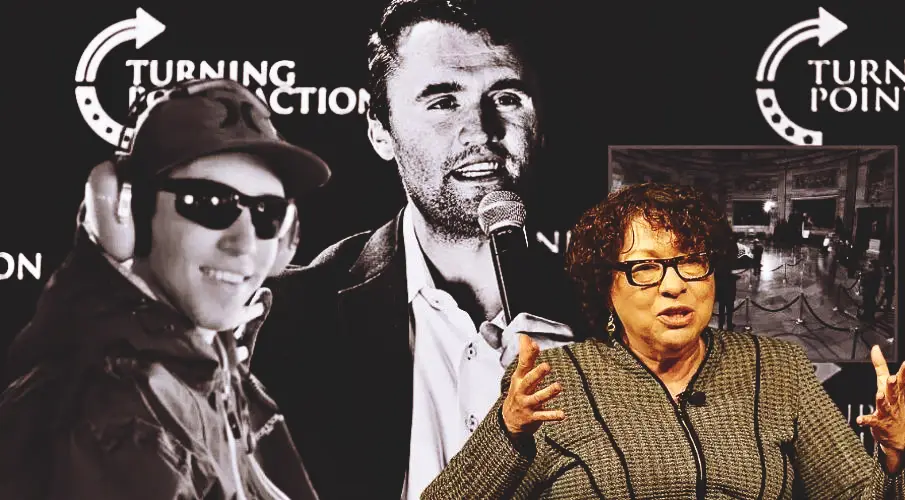
Provo - There are institutions that carry their decline outward, and others that carry it inward - until they no longer can. The Supreme Court of the United States belonged to the latter category, until it did not. What happened in Washington on Thursday was unusual enough to call by its proper name: Two justices of the nation's highest court publicly corrected one another from the bench. Not through a written opinion. Not in a formal dissent. But aloud, spontaneously, before a courtroom audience.
Samuel Alito had just finished reading the summary of the majority opinion allowing the Trump administration to physically turn asylum seekers away at the southern border before they reached U.S. soil. Sonia Sotomayor then rose and read from her dissent. She described the long and difficult journey many asylum seekers endure. She recalled a chapter of American history that is rarely invoked voluntarily: In 1939, the United States and other nations refused entry to a ship carrying Jewish refugees fleeing Nazi persecution. Roughly 250 of those passengers later died in the Holocaust. The majority's decision, Sotomayor said, would lead to more deaths. It "regrettably and tragically extinguishes the light of the Statue of Liberty's torch."

Alito, by all accounts visibly surprised, immediately responded without prepared notes, something almost unheard of at the Supreme Court. He said he would have included more details in his summary had he known what Sotomayor intended to say. He defended the ruling by arguing that the challenged turnback policy had been used under both the Obama and Trump administrations.
Then: "I have nothing further to add."
It is a short sentence that reveals a great deal. Alito did not engage with the argument. He declared the discussion over while a colleague was still speaking. It is the behavior of someone unaccustomed to being answered.

Read also our article: One Day, Three Decisions: "No Asylum, No Children, No Mercy: America Declares Itself Closed"
Earlier this April, Sotomayor issued a rare public apology to fellow Justice Brett Kavanaugh after remarking during a law school appearance that one of her colleagues "probably doesn't know anyone who works by the hour." In March, Kavanaugh and Justice Ketanji Brown Jackson publicly clashed over the Court's growing number of emergency orders that allowed Trump to move forward with major parts of his agenda. The justices often speak in interviews about their collegial lunches, where pending cases are supposedly left outside the room. What happened at the bench this week is difficult to reconcile with that image.
The Court is divided - six conservative justices against three liberal justices, a composition deliberately created through Trump's appointments. Most decisions are still unanimous, including one this week involving the gun rights of marijuana users. But the major cases of this term decided by six to three follow a precise ideological pattern. Next week the Court will rule on Trump's effort to restrict birthright citizenship and on his authority to remove members of independent federal agencies. Both cases strike at the basic structure of American democracy.
Sotomayor's reference to the 1939 ship carrying Jewish refugees was not a rhetorical device. It was a legal and historical argument: The United States made that decision once before, and it is still regarded as a profound moral failure that helped shape modern asylum law. The asylum protections later enacted by Congress with bipartisan support were intended to ensure that such a decision would never be repeated. On Thursday, the Court's majority ruled that the executive branch may effectively bypass those protections by physically preventing people from reaching U.S. soil, where the law would otherwise apply. Alito's response was that Obama had done it too.
Both are right. And that is precisely what makes it so disturbing.
While Washington argued over the future of asylum law, a judge in Utah was deciding the future of a murder case that has become one of the most politically charged criminal prosecutions on the American right in years.
Charlie Kirk, founder of Turning Point USA and a close Trump ally, was shot and killed on September 10, 2025, on the campus of Utah Valley University while speaking before thousands of people. The bullet struck him in the neck. The defendant, 23 year old Tyler Robinson from southwestern Utah, has been charged with aggravated murder. He has not yet entered a plea.
On Friday, Judge Tony Graf found the prosecution in contempt of court. The reason: Prosecutor Christopher Ballard told media organizations that the state had "more than enough evidence" to prove beyond a reasonable doubt that Robinson murdered Kirk. Ballard had previously embarked on what amounted to a media tour, discussing ballistic evidence before the case reached its preliminary hearing. That hearing, during which prosecutors will present their evidence and the judge will determine whether sufficient probable cause exists to send the case to trial, is scheduled for July 6 through July 10, 2026.
Read also our article: The Distorted Truths About Tyler Robinson and Messages From Hell
Charlie Kirk: Death of a Polarizer - Between Extremism and Violence
The Man Who Killed Charlie Kirk – Arrest in Utah and the Open Questions

The boy who had everything and still lost his future - An investigative reconstruction
The background is complicated. Initial ballistic testing failed to match the bullet that killed Kirk with the firearm investigators believe was used in the shooting. That finding fueled widespread speculation, including a March 30 Daily Mail headline claiming that the bullet did "NOT" match the alleged murder weapon. Conspiracy theories involving a second shooter or a staged death quickly spread. Ballard argued that he had merely tried to correct those false claims by explaining that the ballistic results were inconclusive, not exculpatory. He should never have discussed the evidence publicly. He absolutely should never have stated that Robinson was guilty.
Judge Graf ruled that the first part of Ballard's public statements did not violate the court's restrictions, but that the second part did, finding it carried a "substantial likelihood" of influencing the proceedings. As a sanction, the defense asked the court to remove the death penalty as a possible punishment. Graf rejected the request as "grossly disproportionate." According to the judge, any prejudice could instead be addressed through careful jury selection and extensive voir dire. The DNA evidence presented so far by prosecutors is significant: DNA matching Robinson was found on the rifle's trigger, on the spent shell casing, on two unfired cartridges, and on the cloth in which the rifle had been wrapped. Whether that evidence is enough to secure a conviction will be decided at trial. What Ballard's media appearances demonstrated, however, was that the prosecution was willing to risk the integrity of the proceedings in order to control the public narrative.
Two institutions. One day. The Supreme Court, where justices publicly improvised because what was at stake had grown larger than the institution's own conventions. A courtroom in Utah, where a prosecutor violated the rules governing his own case because he believed he needed to shape the public narrative. Both scenes describe the same reality: institutions under pressure greater than their usual ability to contain it. And people within those institutions who no longer seem certain whether the form still holds - or whether it is already beginning to break apart.
From the bench, Sotomayor invoked the refugee ship that was turned away in 1939. Alito responded that Obama had done the same thing. That is the state of the Supreme Court of the United States in June 2026.
Updates – Kaizen News Brief
All current curated daily updates can be found in the Kaizen News Brief.
To the Kaizen News Brief In English


Der Supteme Court ist seit Trumps 2. Amtszeit nur noch eine Marionette der Strippenzieher.
Trump ist das Gesicht der MAGA Bewegung.
Aber Thiel, Miller und die Evangelikalen sind die wahren Mächtigen.
Leider wird der Supreme Court über Jahre hinweg dieser MAGA Linie folgen.
Sie sind unantastbar, auf Lebenszeit eingesetzt.
Man kann nur hoffen, dass keiner der liberals Richter stirbt und Trump noch einen Loyalisten einsetzt.
Alleine, weil Sotomayor die Entscheidung in Bezug auf auf das Asyl derart scharf und öffentlich kritisiert hat, wird es zu einer Entscheidung von 6:3 gegen das Geburtsrecht kommen 😞
MAGA wird jubeln bis zum Umfallen und Trump fühlt sich bestätigt.
Nur am Rande erwähnt.
Rubios Eltern waren keine US-Amerikaner, als er geboren wurde. Sie hatten den Flüchtlingsstatus Kuba
In dem Verfahren um Kirks Ermordung kann es kein faires Verfahren geben.
Erstmal ist die Stimmung schon extrem von MAGA aufgeheizt.
Dann spricht ein Staatsanwalt über Dinge, die unter Verschluss bleiben müssen.
Ein Richter rügt ihn nur und lehnt es ab die Todesstrafe auszzuschließen.
Das könnte man mit der Auswahl der Geschworenen beeinflussen.
Wie soll man faire Geschworene in einem roten Stast finden?
In dem monatelang berichtet wurde, immer negativ über den Täter.
Erika Kirk wird xer Dache mit Fake Tränen nochmal richtig Dramatik geben.
Der Schuldspruch ist sicher, die Todesstrafe wahrscheinlich