
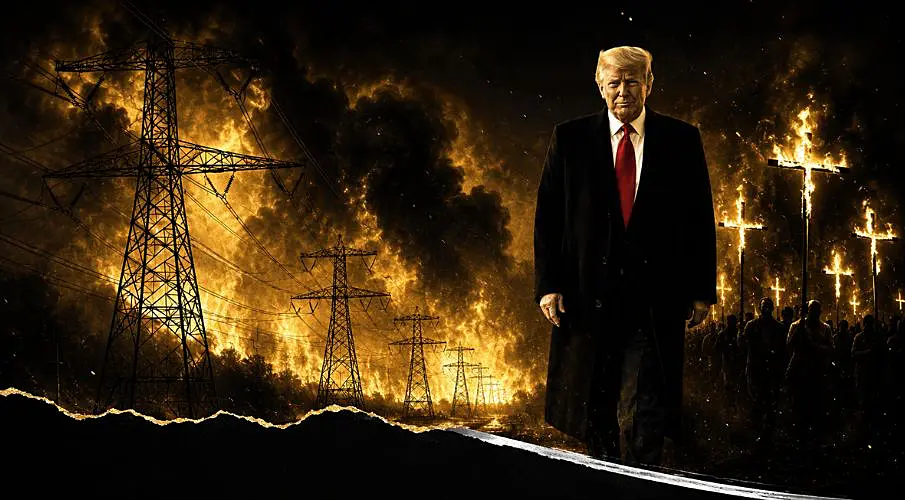
It happened after midnight, on a right-wing show, and at first it sounded like the usual conspiratorial muttering. But what host and conspiracy theorist Wayne Allyn Root whispered into the president’s ear on Tuesday goes straight to the heart of American democracy. Trump should declare a national security emergency over the elections and use it to take control of the midterms in November. Trump did not reject the idea. He said stranger things have happened, and he would leave it at that. That one sentence is the real news: The president considers it conceivable that he could seize control of an election before the first vote is even cast.
WAYNE ALLYN ROOT:
“A lot of people understand that. So let me put an idea in your head, okay? Because it’s so hard to get the Senate to do anything at all. Now they’re in recess, they’re getting nothing done. If they can’t get the SAVE America Act passed, you have the right to declare a national security emergency for elections.
And the Supreme Court ruled in 1983 under Reagan, in INS v. Chadha, that if you, as president of the United States, declare a national security emergency, they can’t challenge it. It can only be overturned by a two-thirds majority in both chambers of Congress. So if you do that next month, we get photo ID requirements, proof of citizenship, and limits on mail-in voting.”
DONALD TRUMP:
“Let me just say: Stranger things have happened, okay? I’ll leave it at that.”
Root’s calculation is as simple as it is brazen. Because the Senate will not pass the election law Trump wants, the so-called SAVE America Act, the president supposedly has the right to declare an emergency. That law would force citizens to prove their citizenship when registering and present photo identification in federal elections. Once an emergency is declared, Root claimed, it cannot be challenged and can only be overturned by a two-thirds majority in both chambers of Congress. If Trump acts next month, he said, they get photo ID requirements and proof of citizenship, along with limits on mail-in voting. At that point, Trump cut him off and suggested that the possibility was very much on the table. It was not a promise, but it was not a no either, and in this president’s language, those are often the same thing.
Except that right does not exist. The Constitution contains no authority allowing a president to rewrite state election laws by declaring an emergency; elections are administered by the states, and the courts have made that abundantly clear. Journalist Mike Rothschild put it plainly: Trump is not a wizard who makes things real simply by saying them or posting them online; there is no such right or mechanism in American law, and both men in this conversation are completely out of their minds. Criminal defense attorney Scott Greenfield stated matter-of-factly that Trump has no authority whatsoever to do this, but added the crucial warning that this does not mean he will not try. TV journalist Jake Tapper likewise saw no reason not to take Trump at his word that his team is planning something alarming to disrupt the midterms and more.
An Italian philosopher described the state of exception as the technique by which modern power suspends the law without formally abolishing it. It invokes a danger that it defines itself and from then on governs in the name of salvation. That is exactly the purpose of this supposed emergency. There is no real threat to be repelled; instead, an authority is to be invented that pushes the law aside for as long as the fear lasts. Whoever declares the exception no longer has to follow the rules, he makes them.

What such authority would look like is no longer something we can merely guess at. Our newsroom has the complete draft, 17 pages, stamped “PROPOSED” across every page. It was written and circulated by Trump-aligned lawyers who say they presented it to the White House. At the end are already the typed name “Donald J. Trump,” the line “The White House,” and the date April 12, 2025; all that is missing is the signature. The document sits there, fully written, waiting only for the stroke of a pen. It invokes national emergency law and the Defense Production Act and claims that foreign actors, working with domestic accomplices, remotely accessed election technology and manipulated results. It provides no evidence for that claim, but dresses up the old story of a stolen election in the language of national security and declares it an extraordinary threat. Its framework is built around an emergency Trump first declared in 2018 over foreign interference and that Joe Biden renewed year after year; now it is supposed to become the tool for remaking the election itself, beginning with the 2026 cycle and remaining in effect until Congress and the states fall in line.
What the draft would impose on voters is an obstacle course likely to discourage many of them. Anyone who wants to vote would have to present photo identification and documentary proof of citizenship, along with proof of permanent residence in the voting district. Voting would be conducted only on hand-marked paper ballots, printed exclusively in English on American security paper, and election technology could only be manufactured domestically and could no longer be remotely accessible. Mail-in voting would be reduced to a narrowly justified exception requiring a reason and a signed sworn statement, and every mail-in ballot would have to be notarized. Ballot drop boxes would be expressly prohibited, and every ballot arriving later than the evening before Election Day would go uncounted, regardless of its postmark. On top of that, everyone would have to register again in person for 2026, receive a nationwide voter number and a PIN, and anyone who failed to respond to a mailed inquiry within 90 days would lose their active registration. In the end, ballots would be counted by hand, in public, in precincts with no more than 1,500 voters.
Here you can read the complete original document:
The draft calls itself bipartisan, but its effect would be one-sided. Every district would have to close its final list of eligible voters 30 days before the election; anyone missing from it after that point could cast only a provisional ballot, and officials would not decide whether it counted until days later. Anyone whose face was deemed insufficiently similar to the photo on their ID would receive no ballot. Every record, every ballot preserved as a high-resolution image, would remain public for seven years, an archive that could serve scrutiny just as easily as intimidation.
But the real explosive charge lies deeper in the document. The emergency rules are supposed to override existing federal laws, including the Voting Rights Act of 1965, the centerpiece of America’s civil rights era, as well as the laws governing nationwide voter registration. Seats in Congress and their allocation among the states would in the future be based solely on the number of citizens, wiping millions of residents without citizenship out of the political calculation. Federal agencies, from immigration authorities to the Social Security Administration, would have to open their data to the states and even private individuals so they could challenge individual voter registrations; districts would then have 30 days to review each challenge and remove those affected. Private funding for election administration would be prohibited, and only citizens could serve as election workers. Americans living abroad would be allowed to register only through an address in the nation’s capital and would be permitted to vote only for president. Above it all would sit a new White House Office of Election Security, reporting directly to the president.
The harshest part, however, is the section aimed at people. The Justice Department and specially appointed federal prosecutors would be ordered to investigate every past federal election and prosecute anyone allegedly involved in interference, using organized crime laws if necessary. The draft defines its enemies broadly, because interference would include the actions of any person abroad or any domestic accomplice; the Director of National Intelligence would provide a list of suspected names. The draft explicitly targets even those who prosecuted or silenced supposed whistleblowers alleging election fraud, a reversal that turns prosecutors into defendants. Even statutes of limitations could be extended so that old allegations could still be prosecuted. And Election Day itself would become a recurring holiday on which citizens are supposed to count ballots publicly by hand. A final clause declares in advance that anything not expressly stated in the order is not authorized for national security purposes.
The draft is not some yellowing piece of paper from 2025; the president has since adopted its rationale himself. As early as February 2026, an investigation uncovered a further developed version that used alleged Chinese interference in the 2020 election as the basis for emergency powers over the 2026 election; Trump announced on social media at the time that he would soon present an irrefutable legal argument, in the form of an executive order. On July 16, 2026, he then carried the claim into his major prime-time address. There he declared that China had interfered in 2020 and obtained the data of roughly 220 million American voters, directly tying that claim to his demand for an overhaul of the election system before the midterms. The next day, the White House backed the claim with declassified documents. His own intelligence agencies, however, do not share that conclusion. Former government attorney Ty Cobb understood the speech for what it was, as groundwork for declaring an emergency.
TTrump claims China obtained the data of 220 million American voters and that the U.S. government itself covered it up for years. He called it the largest theft of election data in U.S. history. He presented no evidence that any votes or the outcome of the 2020 election were manipulated as a result. (July 16, 2026)
The people pushing the draft say plenty about what it is worth. It is being driven by Trump-aligned activists who believe they are coordinating with the White House. One of them, attorney Peter Ticktin, a longtime Trump associate, admits himself that under the Constitution, elections are governed solely by the states and their legislatures, and that the president has no power over them. In the same breath, he claims that foreign interference creates an emergency in which the president can step in after all. Another leading voice, Jerome Corsi, once a promoter of the lie about Barack Obama’s birthplace, is celebrating the revelations about foreign powers as laying the groundwork. Yet an intelligence assessment in 2021 had already concluded that China considered influencing the election but never carried it out. Democratic Senator Mark Warner calls the whole thing what it is: There is no emergency, and what is being planned is an attack on the will of the voters.
The fact that presidents can reach further than usual in matters of national security explains the fixation on China; experts, however, doubt that such a move would survive judicial review. Trump admittedly almost never rejects even the wildest proposal outright, so it would be possible to read too much into a single shrug. But the sheer number of signs that he is reaching for greater control over elections makes any easy reassurance impossible. Under the draft, disputes would ultimately go directly to the Supreme Court, assigning it original jurisdiction that it does not actually have.
This document is part of a long line of actions. Trump ordered the U.S. Postal Service, USPS, to stop delivering election materials in states that refuse to give the federal government access to their voter rolls; even Republican-led states rejected the demand, citing privacy concerns. Another order would require everyone registering to vote to provide proof of citizenship. Courts blocked both orders, after which the administration recently turned to the Supreme Court. At the same time, it had ballots from the 2020 election seized in Fulton County, Georgia, to feed the unsupported story of massive election fraud. Back in February, Trump had urged his party to take over voting in at least 15 places; Republicans, in his words, should nationalize the elections. His stubborn insistence on the SAVE America Act, which never had any real chance of passing and which he nevertheless declared indispensable, can likewise be read as groundwork for the larger grab.
What they mean by it is revealed by the people advocating it themselves. On Steve Bannon’s podcast, Root gloated that this is how Trump destroys his opponents and this is how they win the midterms. The plan, he said, was the Holy Grail and foolproof. The other side could not stop it and would descend into panic and hysteria once it realized there was nothing it could do. Other election deniers praised the proposal in a June report as a path to king-like powers that would allow the president to set the rules himself. A former Defense Department adviser called the whole thing simply insane. The idea is not new; activists in Trump’s camp have been pushing the president to take this step for well over a year.
On Steve Bannon’s podcast, Root gloated that this is how Trump destroys his opponents and this is how they win the midterms. (July 16, 2026)
Where this leads when this president refuses to accept defeat is already known. After losing to Joe Biden in 2020, he refused to accept the result and claimed, despite knowing better, that the election had been stolen. He pressured Georgia election official Brad Raffensperger to find enough votes and pushed his vice president, Mike Pence, to refuse certification of the result, something Pence had no authority to do. When all of that failed, he sent his supporters to the Capitol. They violently stormed the building and attacked police officers, people died and many were injured, while lawmakers were forced to flee. Back then, the attack came after the election. This time, it is supposed to come before it.

There is a reason all of this is happening right now. Trump is losing support even within his own base and is polling miserably, while Republicans fear the White House is leaving them to carry the burden of the Iran war and rising living costs. A poll this month also shows that 54 percent of Americans oppose the federal government taking control of elections and vote counting in individual states. From that position of weakness, he is reaching for a tool that no longer requires a majority. Anyone who can no longer be sure of winning at the ballot box starts looking for a way to make the ballot box irrelevant.
Whether such an emergency would survive in court is doubtful, and perhaps that is the wrong question. The real issue is that a president is openly leaving on the table the possibility of taking over an election by decree, and no one is holding him accountable for it. An emergency that invokes fear of China in order to disenfranchise his own voters and gut the Voting Rights Act of 1965 is not a defense of democracy. It is its end, announced in prime time with a shrug. A republic turning 250 this year can be shaken by a single broadcaster after midnight if no one pushes back. The question is no longer whether he is allowed to do it. The question is whether anyone stops him before it is too late. Stranger things, he said, have happened.
There is a lot of work ahead for all of us. We know the backlash will be fierce; we are used to it, it is our job, and this is not the first time we have had the storm blowing straight into our faces. Anyone who tells the truth has always stood in the wind. So we are stepping up the pace of our reporting, because this president needs to be stripped of power, through the tools of public scrutiny and the vote at the ballot box. He is a destroyer who holds nothing sacred, neither people nor nature, and he does not spare the economy either. He is the fascist who came from hell, and that is where he belongs, sent back into the irrelevance of history.
Updates – Kaizen News Brief
All current curated daily updates can be found in the Kaizen News Brief.
To the Kaizen News Brief


Danke, die letzten Sätze zeichnen was sich abspielt und ich befürchte die drastischen Konsequenzen. Amerika ist einer Bande von Bösartigen und Verrückten ausgeliefert.
….den fangen wir noch alle ein …
Das Trump und die Republikaner alles, wirklich alles, versuchen würden um die Midterms zu manipulieren oder gar zu verhindern, war klar.
Daran bestand nie ein Zweifel.
Es fing mit den Neuzuschnitten von Wahlkreisen an.
Dann folgten Einschüchterungen auf diversen Ebenen.
Jetzt das Notstandsgesetz.
Trump und seine Entourage sind kreativ und werden diverse Szenarien pushen (selbstverständlich wie immer ohne delegate Beweise).
Oben auf die gestohlen Wahl… das punktet bei seinen MAGA. Das glauben tatsächlich rund 90% der MAGA Basis.
Trump sagte vor seinem Wahlsieg „wenn ich gewinne, braucht die USA nie wieder wählen“.
Und da sind wir nun.
Die Vorbereitungen laufen.
Trump schert sich nicht um Gesetze und selten um Urteile … denn es muss ja Jemand da sein, der das durchsetzt.
Da er Militär und Exekutive unter sich vereint, kann er befehligen, wie er will.
Es wird soch kaum Jemand gegen die Befehle stellen.
Als er mit Selensky sprach, der aufgrund des Notstandsgesetzes ohne Wahl weiter Präsident ist, sagte Trump „interessant, dass muss ich mir mal näher ansehen“
Dieser Gedanke, die Wahl an sich zu reißen besteht schon länger (öffentlich)
Aber bisher hat sich wohl kaum Einer damit befasst.
Wenn Trump das tatsächlich durchzieht, dann gute Nacht USA, gute Nacht Welt.
Vielleicht sollte man Trump mal sagen, dass eine verstaatlichte Wahl Kommunismus ist.
Wo er doch gefen den Kommunismus/Sozialismus kämpft (und mit seinem Bildungsniveau nicht weiß, was das Eine oder das Andere ist und wo der Unterschied luegt)