
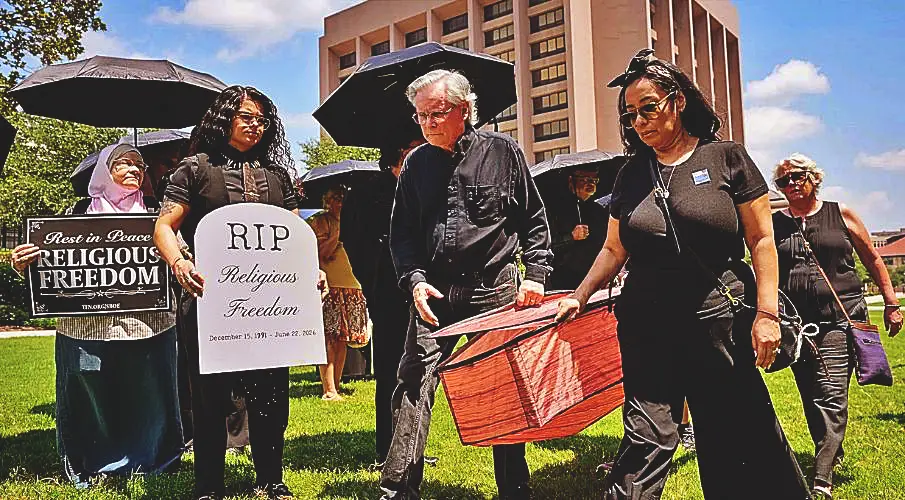
There is a rhetorical trick that is as old as the blending of church and state itself: religion is called culture, doctrine is called history, and missionary work is called education. On Friday, Texas turned that trick into law. The Texas State Board of Education adopted a mandatory reading list for English language arts classes in every public school in the state. The list includes classic works of world literature. And Bible passages. Required reading, to be read in full, for more than five million students from first through twelfth grade.
What supporters present as literary enrichment is, in practice, something very different. Texas could become the first state in America to require a mandatory literary canon for every public school student. Two education experts confirmed as much. Antero Garcia, president of the National Council of Teachers of English and a professor of education at Stanford, says he knows of no other state with a comparable mandatory list. Kasey Meehan, director of the Freedom to Read Program at PEN America, confirmed the same when asked. Recommended reading lists exist in many states. A mandatory one of this kind would be unique.
The contents of the list reveal the real objective. Third graders will read ROAR! - Daniel and the Lions' Den alongside Stuart Little and Charlotte's Web. They will also receive an illustrated version of the story of David and Goliath. Older students will read passages about Adam and Eve. Sixth graders will study Psalm 23, "The Lord Is My Shepherd," alongside the religious writings of George Washington and the poetry of Langston Hughes and Robert Frost. The Bible passages are not merely referenced or quoted. They are read in full, they are mandatory, and they are subject to testing.

Because this is the point hidden beneath the friendly packaging of a "literary canon": once these texts become part of the curriculum, they can also become part of standardized testing. Parents may opt their children out of individual lessons, but doing so risks lower test scores, which in turn affect the performance ratings of the entire school district. Freedom of choice exists on paper. In practice, it carries a penalty. Tiffany Clark, a Democratic board member, a Christian, and representative from the Dallas-Fort Worth area, said exactly that. She voted against the curriculum with a sentence that captures the entire debate: "Bible lessons belong on Sundays."
The policy extends into remarkable detail, and in those details its denominational preference becomes unmistakable. The curriculum requires specific Bible translations, including the King James Version, the edition traditionally used by Protestant and evangelical churches but generally avoided by the Roman Catholic Church. Texas is therefore not simply mandating the Bible. It is mandating a particular Bible that belongs to a particular religious tradition. According to the Pew Research Center, roughly one third of adults in Texas identify as non Christian. Those families will now have to explain to their children why the public school is teaching a sacred text that is not theirs, in a translation that remains disputed even within Christianity.
The arguments offered by supporters follow a familiar pattern that exposes itself the moment it is taken to its logical conclusion. Board member Brandon Hall, a Republican and pastor from Springtown, described the reform at a press conference as "a once in a generation opportunity." Then he made the statement that stripped away the literary disguise: "We are done watering down American history. We are going to teach the truth. Our nation was founded as a Christian nation, and Texas is a Christian state." That is not a statement about literature. It is a theological and political declaration made by a pastor helping decide the curriculum for five million children. Someone who wants to teach the Bible as literature does not say he is teaching "the truth." He says he is teaching a text.
Brandon Hall credited the WarRoom Posse for helping defend the Texas curriculum.
Hall: "Many of the victories we've achieved are thanks to WarRoom and the great patriots of Texas who spoke up. We didn't let this fight slip away from us."
Bannon: "It's the least we can do. You do the hard work. We just sit behind a microphone and yell."
Susan Perez, founder of a Christian parents' advocacy group, offered the historical justification. She argued that history and literature do not need to include every religious tradition because the nation was founded on "Judeo Christian values." She pointed to Christian references in the Declaration of Independence and the Constitution, which was signed "in the Year of our Lord" 1787. The argument contains one truth and one false conclusion. Historical documents unquestionably contain the religious language of their time. That does not mean the state has a constitutional duty to teach children that one specific Bible translation represents truth. That leap is one no constitutional court over the past seventy years would have accepted. Until now.

The broader context makes clear that the reading list is not an isolated decision but one piece of a larger project. During the same meeting on Friday, the Board also approved a revised social studies curriculum. Texas and U.S. history will receive greater emphasis, while world history and foreign cultures will receive less attention. A sixth grade course on "World Cultures" will be eliminated. Instruction on communism will be significantly expanded. Last year, Texas became the largest state to require the display of the Ten Commandments in public school classrooms, a law recently upheld by a federal court. In 2023, Texas became the first state to allow school chaplains to counsel students. The following year, lawmakers approved additional funding for schools that adopted an elementary curriculum infused with biblical content. State education law already requires schools to teach "religious literature, including the Hebrew Scriptures and the New Testament," and their influence on history and literature. What is being added now is mandatory compliance. What schools were permitted to do has become what they must do.
Opposition did not come only from Democrats. Evelyn Brooks, the only Republican board member to vote against the new mandatory texts, called the measure simply "unconstitutional." She defended the autonomy of teachers, who for decades have selected their own classroom books. Kimmie Fink, the wife of an active duty military service member stationed in Texas, asked the Board whether her children's constitutional right to religious freedom would remain intact in a state that claims to champion parental rights. Rabbi Joshua Fixler of Houston's Congregation Emanu El identified the central issue. He said the list was filled with Christian texts that do not belong in public school classrooms. The Board, he argued, must distinguish between teaching about religion and teaching religion. This list forces teachers to cross precisely that line.

It is the central distinction, and it is anything but academic. Teaching about religion means explaining to students what people believe, why they believe it, and what role those beliefs have played throughout history. Teaching religion means instructing students that one particular faith is true. The first educates. The second evangelizes. Board member LJ Francis insisted that this is not about evangelizing but about introducing "great Texas children to the richness of the Western literary canon." He expects reading scores to improve and children to rediscover a love of reading. Perhaps. But a Western literary canon that makes one specific Protestant Bible translation mandatory while forcing Catholic, Jewish, Muslim, and nonreligious students to choose between participation and lower test performance is not a literary canon. It is catechism with grades.
The reform will not take effect until the 2030-2031 school year. That leaves time for legal challenges, and Brooks did not use the word "unconstitutional" by accident. The First Amendment prohibits the government from establishing a religion. For decades, American constitutional law interpreted that to mean that public schools may not prescribe religion. The recent decisions of the Supreme Court, which allowed the Ten Commandments to remain in Texas classrooms, suggest that this wall is beginning to crack. Texas is testing how far it can go. Five million children are the experiment.
In the end, one simple question remains, one that none of the friendly language about literature and culture can answer: If this is truly only about the literary value of biblical texts, why does the curriculum require one specific denomination's translation? Literature does not ask which translation is the correct one. Faith does. And Texas has made its choice.
Updates – Kaizen News Brief
All current curated daily updates can be found in the Kaizen News Brief.
To the Kaizen News Brief In English


Die USA kommen dem Talibanstaat immer näher.
Gilead lässt grüßen.
Was mich erschreckt, wie vehemennt vor allem auch Frauen in Elternbeiräten dafür kämpfen vermeintlich pornografische Bücher aus den Büchereien zu entfernen.
Frauen sind maßgeblich an der Abschaffung von Frauenrechten beteiligt.😞
Wer devot sein möchte, soll das bitte privat machen.
Nun wird eine bestimmte Religionsauslegung als einzig Wahre etabliert und verpflichtend den Schülern eingetrichtert?
Wie war das doch bleich mit der viel beschrienenen Indoktrination von Kindern?
Es ist ok, wenn es der eigenen Sache dient.
Aber ansonsten wird lautstark dagegen protestiert.
Wie sollen Klagen Erfolg haben, wenn der oberste Gerichtshof das Alles passieren lässt.
Einschließlich der 10 Gebote.
Erstens sollte da die Verfassung hängen und zweitens sollten diese Religionsfanatiker erstmal letnen die 10 Gebote zu befolgen.
Es werden sicher bald Tennessee, Oklahoma, Alabama und Florida folgen.
Eine beängstigende Entwicklung.
Die sich in diesen Staaten sicher nicht umkehren lässt.
Sie waren immer tiefrot und werden auch tiefrot bleiben.
Indoktrination bereits im Kindergarten hatten wir schon mal 1933