
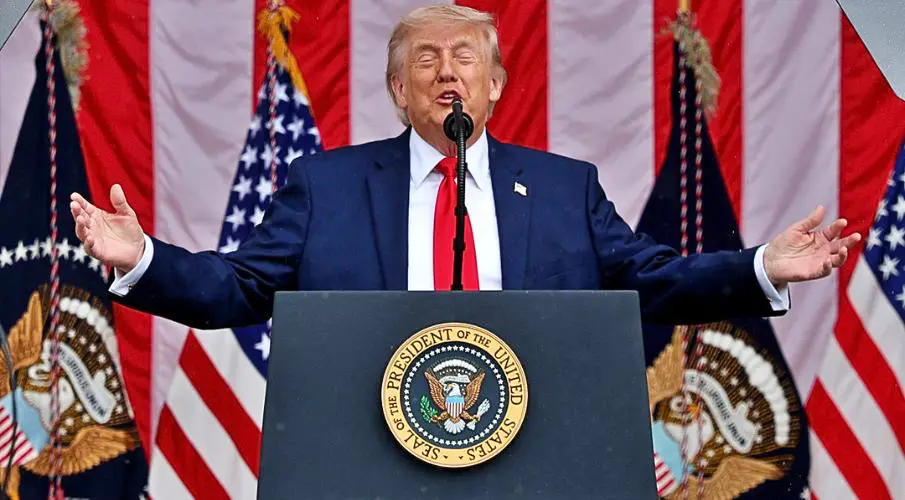
Trump calls inflation at 4.2 percent fantastic, blames it on the war with Iran, and boasts about a secret oil operation without offering any evidence, while oil prices rise on the very same day!
Asked about the new report showing that consumer prices in May were 4.2 percent higher than a year earlier, the highest level since April 2023, Donald Trump responded on Wednesday in a way no one expected. He did not call the figures a Democratic invention as he once did, and he did not claim he was already driving down the cost of living. Instead, he said, you know what I really love, I love inflation.
It is the solution of a man who cannot keep a promise. During the 2024 campaign he swore he would defeat inflation quickly. Since it refuses to disappear, he now embraces it. When someone cannot remove a problem, he declares it a virtue, and when someone cannot change reality, he announces his affection for it. The remark came at the worst possible moment. Ahead of the midterms in November, voters name the economy as their greatest concern and give Trump poor marks on it, and so Democrats needed only minutes to push the quote across social media. Trump really said it, on camera, for all of America to hear, Senate Democratic leader Chuck Schumer wrote, his contempt for you knows no limits. House Democratic leader Hakeem Jeffries added that they had finally found something Trump loves as much as himself.
In Congress, the statement became a test. Representative Emilia Sykes of Ohio presented it to Energy Secretary Chris Wright during a hearing and asked simply whether he too loved inflation. Wright avoided the question and said he loved taking away Iran’s ability to obtain a nuclear weapon, and only after repeated pressure did he admit that lower inflation would be preferable. Asked about Trump’s words, he called his president an entertaining man with a tendency toward exaggeration who had shown tremendous leadership strength, which carried more weight as a defense than as criticism.
The explanation Trump now offers for rising prices is that they are solely a consequence of the war with Iran, which has pushed up energy costs, and that once the issue with Iran is resolved everything will fall like a stone. Relief, he insists, is already on the way thanks to a secret military operation. I am announcing it today for the first time, he said, we have been moving millions of barrels of oil every night since last month. On social media this became, in all capital letters, more than one hundred million barrels making their way through the Strait of Hormuz onto the open market and more than two hundred commercial ships safely escorted through. No evidence for these figures was presented, and it remained unclear what role the American military had actually played.
Anyone who does the math sees the number shrink. Through the Strait of Hormuz, through which one fifth of the world’s oil is shipped and which the war has effectively closed since late February, roughly twenty million barrels a day moved before the conflict. One hundred million is the volume of five ordinary days, presented as a great announcement as though it were a miracle. Trump further claimed this secrecy had pushed prices below ninety dollars a barrel after they had crossed one hundred ten in early April. The market did not listen. That same Wednesday, American oil futures rose by roughly four percent and closed at nearly ninety two dollars. While the president announced falling prices, they climbed. The speech and the numbers parted ways, and it was the numbers that did not lie.
The White House tried to make the figures appear less severe and pointed out that in May some things had become cheaper than the month before, including new vehicles, prescription drugs, and auto insurance. But when inflation is measured against hourly wages, the conclusion remains bleak: people’s purchasing power has declined relative to what they earn. Spokesman Kush Desai stated that the president had always said oil and gas prices, and with them inflation overall, would collapse once the issue with Iran was resolved, and that the administration would continue helping people keep more of their hard earned money. Financial markets did not trust the promise that the president could lower prices by moving tankers through the strait, especially while the same administration was carrying out airstrikes against Iran and Tehran was responding against countries in the region. It is difficult to calm a market with promises of cheap oil while bombing the country through whose waters that oil is supposed to flow.
What remains is love. It is the final refuge of power when it can no longer change reality and instead tries to reinterpret it. One loves what one cannot defeat and proclaims what one cannot prove. He calls great what takes money out of people’s hands at the checkout line. The president turned a number speaking against him into a declaration of belief, and perhaps that is the entire art of these days: turning a loss into love simply by announcing loudly enough that it had been intended all along.
Updates – Kaizen News Brief
All current curated daily updates can be found in the Kaizen News Brief.
To the Kaizen News Brief In English


