
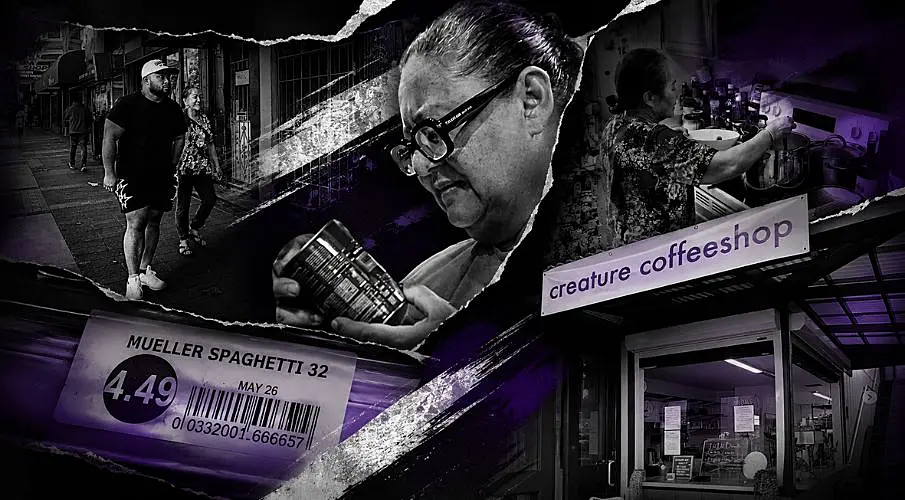
In Cleveland, a town about 45 miles northeast of Houston, Ada Torres cooks for a family of five, and beef has almost disappeared from the table. Five pounds of ground beef now cost nearly $20, and the 60-year-old simply can't afford it anymore. She says $100 worth of groceries barely gets you anything today, maybe seven family-size packages if you catch a really good sale. Instead of buying Goya and Hunt's, she reaches for Walmart's store brands. Chicken and deli meat have replaced beef, even though she worries all that processed meat isn't good for her grandchildren, who are 12, 15, and 16 years old. The lasagna with ground beef, the beef fajitas, the steak with fried plantain chips - they're all gone. During the rainy season, when her daughter's work with a mobile car wash dries up, the family can only afford one full meal a day. Breakfast and dinner are eggs and generic cornflakes.

This is what the biggest jump in food prices in half a century looks like when it lands on a kitchen table in Texas. Since the beginning of 2019, the cost of groceries in America's cities has climbed 33 percent, according to official figures. During the previous seven and a half years, prices had gone up just 6.4 percent. The reasons stretch back years. The pandemic ripped apart supply chains and drove up labor and transportation costs. Droughts, hurricanes, and bird flu cut production. Russia's war in Ukraine disrupted supplies of oil and fertilizer.
What started as the legacy of multiple crises has long since become the signature of a government that promised exactly the opposite. Food prices today are higher than they were when Trump took office, despite his pledge to bring grocery costs down. And the policies he has pursued since then have pushed prices even higher instead of lowering them. His tariffs have made imported goods like coffee, tomatoes, and chocolate more expensive. The new war in the Middle East, which he led the United States into, is driving food inflation even higher this year. And the people with the least have been hit the hardest. Last year, his administration tightened the eligibility rules for SNAP food assistance. In April, 37 million Americans were still enrolled in the program, a 12 percent drop in just one year.
There's an old truth every government is judged by in the end, and it's far less forgiving than any poll. Before freedom and before justice comes a full plate of food, and no government survives forever once people can no longer feed their own families. A president who promises prosperity while stripping away the last safety net from the poor as prices keep climbing will ultimately be judged at the dinner table, not by his speeches.

In San Francisco, 33-year-old barber Jack Chang is fighting that battle every single day. He has three young children and a partner who isn't working, and what he earns cutting hair five or six days a week often isn't enough, especially since he also helps support his mother whenever he can. The rent for his barbershop has gone up by 10 percent, while many of his customers disappeared after losing their jobs in the tech industry. On top of that, he's now making monthly payments on a used minivan. Every month, he looks at his credit card bill and wonders how he's supposed to pay it. His partner, Tina Chhous, brings home leftover food from their four-year-old daughter's daycare and relies on SNAP benefits, saying she has no idea what they would do without them. Chang's 77-year-old mother, Lien, also receives SNAP and visits two different food banks every week, sharing canned goods, eggs, and vegetables with the family. Giving up, Chang says, simply isn't an option.

Even in places where the ocean determines the price of almost everything, government policy has made its mark. Hawaii depends on cargo ships for nearly everything it consumes, and the cost of shipping goods between the islands has climbed sharply, driven by higher fuel prices linked to the Iran conflict and by the financial troubles of the company that controls most of the inter-island shipping market. A pound of strawberries and blueberries grown on Maui sold for $7.99 in 2024. Today, it's $11, while berries from California or Mexico can still be found at Costco for around $5. In Honolulu, an iced coffee and a bag of lychees now cost about $30. A gallon of milk at one local grocery chain sells for $9. Foodland, the grocery chain famous for its poke bowls and especially popular with tourists at its flagship Honolulu location, has become too expensive for many local residents, who now shop at Target or the Hawaii-based Times Supermarket instead. Even local-style beef stew has become a luxury after beef chuck climbed from under $8 to around $10 a pound, unless shoppers happen to catch Safeway's Friday special at $5.

Nothing illustrates the loss of control more clearly than beef, especially in a country that is the world's largest cattle producer. In June, a pound of ground beef reached $6.82, up 79 percent from the beginning of 2019. A shrinking cattle herd, drought across the western United States, and higher feed and fuel costs have all pushed prices higher. Demand is falling because more and more families, like the Torres family, are simply giving up beef because they can no longer afford it.
The overall numbers don't contradict what people are feeling - they explain it. Average weekly wages for full-time workers have technically risen a little faster than grocery prices since 2019. But consumers remember food prices more vividly than almost anything else, says economist Jared Bernstein, who once chaired President Biden's Council of Economic Advisers. Before the pandemic, wages were rising much faster than supermarket prices. Now that paychecks are only barely staying ahead of grocery bills, people feel worn down because rent and electricity have also become much more expensive. You need food to live, Bernstein says, and an average figure like the median wage doesn't show how much additional price increases a household can actually absorb. On average, Americans spent about 12.9 percent of their pre-tax income on food at home and away from home in 2024. For the lowest-income fifth of households, that figure reached 33 percent.

The burden also varies dramatically depending on where people live. In June, grocery prices in St. Louis were just 2 percent higher than a year earlier. In San Francisco, they were up 6 percent. Grocery shopping has become a strategy of its own, almost a weekly survival plan as families try to stay ahead of rising costs. Anyone working with a fixed weekly grocery budget - say $250 - starts splitting up shopping trips the moment one store becomes too expensive, and eventually stops going there altogether. Families heading into Boston now spend time at home checking store apps for weekly deals, buy steak only when it's discounted, and build their meals around whatever happens to be on sale. A three-day special on chicken becomes chicken with vegetables and rice. Brand-name products are often the first thing to disappear from the shopping cart, even though many shoppers still say store brands simply don't taste the same.
Looking across the Atlantic doesn't make the American situation any less serious - it simply puts it into perspective. Food prices across the eurozone have also risen by about 34 percent since 2019, almost exactly the same as in the United States, something the European Central Bank had already pointed out in 2025. Over the long term, the two sides look surprisingly similar. The difference is where things stand today. While the U.S. Department of Agriculture expects food prices in America to keep climbing, overall inflation across the eurozone fell to 2.8 percent in June 2026, and food inflation is now running at just about 1.6 percent. Germany sits close to the European average. Prices remain high, but they're rising far more slowly than they are across the United States.
The real difference, though, isn't the price tag - it's the safety net underneath it. In Europe, a stronger social welfare system cushions the fall. In America, families talk about cutting beef from their meals, driving from store to store, clipping coupons, relying on food banks, or simply being able to afford only one real meal a day. And at exactly that moment, the government made it harder for them to qualify for food assistance. The president promised Americans a cheaper dinner table. What he delivered was the most expensive grocery bill in 50 years - and then took away the last pair of hands helping the poorest families carry it.
Updates – Kaizen News Brief
All current curated daily updates can be found in the Kaizen News Brief.
To the Kaizen News Brief In English


Und dennoch glauben Viele, selbst wenn es höhchstens eine vollwertige Mahlzeit pro Tag gibt, dass Trump es besser macht und das nur doe Lasten der Biden Regierung sind.
Viele werden weiter republikanisch wãhlen, weil ihr Sektenführer Trump ihnen einredet es wird bald besser, das golden Zeitalter von MAGA kommt.
Immer mehr Menschen gehen zu Tafeln, weil sie durch Trump SNAP verloren haben.
Die Spenden brechen aber ein und mit immer Weniger kann man bicht immer mehr Menschen versorgen.
Ein Teufelskreis.
Entweder Essen oder ein Dach über dem Kopf haben.
Diese Frage wird sich für immer mehr US-Amerikaner in Zukunft stellen.
Nicht nur die Arbeitslosen, es wird immer mehr auch die Mittelschicht treffen. 😞
Und in Deutschland wird leider auch mächtig am Sozialstaat gekürzt.
Andere europäische Länder haben ein noch weniger stabiles soziales Netz.
In den USA gibt es nach wie vor sehr viele Menschen, Unternehmen, Kirchen und Organisationen, die Food Banks unterstützen. Das eigentliche Problem, das viele Food Banks schildern, ist oft: Wegfallende Fördermittel in einzelnen Regionen, aber privat wird sehr viel den Menschen geholfen.