
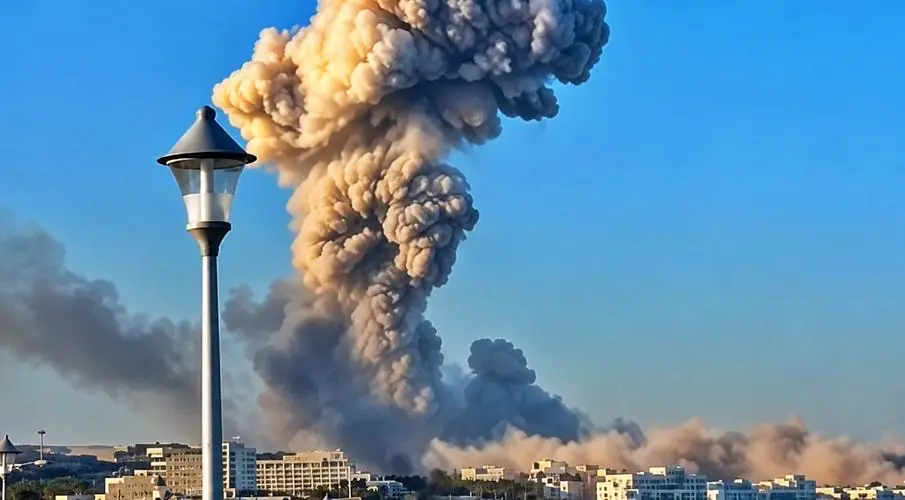
For the second time within twenty four hours, the American military attacked Iran overnight into Thursday, and this time nobody even named a reason. President Trump had previously warned that Tehran would pay the price because its leadership was taking too long to negotiate. Defense Secretary Pete Hegseth, speaking to reporters at MacDill Air Force Base in Tampa, said it openly. If negotiations must be conducted with bombs, he said, then negotiations will be conducted with bombs, and nobody in the world does that better.
For the second time within twenty four hours, the American military attacked Iran overnight into Thursday, and this time nobody even named a reason. President Trump had previously warned that Tehran would pay the price because its leadership was taking too long to negotiate. Defense Secretary Pete Hegseth, speaking to reporters at MacDill Air Force Base in Tampa, said it openly. If negotiations must be conducted with bombs, he said, then negotiations will be conducted with bombs, and nobody in the world does that better.
With that, what is usually left unsaid has been said. Here war is not treated as the failure of dialogue but as its continuation by other means, and the other means are now the only ones still being used. Trump and Hegseth left no doubt on Wednesday that the new strikes were not retaliation for any specific act but pressure intended to force Tehran into accepting peace on Trump’s terms. A peace imposed with bombs carries its contradiction within itself.
Trump: “We will hit Iran hard today - unless you do not turn on your television.”
Because the same president has spent weeks insisting that an agreement with Iran is imminent. The repeated attacks expose those assurances as false and completely undermine the credibility of the ceasefire announced two months ago, under which both sides have continued to exchange fire from time to time and contradict each other almost daily over who was responsible, what exactly was being fought over, and what state the negotiations were actually in. United Nations Secretary General António Guterres found a bitter phrase for it on Wednesday, saying the declared ceasefire looked less like an end to the fighting and more like reduced fire, as shown by the growing intensity of both attacks and rhetoric over the previous forty eight hours.
Trump on the Iran deal: “Two or three days … we have a very good chance to get it done.” (June 9, 2026)
Central Command announced that the strike began at 5:15 p.m. Eastern Time, which corresponded to 12:45 a.m. Thursday in Iran, and was completed shortly before sunrise. It said the attack targeted Iran’s military intelligence and communications systems as well as air defense positions and involved the Air Force, Navy, and Marine Corps. The command remained silent about the extent of the damage. Explosions echoed over Tehran and Bandar Abbas, over Qeshm near the strait, and over Minab and Sirik in the south. Trump himself told Fox News reporter Trey Yingst in Tel Aviv that forty nine Tomahawk cruise missiles had been launched at targets in Iran along with bombs dropped by fighter jets. He added that there would soon be a pause, but operations would continue Thursday evening if Iran refused to yield in negotiations.
Iran claimed to have responded in two waves. Through the state agency IRNA, the Revolutionary Guards declared that they had struck eighteen major American military assets at Ali Al Salem and Ahmad Al Jaber air bases in Kuwait and at Sheikh Isa Air Base in Bahrain in response to American attacks on Guard units, coastal positions, police command facilities, and areas surrounding Bandar Abbas airport. The targets had been hit and destroyed, they claimed. That could not be independently confirmed, and neither Washington nor Kuwait nor Bahrain confirmed the account.

IRGC: “In the early hours of Thursday, the Aerospace Force and naval units of the Revolutionary Guards attacked the aggressor and responded to the provocation of the US military. According to the IRGC, eighteen major US military assets at Ali Al Salem, Ahmad Al Jaber, and Sheikh Isa air bases were struck and destroyed.”
The shock spread beyond Iran’s borders. In Bahrain, home to the headquarters of the US Fifth Fleet, sirens sounded Thursday morning without the Interior Ministry explaining what triggered them, and the Kuwaiti military reported intercepting hostile targets with its air defenses, though it did not specify whether they were missiles or drones or where they came from. After the first round on Wednesday, Iran had already directed missiles toward Bahrain and Kuwait as well as Jordan, all three hosting American troops. In Lebanon, an Israeli airstrike hit the southern port city of Sidon on Wednesday. After Tehran declared the Strait of Hormuz closed to all vessels, including oil tankers and commercial ships, the Revolutionary Guards Navy warned ships anchored in the Persian Gulf and the Gulf of Oman not to move, declaring that anyone approaching the strait would be considered an accomplice of the enemy. Central Command denied that the strait was closed. Although much of Iran’s regular navy has been destroyed, the Guards still maintain a fleet of small, fast boats capable of disrupting traffic through one of the world’s most important energy arteries, through which one fifth of global oil shipments pass.

The threats escalated without limit. General Majid Mousavi, commander of the Revolutionary Guards Aerospace Force, declared in a short statement that the entire region would be turned into hell. You have made the sacred Strait of Hormuz unsafe, he wrote, and therefore from all parts of Iran we will turn the entire region into hell, this being the response to America’s aggression. The Guards announced that the country’s armed forces would respond powerfully and decisively to every attack, and the hardline generals leading Iran have made clear they are prepared to settle the conflict by force.
Amid this balance sheet of numbers and threats stands one quiet event that outweighs much of the noise. Overnight into Wednesday, an American strike destroyed what had been a drinking water facility in the southern province of Hormozgan near the strait. Central Command itself had announced that precision weapons launched from fighter aircraft had been used near the strait. In the village of Bemani, two small water reservoirs stood on a hill outside the settlement, identifiable by their light blue pipes. The roof of the smaller reservoir collapsed. The larger remained standing, but in the center of its roof is a small hole whose size and position suggest a deliberate strike. Fragments recovered from the debris were reported by the semi official Tasnim agency as originating from the site and were identified by specialists from the Open Source Munitions Portal, a database documenting weapons remnants from war zones, as parts of a GBU-39 glide bomb, a small precision guided bomb in the roughly one hundred fifteen kilogram class whose effect matches the clean hole in the roof and the limited surrounding damage.

Both structures stood in isolation with no other facility nearby, and precisely that fact, the strike centered directly on the roof of a solitary building, is considered an indicator of a deliberate hit. Abdolhamid Hamzehpour, head of the provincial water authority, said both reservoirs had been destroyed. More than twenty thousand people in one city and surrounding villages lost access to water for twelve hours during temperatures that climbed above thirty eight degrees Celsius that week. Whether the United States intentionally struck the water facility or knew what the buildings contained remains unclear. Deliberately targeting civilian infrastructure can constitute a war crime under international law. Asked about the incident, a Central Command spokesperson stated only that the reports of damage were known to him and declined further comment. On a wall that survived the strike, written in green and blue letters, remains a warning not to waste water. Water is the pulse of life, it says. So the wall still calls for conservation while behind it the facility lies in ruins and tanker trucks roll in, which Hamzehpour used to supply residents until his teams built a bypass pipeline around the destroyed reservoirs within twelve hours.

Elsewhere, uncertainty remained. In Asaluyeh, Iranian media reported air defense activity and a possible intercepted projectile, but authorities denied any attack on South Pars and nearby facilities, among the country’s most important gas production sites. In Karaj, a city roughly thirty kilometers southwest of Tehran, residents reported heavy explosions in the early hours of Thursday. Iran maintains a missile factory and military facilities there, including Bidganeh military base. As early as March, the American military had struck a large bridge on the road between Karaj and Tehran, a civilian bridge that had not yet even opened to traffic.
Above the war hangs its bill. Consumer prices in the United States rose 4.2 percent in May compared with the previous year, the strongest increase since April 2023, and oil prices jumped upward on Wednesday while negotiations over Iran remained deadlocked. Trump, who now calls inflation fantastic, also boasted of a secret operation through which millions of barrels of oil had supposedly been moved through the strait under Iran’s nose. A military representative clarified that the remarks made in the Oval Office on live television referred to nothing more than a long known effort to guide commercial ships through the passage. The secret behind the secret mission was that it had never actually existed as a secret.
And so what many thought had been overcome returns: open war in the center of the Middle East. Two powers exchange strikes and call it negotiation, one threatening to turn the region into hell, the other destroying a water reservoir while promising prices will fall like a stone. What remains is the wall in Bemani calling water the pulse of life, behind it the shattered reservoir, and above it a peace said to be just around the corner that announces itself only through impacts. Perhaps that is the truth Hegseth spoke without meaning to, that a conversation conducted with bombs is no longer a conversation at all but only the noise power mistakes for one.
Updates – Kaizen News Brief
All current curated daily updates can be found in the Kaizen News Brief.
To the Kaizen News Brief In English


