
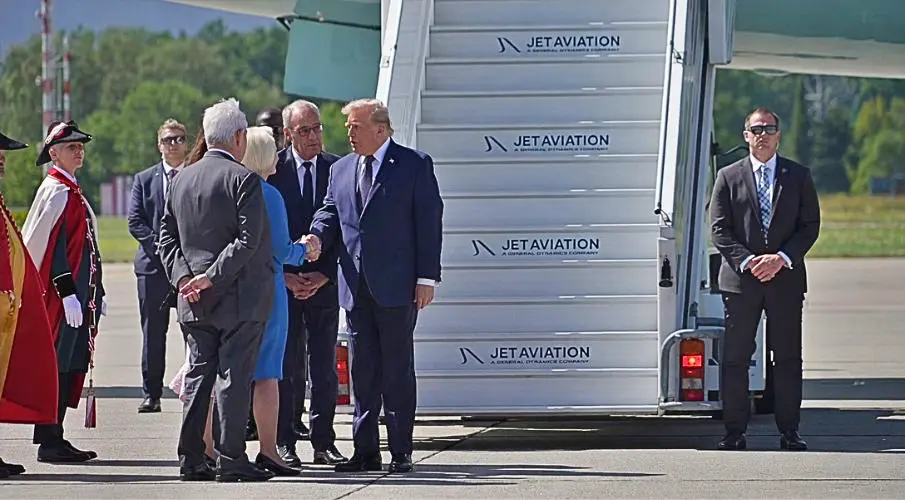
In Evian, Trump presents himself with confidence in victory, but the agreement with Iran has only been signed electronically, the text remains secret, the naval blockade stays in place, and in the Strait of Hormuz there is now supposed to be no toll, only fees. Of all people, he gives thanks to Xi and Putin!
In Evian-les-Bains, Trump appeared appropriately confident of victory as he met with the leaders of the Group of Seven. During his meeting with Macron, the host offered to send European forces to the Strait of Hormuz so energy could once again flow freely into the markets after the preliminary agreement with Iran is meant to end the war. As early as Tuesday, France could send fighter jets over the waterway, Macron said, and frigates within forty-eight hours. Within two to three days, the nuclear-powered aircraft carrier already stationed in the Middle East could follow. Trump waved it off, saying much help would probably not be needed, the strait would be open anyway, but a ship or two from some countries would not hurt, and France would be a great country for that.
What the signature actually means became clear only through the vice president. As early as Sunday, JD Vance said, the preliminary agreement had been electronically signed, while the formal ceremony would follow on Friday in Geneva, where Trump stopped on his way to the summit. They had signed digitally, no money had changed hands, and it would stay that way, the arrangement was tied to performance. He pushed back against reports in Iranian media that assets would be released upon signing, saying not one cent would go to Iran until it fulfilled its obligations, and the text would be published this week. Trump left open whether he himself would attend the signing, saying it depended, maybe he would be there, maybe not, JD was intended for that. He called the agreement promising, but not guaranteed, and said if they could not get along, they would be back where they started.
CBS: The Iranians are saying they will have access to a $300 billion reconstruction fund. Is that true or not? JD Vance: Those are the kinds of things they could have access to - provided they uphold their end of the agreement.
So the peace is signed, and the blockade remains. Until implementation of the ceasefire planned for Friday, the American military informed commercial shipping, the closure of Iranian ports would remain in effect. No one should cross the line until an explicit green light was given, captains should think of the safety of their crews and avoid Iranian ports. Anyone who failed to immediately comply with the instructions of those enforcing the blockade should expect rapid escalation up to disabling or destructive fire.
Before the press, in a hoarse voice, Trump announced big things. A lot of good would now happen in the Middle East, oil was falling, and the stock market was rising like a rocket that day. He said he regretted that there had still been attacks for two more nights and hoped relations would become good. He arrived after celebrating his eightieth birthday on Sunday with a UFC cage fight at the White House.
The war may end, but its toll on the economy does not. Neither side has released the full text of the framework agreement. At the beginning of the war, Trump promised that his intervention would end quickly and only slightly disrupt the economy, but the campaign stretched across more than three months and left burdens likely to remain into next year. Oil is falling, but gasoline is not immediately returning to prewar levels. On Monday, the national average stood above four dollars per gallon, just over one dollar per liter, roughly one dollar more than a year ago. The shipping backlog is not disappearing overnight either, fertilizer may remain scarce and push food prices higher. In May, inflation accelerated at its fastest pace in three years, faster than wages.
Experts are warning. James Knightley of ING Bank calls it uncertain whether this will become a lasting peace. It may take until 2027 before gasoline falls below three dollars per gallon again and inflation reaches the Federal Reserve's two percent target. Real relief will likely come only after the midterms, a drag on Republicans. Ajay Parmar of ICIS also expects prices to remain above prewar levels at least through the end of the year, and Oxford Economics warns that even if oil falls, inflation may not fall with it, fertilizer will push food prices higher worldwide even after the war. At least the labor market recently created 172,000 jobs, and markets surged on Monday.
Trump himself fuels the anger. Even as gasoline rose, he dismissed concerns about affordability as a hoax, and he called the latest inflation report fantastic, saying, I love inflation. What Trump was thinking, Democrat Chuck Schumer asked in the Senate, whether he had lost a bet over saying the most tone-deaf thing imaginable. The White House dismisses poor numbers as partisan. Spokesman Kush Desai points to lower prescription drug prices and Trump's promise that oil and inflation will collapse once the Iran issue is resolved. The rebound his advisers hoped for, one that would lower prices, was prevented by the war. There will be a rebound, economist Joseph Lavorgna says, just not one that lowers prices. People did not want this war, says Elizabeth Pancotti of Groundwork Collaborative, and there will be no sympathy for it at the ballot box.
At the water itself, it becomes clear how much of the victory exists only in words. The Strait of Hormuz would remain permanently toll free, Trump had announced on Sunday, but on Monday Iran said it would impose fees for unspecified services. No toll, Foreign Ministry spokesman Esmaeil Baghaei said, but fees for services rendered, though he did not explain which services, possibly environmental protection. Legally, a toll for passage differs from a fee for an actual service, and a toll on a historically open waterway does not become lawful simply because it is called a fee. In May, Iran specifically created a transit authority for passage permits and spoke with Oman about compensation. James Holmes of the Naval War College considers that unsustainable. No one pays to pass through a natural waterway, not through the Strait of Malacca, not through the Taiwan Strait, and the only service Iran offers is not attacking, which is not enough. We will do everything so there is no toll, Macron said, and Secretary of State Rubio called any transit charge simply unacceptable. Trump, however, has already suggested that the United States itself might collect as the victor.

Trump directed his thanks for the agreement of all people to two men he calls friends, Xi Jinping and Vladimir Putin. They had helped create the conditions, he said, by not sending tankers through Hormuz to break the American blockade. Xi was a complete gentleman, Trump said, he had not sent a single tanker, flanked by twenty destroyers, to break the closure. Just last month Trump had traveled to Beijing for a summit and state banquet, discussing trade and Taiwan as well as the war against Iran, and afterward spoke enthusiastically about a G2 of the two great powers. China, Iran's largest oil customer, had pushed Tehran to continue negotiating, in its own interest.
What he does not say weighs more heavily
Chinese companies tried to deliver weapons to Iran, shoulder fired anti aircraft missiles, which is why Washington imposed sanctions last week, including against Armory Alliance, a Belarus based intermediary that helped move hundreds of such missiles from China into Iran through third countries and disguised origins. Russia, meanwhile, supplied Iran with targeting data for attacks on American bases. Trump says nothing about any of this. And barely three weeks after the meeting in Beijing, China arrested an American, U Min Zin, who researches Myanmar's politics, under the rare accusation of espionage, disappearing around June third in Kunming. The president stayed silent about that as well, while Representative John Moolenaar demanded his immediate release.

While the powerful met, protests marched outside. Organizers of the anti summit demonstration counted thirty thousand participants, the police twenty thousand, including roughly six hundred from the black bloc. Police used tear gas and water cannons against stone throwing youths, kettled around three hundred people overnight, including minors and tourists, along with bystanders, and checked nearly five hundred fifty individuals. A handful were arrested and later released. Organizers are demanding an apology for what they call provocation and police violence.
And so a war ends in words. Digitally signed, tied to performance, toll free and yet fee based, inflation loved, autocrats thanked, and above all a blockade threatening destructive fire. Words do what actions refuse to do. The strait is declared free and carries a price, peace is signed and the guns remain aimed. The victor thanks the men whose missiles and targeting data served the opponent, and at the gas pump a family waits for relief that even economists place beyond the election. He calls it victory because victory is the easiest thing to say. Between the announcement and the tank, between the signature and the text no one has read, lies the entire truth of this peace.
Updates – Kaizen News Brief
All current curated daily updates can be found in the Kaizen News Brief.
To the Kaizen News Brief In English


Danke für diese gute Recherche zu dem, was gerade Stand der Dinge ist und was nicht.
Die Medien hier geben so viele falsche oder verdrehte Meldungen weiter.
Leider folgt es dem üblichen Muster.
Große Ankündigung von Trump, keine Bestätigung….. viel Raum für Spekulationen.
Freitag wird sich zeigen, ob was drin ist.
Aber welchen Stellenwert es hat, zeigt die Aussage „ich weiß bicht ob ich bei der Unterzeichnung dabei bin“.
Wahrscheinlich ruft Mar-aLargo und sein Golfplatz.
Außerdem hat er durch die „Feierlichleiten“ das ganze Wochenende keine Zeit gehabt sein Posting-Stakkato zu machen.
Vielleicht ist das Ganze auch nur eine Finte um wieder groß mit steigenden Ölpreisen zu verdienen.
Die Menschen im Iran sind der Spielball, der den hohen Preis zahlt. 😞
Ich danke dir – aktuell she ich die Kommentare, doch mir fehlt schlicht auf das gute engagement zu antworten, weil wir total überlastet aktuell sind.