
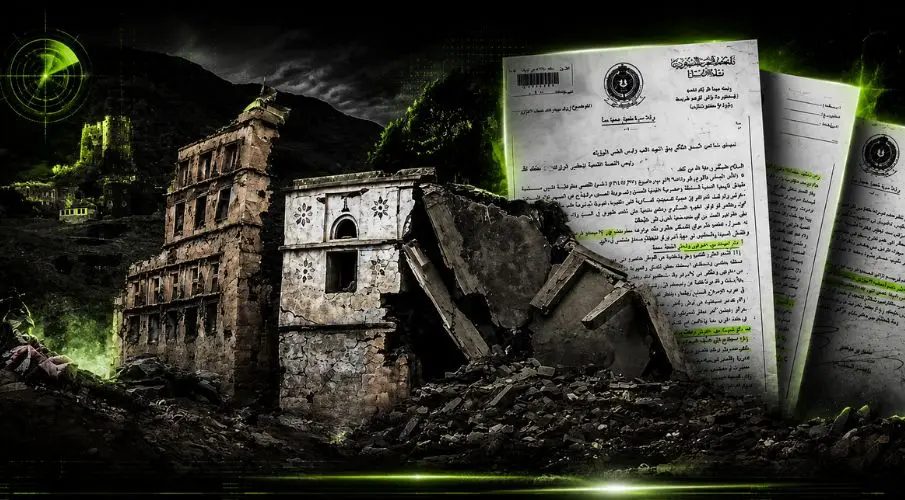
The order exists in black and white, signed by Salman bin Abdulaziz, now the King of Saudi Arabia. In January 2012, when he was defense minister, he instructed his government to create a sectarian war in northern Yemen where none existed, while making sure Riyadh's name would never be tied to it. The document was marked "Top Secret, Extremely Urgent" and sent to a body whose name has never appeared in any official statement issued by either country, the Saudi Council of Ministers' Special Committee. A leaked collection of these dispatches shows how a battlefield was designed at a desk before the first shot was ever fired.
The timing was deliberate. A popular uprising in 2011 had ended President Ali Abdullah Saleh's 33-year rule. The army had splintered into rival factions, both camped inside the capital, Sana'a, and a successor was waiting to take office through an election with only a single candidate, hardly the leader a fractured country needed. Saudi Arabia, which shares an 812 mile border with Yemen, watched its longtime rival, Ansarallah, rise inside that political vacuum, rooted in the northern highlands with its stronghold in Saada.

The documents come from Saudi Arabia's defense and security establishment and deal with the situation in Yemen during the fighting against the Houthis. The passages highlighted in pink mark the sections that proved decisive for our investigation. They show how the Saudi leadership assessed military developments, what role Sunni tribes were expected to play, and which political consequences were considered necessary. Particularly striking is that military operations were only one part of the strategy. The political perception of the conflict was treated as equally important. Together, the documents provide a rare look inside internal assessments and decision-making at the highest levels.
The first page describes how Sunni tribal fighters captured key Houthi positions around Dammaj and made territorial gains. At the same time, it reports that the Houthis were reorganizing and strengthening their security measures.
The second page contains reports about additional clashes, negotiations with Sunni tribes, and the first indications that the Houthis might be willing to accept conditions set by those tribes. It also documents confrontations involving followers of the Zaydi faith as well as fighting with Sunni groups.
The third page contains the political assessment. It recommends supporting Sunni tribes, expanding contacts with various actors, and at the same time ensuring that the conflict would not be perceived as a war between Sunnis and Shiites. That passage is what makes these documents particularly remarkable because it shows that controlling the political narrative surrounding the conflict was already considered an essential part of Saudi strategy at the time.
A political thinker of the 20th century, whose work remains inseparable from his role as the chief legal theorist of the Nazi regime and who can only be cited with that qualification, argued that politics is defined by the distinction between friend and enemy. Salman's directive turns that idea on its head. The enemy did not exist. It had to be created. Where people had lived side by side, a dividing line had to be drawn until neighbors became enemies. The enemy did not create the front. The front created the enemy.

The Zaydis of northern Yemen, the Shiite branch that ruled the highlands for a thousand years until 1962, stand much closer in doctrine to the 4 Sunni schools of Islamic law than to Iran's Twelver Shiism. Even in the early 2000s, most Zaydis had not joined the Houthi movement. That closeness was exactly what Riyadh wanted to destroy.
The Two Edges of the Plan
The strategy had 2 edges. One armed the tribes fighting the Houthis, mostly ultraconservative followers of the Salafi school educated in the kingdom's Wahhabi doctrine. The other drove a wedge between Ansarallah and the broader Zaydi community. The dispatch states it plainly. Support the tribes hostile to the Houthis, open multiple fronts against them, and sow division between the Houthis and their Zaydi supporters, while making sure the fighting would not appear to be a Sunni-Shiite sectarian war or one directed by the kingdom itself.
That effort to conceal the operation is the real revelation. Had the conflict appeared to be nothing more than a religious war between Sunnis and Shiites, the Zaydi majority in northern Yemen would almost certainly have rallied behind the Houthis out of religious solidarity. The violence had to look like a local dispute between neighboring communities. If Saudi-backed Sunnis had openly been seen attacking local Shiites, the Houthis would have instantly become defenders of their faith instead of just another local movement. Riyadh financed one side of the line while carefully keeping its own name out of sight.
Names, Fronts, and Money
The papers name names and list amounts. The same January 2012 dispatch claims that a sheikh named Mohammed al-Imam, head of a Salafi institute in Dhamar, had assembled 300 armed fighters to attack Houthi positions and relieve the besieged Salafis in Dammaj, a claim that could not be independently verified. Dammaj, where a Saudi-backed religious institute had been established in 1979 in the heart of Zaydi territory, had by 2012 become the symbolic front line of the conflict. Hussein Khiran, an active artillery commander in the Yemeni army, was reportedly supplying ammunition to those fighters.
The dispatches also reveal the desperation on the other side. Houthi leader Abdulmalik al-Houthi sent messengers to 2 estranged Zaydi figures, Mohammed Abdulazim and Abdullah al-Razami, with a plea: "We can no longer hold back the Wahhabis. If you do not support us, we will hand Saada over to them because we cannot keep fighting." Abdulazim refused. Al-Razami sent 70 men.
A separate dispatch records the money. Prince Mishaal bin Abdullah, then governor of the border province of Najran, signed a Ministry of Interior document dated May 7, 2012, under the subject line "Regarding the Houthis and the Sunnis." According to the document, his office had received an installment of 5 million Saudi riyals, about $1.3 million, and distributed it to the fronts in Dammaj and Aahim before requesting a second payment. Forces were reinforced in Aahim in Hajjah Province, and a third front was established in Rahub. Earlier, on March 15, 2010, King Abdullah had personally ordered the immediate release of 50 million riyals, roughly $13 million, to arm tribes along the border. The same document also approved a proposal by Salafi sheikh Musleh bin Hamad Fanis Al-Athla to establish another branch of the Dammaj religious institute as part of an effort to weaken the Houthi movement. Individual pages from this collection had surfaced years earlier and helped confirm its authenticity. No Saudi authority responded to requests for comment.

Riyadh armed one side, but the other side had a financial backer as well. A March 2012 report signed by intelligence chief Muqrin bin Abdulaziz describes how the ousted President Saleh secretly financed the Houthis as a counterweight to the Salafis because the movement stood in the way of Salafi expansion. According to the report, he funneled about 12 billion Yemeni riyals, approximately $55.8 million, to the Houthis, a figure that could not be independently verified and may have been exaggerated by informants hoping to secure more Saudi funding. Northern Yemen carried the burden of a war financed by both sides. The fighting around Dammaj lasted from October 2011 through January 2014 and spread into additional strongholds. The International Committee of the Red Cross recorded more than 100 deaths, including 4 children, during the first siege in late 2011. A report by Yemeni health authorities counted 199 people killed, including 29 children, and 594 wounded during the final 100 days alone. When a ceasefire finally took hold in January 2014, about 10,000 people were evacuated from the besieged area aboard 300 buses.
What Became of the Rift
The plan failed completely. In early 2014, the Houthis overran Dammaj and expelled the students Saudi Arabia had been paying to protect. By September, they had captured Sana'a. In March 2015, shortly after Salman ascended the throne, the covert war became an open one when a Saudi-led coalition, backed by American military and intelligence support, began its bombing campaign. The kingdom was now openly playing the very sectarian card it had tried to conceal in 2012. The campaign lasted 8 years and involved more than 25,000 airstrikes, nearly one-third of them hitting civilian targets. The accompanying blockade fueled the largest cholera outbreak in recorded history and what the United Nations described for years as the world's worst humanitarian crisis. By the end of 2021, the UN estimated the death toll at 377,000, most of them from hunger and disease.
Ansarallah, the movement Salman's ministry once tried to split apart, still controls most of Yemen today. It continues launching missiles toward Israel and has imposed a blockade on all Saudi ships passing through the Bab al-Mandab Strait, while an attack on Sana'a earlier this month now threatens to shatter a 4 year ceasefire. The Special Committee, established in 1962, the same year officers backed by Gamal Abdel Nasser overthrew the thousand-year-old Zaydi Imamate, is still operating. It reports directly to the office of the Saudi prime minister, the Saudi ambassador in Sana'a sits on it, and its name has never appeared in any official government statement. It kept files on tribal sheikhs and military commanders, paid monthly stipends in exchange for loyalty, and it continues to do so today. The war between brothers that Riyadh created has outlived every hand that wrote it.
Updates – Kaizen News Brief
All current curated daily updates can be found in the Kaizen News Brief.
To the Kaizen News Brief


Warum muss man solch unsinnigen Kriege führen, die nur Menschenleben gekostet haben und keinen „Nutzen“ gebracht haben?