
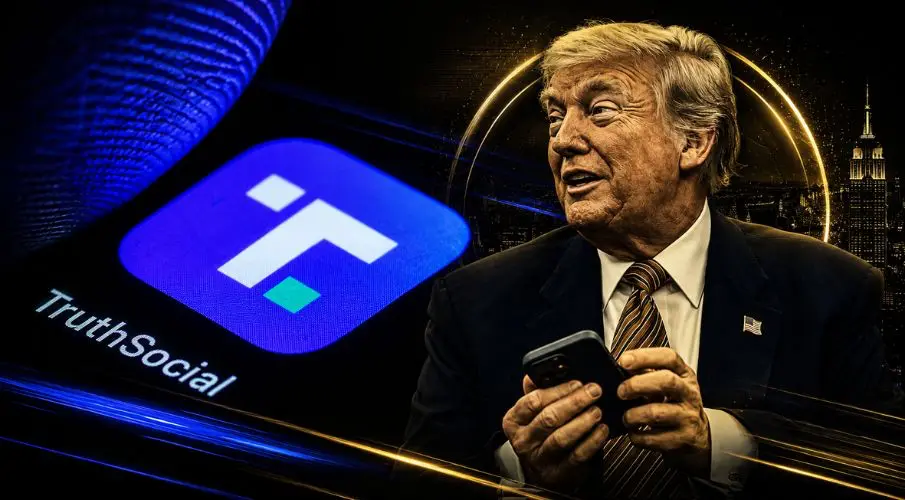
Since August 1, Donald Trump has put a price tag on his own influence. Pay $100,000 a month, and you get to know what the man in the White House is thinking a split second before the rest of the country does. The product is sold through his Truth Social platform, offering preferred access to the messages he calls "truths" and that routinely move financial markets. Those who pay get the information before ordinary Americans even have a chance to react, and in markets where milliseconds can mean millions of dollars, that is not a small advantage. It is the entire advantage. Customers willing to commit for multiple years get a discount, bringing the monthly cost down to $60,000. It is the first product the company has ever offered that promises to make real money, and what it is selling is the presidency itself.
There is no need to dress this up with polite language. A sitting President of the United States is selling insider information from the White House to professional traders and hedge funds, while personally pocketing the money. Everything else is simply decoration around that one sentence.

By now it has become standard practice inside this administration for senior officials to make major government announcements not through official press offices but through this platform. Market moving information from half the federal government now flows through a company owned by Trump himself. He controls the source, then sells access to that source to the very financial institutions and against the very citizens he is supposed to govern.
The Law That Stood in the Way
For nearly half a century, a president's official communications have belonged to the United States, not to the individual holding the office. The Presidential Records Act places everything a president creates or receives while in office under government ownership, with only narrow exceptions for national security matters and genuinely private materials such as a personal diary. Anyone who sells faster access to those records is selling property that does not belong to them. It belongs to the country. Trump knows that. His lawyers know that. That is why, earlier this year, the Justice Department's Office of Legal Counsel issued an opinion declaring this long accepted law unconstitutional. When reaching into the cash register becomes too obvious, he simply gets rid of the law that says he cannot.
An early modern political philosopher drew a strict distinction between the king's two bodies, the mortal body of the individual and the enduring body of the office, which belongs to the nation rather than to the person temporarily occupying it. Trump erases that distinction. The office once again belongs to the man so the man can sell it. A president is supposed to safeguard what has only been entrusted to him. This one takes inventory of his personal assets and adds the presidency to the list.
A Company That Is Worth Almost Nothing
Trump needs the money because the company itself is worth very little. He owns 41 percent of the parent company, after transferring his shares in December 2024 into a trust controlled by his son. At that time he held 52 percent, valued at roughly $4 billion when the company carried a market capitalization of $7.5 billion. Today his stake is worth only about $1.2 billion, yet it still represents roughly 18 percent of his estimated $6.5 billion fortune. The stock even trades under his own initials, turning vanity into a publicly listed asset.
The numbers beneath it are a disaster. In 2024 the platform generated just $3.6 million in revenue while losing more than $400 million. The following year revenue barely increased, reaching only $3.68 million, while losses climbed past $700 million. The company's market value has fallen to less than one quarter of what it was in the spring of 2024. Attempts to expand into prediction markets, launch its own digital currency while buying Bitcoin, and move into nuclear energy, perhaps inspired by an uncle who happened to be a physicist, produced nothing of substance. So Trump turned to the only asset that still had value, the office that does not belong to him. The deception sits in the fine print. The company insists its interface delivers posts exactly when they become publicly visible, not earlier. The wording is carefully crafted to deny the very thing it quietly admits. Anyone who does not pay does not receive the same information at the same speed as the paying hedge funds whose systems are connected directly to the data feed. That timing advantage is the entire product. Professional traders and investment funds get ahead of the market and capture profits ordinary investors never even have a chance to reach. The company calls it a service. What it really sells is an information advantage drawn directly from the center of political power, with the most powerful man in America acting as the salesman. Anyone who cannot afford $100,000 a month enters the game already designated as the loser.
Two senators, Adam Schiff and Elizabeth Warren, described it in a letter to the Securities and Exchange Commission as an extraordinary abuse of public office for personal gain that undermines ordinary investors and the integrity of the financial markets while enriching the wealthy. Others called it brazen corruption and the most desperate scam yet. Both descriptions are accurate, and both are still too polite. This is bribery with a published price list, hanging out in the open where nobody even bothers to hide it anymore because the person taking the bribe and the person collecting the money are one and the same.
The transaction becomes even more disgraceful when viewed alongside this administration's repeated habit of releasing information too early, by mistake, or at times even unlawfully, often through this very same platform. Trump is selling orderly access to information even though he cannot control the disorderly flow of that information himself. He is charging money for a promise he cannot actually guarantee. This presidency has rested from the very beginning on two pillars that reinforce one another, the collapse of a shared reality and the commercialization of whatever remains of it. There is no clearer image than the one before us now: a president placing a price tag on his own voice and making the republic stand in line at the checkout counter. What once belonged to everyone now belongs to whoever can afford to pay first. This is no longer a government. It is a marketplace, and the product for sale is the country.
Updates – Kaizen News Brief
All current curated daily updates can be found in the Kaizen News Brief.
To the Kaizen News Brief


Er greift in die Staatskasse.
Verkauft das Amt des Präsidenten.
Alles um sich selber zu bereichern.
In jedem noch demokratischen Land nennt man das illegalen Insiderhandel und Korruption.
Trump versteckt es nicht einmal.
Rainer weißt Du, ob schon Klagen eingereicht wurden?
Die „Abschaffung“ desGesetzes Bernhard ja nur auf der Aussage des Justizmjnisteriums, dass es „verfassungswidrig“ sei..
Nicht auf ein Urteil eines Gerichtes.