
There are phenomena that cannot be negotiated with. El Niño is one of them. No agreement, no summit, no well intentioned appeal to the reason of nations will stop the trade winds when they slow down or reverse, when warm water moves eastward across the tropical Pacific and redistributes the atmosphere over a planet that is already running a fever. The American weather agency NOAA has officially confirmed it: El Niño has begun. Meteorologists warn it could become the strongest event of this century. And anyone who still believes this is news for scientific journals has not understood what is at stake.
El Niño is not an exception. It is a cycle - a naturally recurring pattern that appears every two to seven years and reorganizes the climate of half the planet. South American fishermen named it after the Christ child because it became noticeable around Christmas. That this same child now serves as an apocalyptic symbol belongs among the ironies of a civilization that wages wars in holy names and freezes in feelings of technological triumph while the world burns around it.
Typically, El Niño begins in summer and reaches its peak in December or January of the following year. What that means: the worst impacts are still ahead. NOAA’s latest calculations show a high probability of a "very strong" El Niño event - average Pacific surface temperatures rising by more than two degrees Celsius. Some experts are already speaking of a "Super El Niño," even though the World Meteorological Organization rejects that language. Whether that is terminological precision or institutional caution toward its own judgment is another question.

The U.S. Weather and Ocean Agency NOAA has officially confirmed the return of an El Niño event that, according to current models, carries a 63 percent probability of developing into an exceptionally strong "Super El Niño" by the end of 2026. Because of the unusually rapid warming of the tropical Pacific, sea temperatures significantly above the long term average are expected, potentially creating one of the strongest El Niño cycles since modern measurements began in 1950. Researchers warn that this additional heat could intensify already human driven global warming and trigger new global temperature records by 2027 along with more floods, droughts, and wildfires worldwide.
Climate scientist Deepti Singh of Washington State University wrote a study about the El Niño event of 1877 - one of the strongest ever recorded. It was linked to historic droughts across Asia, parts of Brazil, and North Africa. Those droughts, intensified by colonial systems of exploitation, led to famines whose death toll is estimated at more than fifty million people. Fifty million. Numbers on that scale overwhelm moral imagination - not because they are too large, but because we have learned to think past them. Singh herself called that number "humbling." That is the right word. Humility is what is missing.

The last El Niño event occurred in 2023 and 2024 - one of the five strongest ever measured. It is considered partly responsible for the historic temperatures of 2024, the hottest year since records began. Across Sub Saharan Africa it intensified droughts that worsened food insecurity and malnutrition in multiple countries. Anyone who read that and forgot because there was no war on television at the time should hear this: it was a war. Just without uniforms and without an enemy that can be bombed.

Weston Anderson, a climate scientist at the University of Maryland, emphasizes that El Niño does not have uniform effects. It strikes "a diverse geography," he says - and that is exactly what makes this phenomenon so dangerous. In one region it brings devastating drought, in the next floods. Both extremes destroy harvests. Both destabilize societies. The difference from war is only that war has a beginning. El Niño does not. It has always been there, and it will always return, and this time it arrives on a planet whose atmosphere has already been loaded with additional heat and moisture by human caused climate change. What that means was stated clearly by Singh: we must expect the "severity, scale, and likelihood" of extreme weather events to increase in today’s warmer climate.

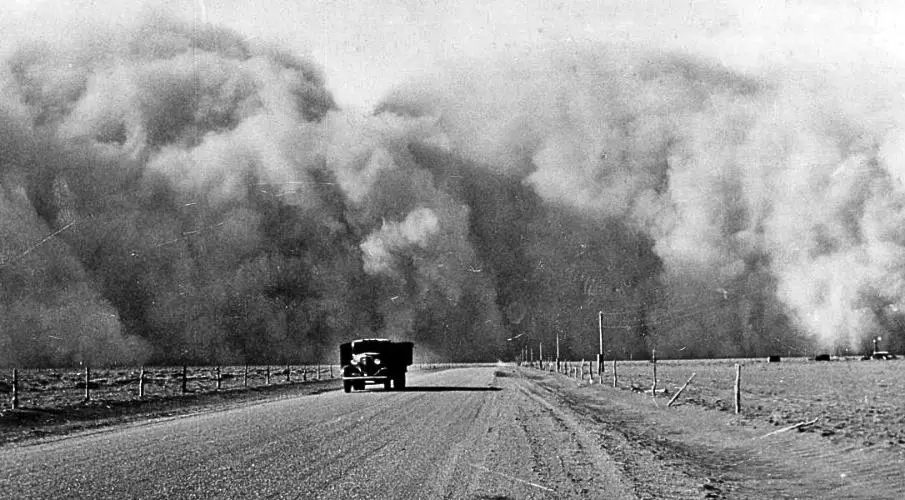
American agriculture is once again under pressure after several years of crisis: after inflation, high financing costs, Trump’s tariff policy, and the collapse of soybean exports to China, farms are now also being hit by higher diesel and fertilizer prices following the Iran war. At the same time, weather services warn of a potentially strong El Niño that could intensify drought in parts of the United States for years and trigger crop failures. AccuWeather even considers a scenario possible that resembles a weakened version of the historic Dust Bowl crisis, although experts explicitly do not forecast a repeat of the 1930s. Falling yields could increase food prices, place additional pressure on water reserves, and deepen the economic strain on farmers. Despite billion dollar support programs, bankruptcies continue to rise - family farm bankruptcies alone increased by 46 percent in 2025.
India, which produces most of the world’s rice, faces a weaker monsoon season - which will reduce harvest yields. South Africa faces drier and hotter conditions that threaten corn production. The southern United States, from California to the East Coast, is expected to become wetter than usual - with flood risks that may severely disrupt farming. Added to this are fertilizer shortages and rising prices that have affected farmers worldwide since spring, when the closure of the Strait of Hormuz during the Iran war disrupted global supply chains. This El Niño event is therefore not arriving in a political vacuum - it is hitting a world economy already straining under geopolitical fractures.
Jennifer Burney, professor at the Stanford Doerr School of Sustainability, points to a shift that often gets overlooked in food security debates. Local governments in vulnerable regions can adapt planting strategies, plant earlier in the season, increase imports - and ensure that "enough food" exists. But, Burney says, that will not "protect the people whose livelihoods depend on agriculture." A truth that politics conveniently forgets: this is not only about calories. It is about livelihoods. About dignity. About whether a farming family that has worked the same land for generations will still have a future after El Niño.

The highlighted area shows the tropical Pacific along the equator - exactly where El Niño develops. The red and pink regions mean that sea surface temperatures are significantly warmer than the long term average, in some places by several degrees. This additional heat is released into the atmosphere and can change weather patterns worldwide - bringing more flooding to some regions and more drought, heat, and wildfires to others. The stronger and longer this warming persists, the greater the risk of new global temperature records.
That is the philosophical burden of this phenomenon. El Niño forces us to think about time - about the inertia of natural systems, about the imbalance between human action and planetary reaction. The emissions that intensify this Super El Niño were released years ago, decades ago. The people who decided back then to burn coal and clear forests will not bear the consequences. Those consequences will be carried by farmers in Maharashtra, by herders in Malawi, by rice growers in Bangladesh, who globally bear the least responsibility for climate change. That is not rhetoric. It is the sober description of an injustice so structural that outrage barely reaches it anymore.

And science? It observes. It measures. It models. Exactly what this El Niño will trigger in interaction with human caused climate change - in which regions, with what intensity - remains, as researchers themselves admit, "important open science." That is honest. It is also frightening. Because it means: we know it will be bad. We just do not know exactly where. And we will know once it is too late to act - but early enough to understand afterward what we could have done. There is a kind of collective forgetting that societies develop toward slow disasters. One can simply call it "slow violence" - creeping violence that produces no headlines because it delivers no dramatic image. El Niño is slow violence with warning. It is a phenomenon that takes weeks and months to reach its peak, that reveals its worst consequences only after political attention has already moved elsewhere. It is a phenomenon that kills the poor, slowly and without spectacle, while the world talks about something else.
What remains is a bitter realization: we have the tools to understand these connections. We have the science, the models, the historical data. What we do not have is a political culture willing to act before the damage arrives. El Niño gives no speeches. It is already on its way.
Updates – Kaizen News Brief
All current curated daily updates can be found in the Kaizen News Brief.
To the Kaizen News Brief In English


Wenn der Mensch krank ist, fiebert er um die Viren loszuwerden.
Die Erde versucht wohl mit El Niño den Menschen loszuwerden. .
Wahrscheinlich das Beste, was dem Planeten passieren könnte, bevor wir ihn ganz zerstören.
Trump und Co, die AfD etc leugnen die Wissenschaft.
Leugnen den Klimawandel.
Und mit ihrer Politik befeuern sie die noch schnellere Zerstörung des Planeten Erde.
Die Schäden, die Trump bisher angerichtet hat, machen so viele Erfolge zunichte.
Und leider ziehen Andere nach.
Aber egal wie sehr sie den Klimawandel leugnen, egal wie sehr sie ihn als „woke Hirngespinnste“ bezeichnen.
Er ist real, er ist da und lässt sich nicht mit populistischen Parolen auslöschen.