
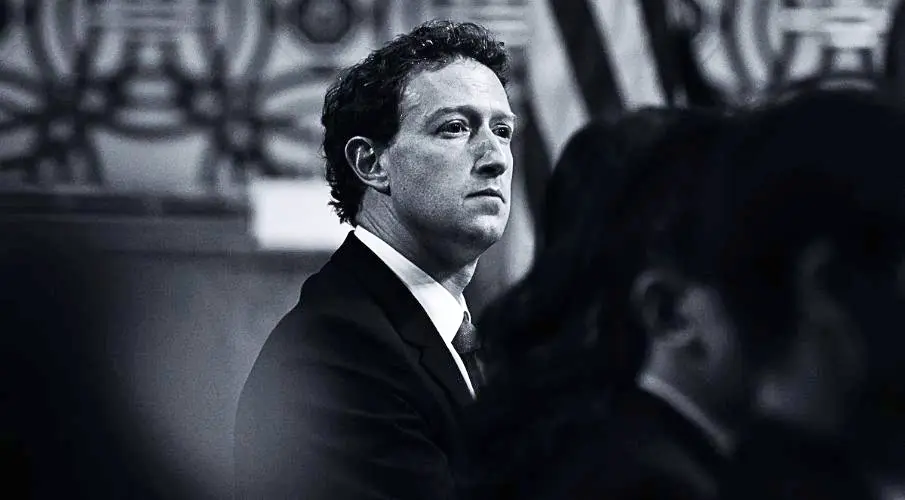
There is a certain kind of power that does not express itself through force but through patience. Mark Zuckerberg has perfected that patience. While other corporations conquer markets, he watches first - quietly, precisely, without urgency. He waits until behavior on the internet hardens into habit, until a platform proves that people are willing to give up time, money, and attention for something. Then he moves. And when he moves, three and a half billion people move with him.
This week, Zuckerberg moved on two fronts at once. First, Meta announced that it would invest nine hundred million dollars in the Indian fintech company Cred and acquire a twenty percent stake. Cred, based in Bengaluru, rewards users who pay their credit card bills on time - a simple business model that has found fertile ground in India. Cred founder and chief executive Kunal Shah will join Meta as part of the transaction and take over global leadership of WhatsApp. India is WhatsApp’s largest market, with more than five hundred million users. The question Zuckerberg is asking is not how to get more Indians onto WhatsApp. The question is: how do you get them to do more on WhatsApp?
The answer is the super app. The concept has long been proven in Asia - WeChat in China, Grab in Southeast Asia, Paytm in India. A single platform where people communicate, pay, shop, book, and invest. The Western technology company that has so far failed to replicate this model is Meta. The acquisition of Cred is the clearest attempt yet to change that - and India, with its young population, growing digital middle class, and structural lack of traditional banking services, is the obvious place to try. Nine hundred million dollars for twenty percent of an Indian fintech company is not an expensive hiring decision. It is a territorial acquisition.

At the same time, Zuckerberg has discovered prediction markets. Internally, the new product carries the name “Arena” - a word that carries no innocence. In the arena, people fight. In the arena, people lose. In the arena, someone watches and profits from the fact that others are fighting. The app is intended to operate independently from Facebook, Instagram, WhatsApp, and Messenger - a standalone competitive space that would nevertheless be fed by Meta’s enormous user base. At first, according to reports from inside the company, the system will rely on points similar to a video game. Real money is reportedly not planned for now. For now.
Polymarket and Kalshi, currently the dominant prediction markets, recorded fifty billion dollars in online betting volume combined in 2025. This year, that volume has already surpassed one hundred thirty billion dollars. What was once considered a niche phenomenon of the cryptocurrency world has long become mainstream: prediction markets now appear during Super Bowl broadcasts, were integrated into the Golden Globes broadcast, and traditional gambling providers such as FanDuel and DraftKings have begun offering their own versions. Even Trump Media & Technology Group has announced plans for its own prediction market - which, if one pauses for a second, says quite a lot about the condition of American democracy.
Zuckerberg is late, but not for the first time. His career pattern resembles that of a predator waiting for the right moment. He copied Snapchat and turned it into Instagram Stories. He watched TikTok and introduced Reels. He watched Twitter and built Threads. In 2020, Meta already attempted once to establish a prediction market: the app “Forecast” was intended to gather collective knowledge during the early weeks of the Covid pandemic. It was shut down in 2022. Now comes the second attempt - and this time with a company that holds five times as much user data as it did back then. Prediction markets are now viewed by some as an epistemic tool - a method of generating more reliable assessments of the future through collective betting than through expert advice or opinion polling. The idea goes back to Hayek, to the question of whether markets aggregate information more efficiently than centralized planning. What is new is the scale. And with scale comes the problem.
In April of this year, prosecutors in New York City charged a member of U.S. special operations forces. The allegation: he used classified intelligence about a planned operation to detain Venezuelan President Nicolás Maduro to place bets on Polymarket - earning more than four hundred thousand dollars in the process. On Polymarket, a pattern of suspicious trading activity ahead of major political events has emerged that investigators in Washington have been examining for months. Whoever possesses insider information can turn it into wagers. Whoever places wagers moves markets. Whoever moves markets may influence perceptions of reality. Oversight of these markets falls to the Commodity Futures Trading Commission - an agency that, under the Trump administration, has shrunk to its smallest staffing level in years while its responsibilities have grown exponentially. This is not negligence. It is intent. Markets are created, oversight is withdrawn from them at the same time, and when something goes wrong, people speak of unforeseen consequences.
Senator Richard Blumenthal of Connecticut put it plainly: Meta copied slot machines to make children addicted to Instagram and is now transforming its business into a prediction market. He called Meta’s business model “profiting from addiction.” Blumenthal is not exaggerating. He is describing.
Walter Benjamin wrote about the transformation of the world into one endless exhibition of things available for purchase. What Zuckerberg is building is the digital equivalent - a passage where products are not displayed but futures. You do not buy products. You buy versions of reality that have not yet happened and pay with time, data, and emotional energy. In India, people may soon also pay with their credit limits. The market of the future is the last market left to conquer - because the past cannot be changed and the present moves too quickly to be fully monetized. What remains is the question that follows every new Meta product and that nobody publicly dares to ask: Who benefits when three and a half billion people begin betting on the future - and five hundred million Indians also pay their bills through the same platform? The people? Or the man who owns the arena?
Updates – Kaizen News Brief
All current curated daily updates can be found in the Kaizen News Brief.
To the Kaizen News Brief In English


Die Frage ist schnell beantwortet.
Sie nutzt dem Mann, der die „Arena“ besitzt.
Wetten auf die Zukunft.
Wie absurd.
Anstatt Millionen dort zu verpulvern oder eigene Gewinne zu maximize, sollte man lieber direkt in die Zukunft investieren.
Erneuerbare Energie, Nachhaltigkeit, Umweltschutz….
Zuckerberg will noch reicher und mächtiger werden.
In der Hoffnung damit noch unantastbarer zu werden.
Und um Musk als reichstem Mann der Welt den Rang abzulaufen.
…einfach nur noch krank …