
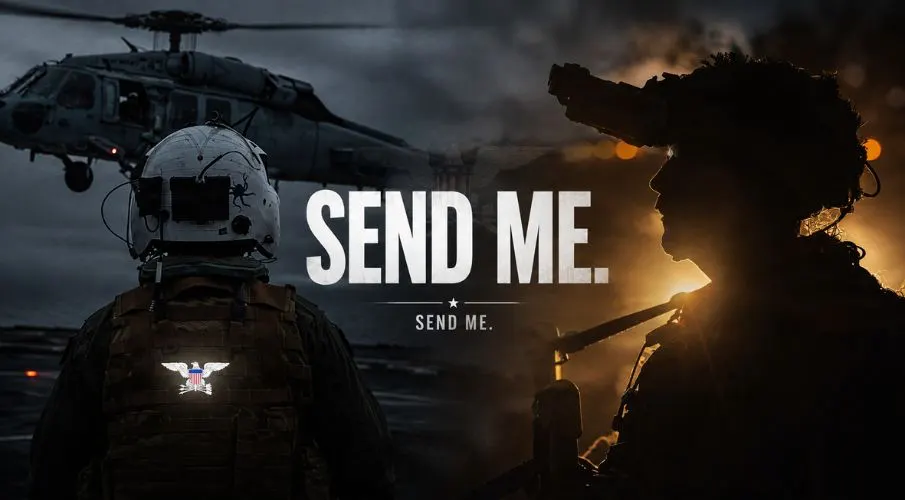
A soldier, black against a dark sky, with two words above him in capital letters: SEND ME. On Saturday, two accounts belonging to the U.S. Department of Defense posted this image online, while another showed a soldier in front of an aircraft carrier, with a helicopter above him. The department’s top spokesman, Sean Parnell, added the verse Isaiah 6:8. The department’s official account, which now calls itself the Department of War, amplified both messages. It happened in a week when senior military officers warned behind closed doors that the war against Iran was overstretching U.S. forces and draining missile defenses to the point that the Navy no longer had the means to keep protecting Israel.
The verse comes from the Book of Isaiah in the Old Testament. God asks whom he should send, and the prophet answers: Here I am, send me. In many Christian circles, the line is understood as an acceptance of a divine calling, spoken at mission gatherings and ordinations. Read the passage to the end and it becomes disturbing. God sends Isaiah out to proclaim judgment, at the end of which cities stand without inhabitants, houses without people, a land completely devastated, before renewal eventually comes.

But the destruction in this chapter does not strike a foreign enemy. It strikes God’s own covenant people, as religious historian Jemar Tisby points out. The nation doing the sending is the one being addressed. In American Christianity, he says, the verse is used almost entirely as a missionary line, detached from what comes after it.
The department left open what the two posts were supposed to mean. Whether they were statements of faith or promotion of faith, a message aimed at Iran or part of a coordinated line, a spokesman said the department had nothing to add. The silence has a history. Under Secretary Pete Hegseth, the department has been fighting for months over the place of religion. In the spring, it became known that more than 100 service members had complained that superiors had described the war against Iran as part of God’s plan and encouraged them to view it through a biblical lens. That same spring, the appointment of Christian activist Erika Kirk, Charlie Kirk’s widow, to the Air Force Academy board prompted former military officers and constitutional lawyers to warn against an education shaped by ideology.

Tisby sees a larger project behind it. Hegseth, he says, is under the influence of preacher Douglas Wilson and has introduced worship services at the Pentagon; taken together, it fits an effort to bring a narrow interpretation of Christianity into the military and the state. There is a precedent. Under George W. Bush, the same verse, Isaiah 6:8, appeared on intelligence briefings presented to Defense Secretary Donald Rumsfeld during the Iraq War. When that became public in 2009, there was an outcry and the administration backed away. This time, Tisby says, the administration is leaning into it.
What is new is the level at which this is happening. In the past, individual commanders or appointees drew attention. Now several official accounts are carrying the same verse, and the department will not explain why. That is not automatically unconstitutional. The First Amendment bars the government from favoring one religion, but old formulas such as In God We Trust or the phrase God save this honorable Court, traditionally used before the Supreme Court, have remained permissible. Legal scholar Nelson Tebbe says the constitutional problem is closer here because this is not a general religious phrase, but a specific Bible verse that has a more immediate effect on service members. Even so, he says a court is unlikely to strike it down after the Supreme Court weakened restrictions on this kind of religious expression in government speech.
Religious studies scholar Jonathan Ebel says what is especially troubling is the merging of divine calling and military service into one thing. It diminishes the military through openly Christian rhetoric and alienates non-Christian service members. The sharpest warning comes from Rachel VanLandingham, a former Air Force military judge. Waving Bible verses around this way, she says, implies a religious war against Iran and in doing so validates Iranian propaganda claiming that the Great Satan is fighting Islam. Tehran has called the United States that since the Islamic Revolution of 1979. Honor and fidelity to the law are what hold the American military together, not a verse from the Old Testament.
What remains is the verse itself, read all the way through. It does not send the prophet against an enemy. It sends him to a people whose cities end up standing empty. Anyone who places a war under God’s command strips away the limits that make war bearable. Two powers calling each other Satan have already lost those limits.
Updates – Kaizen News Brief
All current curated daily updates can be found in the Kaizen News Brief.
To the Kaizen News Brief


MAGA ist bekannt dafür, dass sie Bibelverse nur halb, aus dem Kontext oder ganz verdreht nutzen.
Oder Pulp Fiction anstatt die Bibel zitieren.
Hegseths Traum ist eine weiße und christliche Armee.
Den Traum lebte schon einmal Jemand. Hitler mit seiner Arierarmee.
Als Atheist, Farbiger, Muslim, Frau, Homo würde ich mich in dieser Armee nicht wohl fühlen.
Es wird nicht passieren, aber wenn all die o.g. die Armee auf einmal verlassen würden…. was bliebe?
Ein armselig kleiner Haufen. Weder in der Lage die USA zu verteidigen noch außerhalb tätig zu sein.
Weder Proud Boys etc würden sich dem Drill der Armee unterzuehen und sich in fremden Ländern für einen unsinnigen Krieg töten lassen.
… es ist einfach nur lächerlich, was da mittlerweile abläuft