
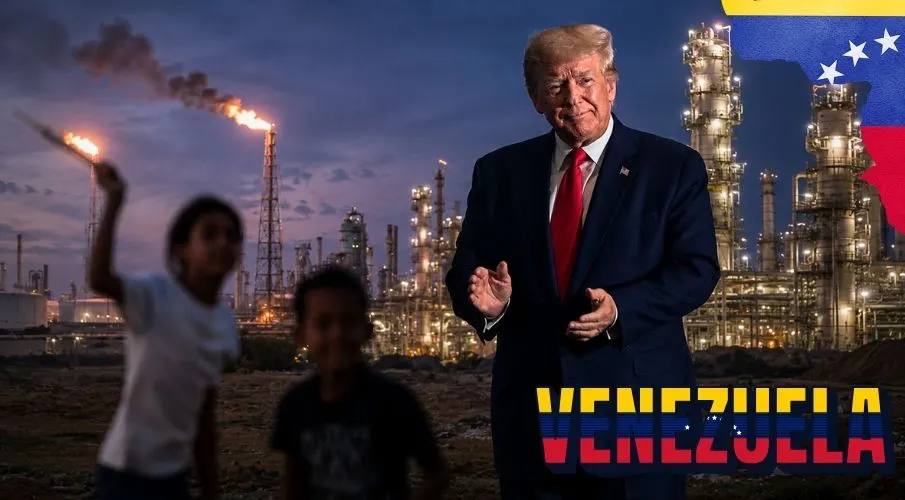
On Friday night, Donald Trump announced on social media what he called "THE BIGGEST OIL DEAL IN WORLD HISTORY." Behind the capital letters is a simple transaction: The U.S. government is reaching for another country's oil and having that grab signed off as an agreement. Washington is taking a 35 percent passive stake in North American Blue Energy Partners, a private company set to receive 100-year rights to 17 Venezuelan oil fields holding around 65 billion barrels, roughly one-fifth of the country's reserves. One country puts its hand on another country's soil and calls it a business deal.

The oil was taken in stages. In January, U.S. forces removed then-President Nicolás Maduro from the country in an overnight operation and brought him to New York, where he now faces drug charges. His former vice president, Delcy Rodríguez, took his place, unelected and kept in power with Trump's backing, praised by him as "fantastic." A few days before the announcement, the two agreed on the basic terms over the phone. A government nobody elected is giving away something it has no authority to give away.

The insidious part lies in how it was built. The deal is deliberately being run through a private company to bind future Venezuelan governments as well and make it harder to unwind; the people involved are counting on a new government being reluctant to expropriate a private business. That is how the grip is supposed to survive every election. The company is led by Alejandro Betancourt, who was investigated in Spain and Switzerland over alleged money laundering without ever being formally charged, and whose company rose within two years to become Venezuela's second-largest private oil producer after Chevron.
The stake is being paid for with next to nothing. The Pentagon's Office of Strategic Capital plans to book the investment through warrants at a symbolic price, effectively giving Washington the shares almost for free. The State Department negotiated the whole thing, with the Pentagon brought in only late in the process. Its director, David Lorch, traveled to Caracas in July; Trump named Secretary of State Marco Rubio and War Secretary Pete Hegseth as his negotiators. Ultimately, the Defense Department will hold the stake and the purchase rights. The United States is securing a 35 percent passive stake in the company and, on top of that, preferential rights to buy 20 percent of its production at cost. The oil is intended for the Strategic Petroleum Reserve and the military. According to U.S. officials, the government-backed company would therefore become the world's second-largest corporate holder of proven reserves after Saudi Aramco. Rubio is celebrating it as a huge win that will lower gas prices.

This is exactly where power contradicts itself. Asked about it, Pentagon spokesman Sean Parnell said the Office of Strategic Capital does not take stakes in private companies; its authority extends only to loans and loan guarantees, not ownership in a company. The law governing the office, 10 U.S.C. 149, confirms that limit, and simply producing crude oil does not clearly fall among the strategic sectors it is authorized to support. The office, created in 2022 and only beginning to issue loans under Trump's second administration, would be moving far beyond its mandate in this role. One energy economist therefore asked why the United States was using government money to build a future competitor to its own oil industry. A structure whose own executor denies having the authority to build it already carries the doubt in its foundation.
Venezuela's constitution stands in the way as well. Article 12 declares the country's oil reserves the inalienable property of the Republic, Article 113 allows only time-limited concessions in exchange for adequate compensation, and a new law passed in January 2026 opened the sector to private and foreign operators. The sharp question is whether 100 years of production and purchase rights still qualify as a concession or whether, economically, they amount to the prohibited transfer of the reserves. The text of the agreement that would allow anyone to examine that question still has not been released. People are talking about 65 billion barrels and a military stake while the actual document remains hidden.
The criticism came quickly and hard. Former minister Diego Arria, now living in exile, called the deal a completely unconstitutional operation. Harvard economist Ricardo Hausmann, once Venezuela's planning minister, called it a shameful deal that would not last because no major oil company would take it seriously. In the Senate, Tim Kaine accused the president of corruption on an epic scale, while Chris Van Hollen said Trump had put service members in danger to get oil for his billionaire buddies. Rodríguez is promising her country more than $100 billion in investment and more than $209 billion in taxes while insisting that ownership and sovereignty remain untouched. Trump's Senate allies, including Bernie Moreno, are praising it as a historic success. At a market, one citizen reduced the whole thing to a simpler formula: oil in exchange for the right to stay in power.
But the price at the pump follows arithmetic, not announcements. Venezuela currently produces around 1.25 million barrels a day, roughly as much as the state of North Dakota. The agreement is supposed to raise that initially to around 1.5 million, a little more than 250,000 additional barrels on a global market of more than 100 million. Rebuilding Venezuela's collapsed production will take years and cost billions. Major U.S. oil companies ExxonMobil and ConocoPhillips stayed on the sidelines despite all the pressure, while Chevron, the only U.S. company still producing there, declined to comment. In better years, Venezuela produced more than 2.5 million barrels a day above today's level, but volumes like that do not come back overnight. The average U.S. gas price stood at $4.08 a gallon on Saturday, compared with $3.20 a year earlier, driven higher by Trump's war with Iran. What remains of the promised quick relief is a number that helps nobody.
European governments have little political or economic interest in openly confronting Trump over this deal. Europe is heavily dependent on the United States for security, European energy companies are themselves active in Venezuela, and many deals there still depend on the U.S. sanctions regime. At the same time, strong criticism would immediately raise the question of why Europe talks about sovereignty and international law when it comes to Russia, China, or other countries, yet is considerably quieter here.
On top of that, Washington is giving itself a strategic advantage over one of the world's largest oil reserves. Europe should actually be watching very closely, because it could end up paying higher world-market prices while the United States secures preferential access.
That is why the silence is, above all, politically convenient.
For Europe, the danger lies one level deeper. In July, around 786,000 barrels of Venezuelan oil were already flowing to the United States every day, compared with only about 82,200 to Europe, down from roughly 99,000. If Washington gets preferential access at cost in the future, barrels that otherwise might have gone to Spain or Italy will cross the Atlantic first. In an already tight market, with diesel in short supply and refinery output almost 2 million barrels below demand, that intensifies the race for what is left. America buys cheap, Europe pays the world-market price, and Trump also wants to funnel the secured oil into the Strategic Petroleum Reserve.

That is how the picture comes together. A deposed president sits in a cell in New York, while his unelected successor gives away what does not belong to her. The military becomes a shareholder in defiance of its own law, and nobody is allowed to read the agreement against which all of this could be measured. In Caracas, people took to the streets against the deal while Trump calls it the biggest in history. Diego Arria's words are more precise: They're simply taking it.
Updates – Kaizen News Brief
Alle aktuellen ausgesuchten Tagesmeldungen findet ihr in den Kaizen Kurznachrichten.
To the Kaizen News Brief In English


