
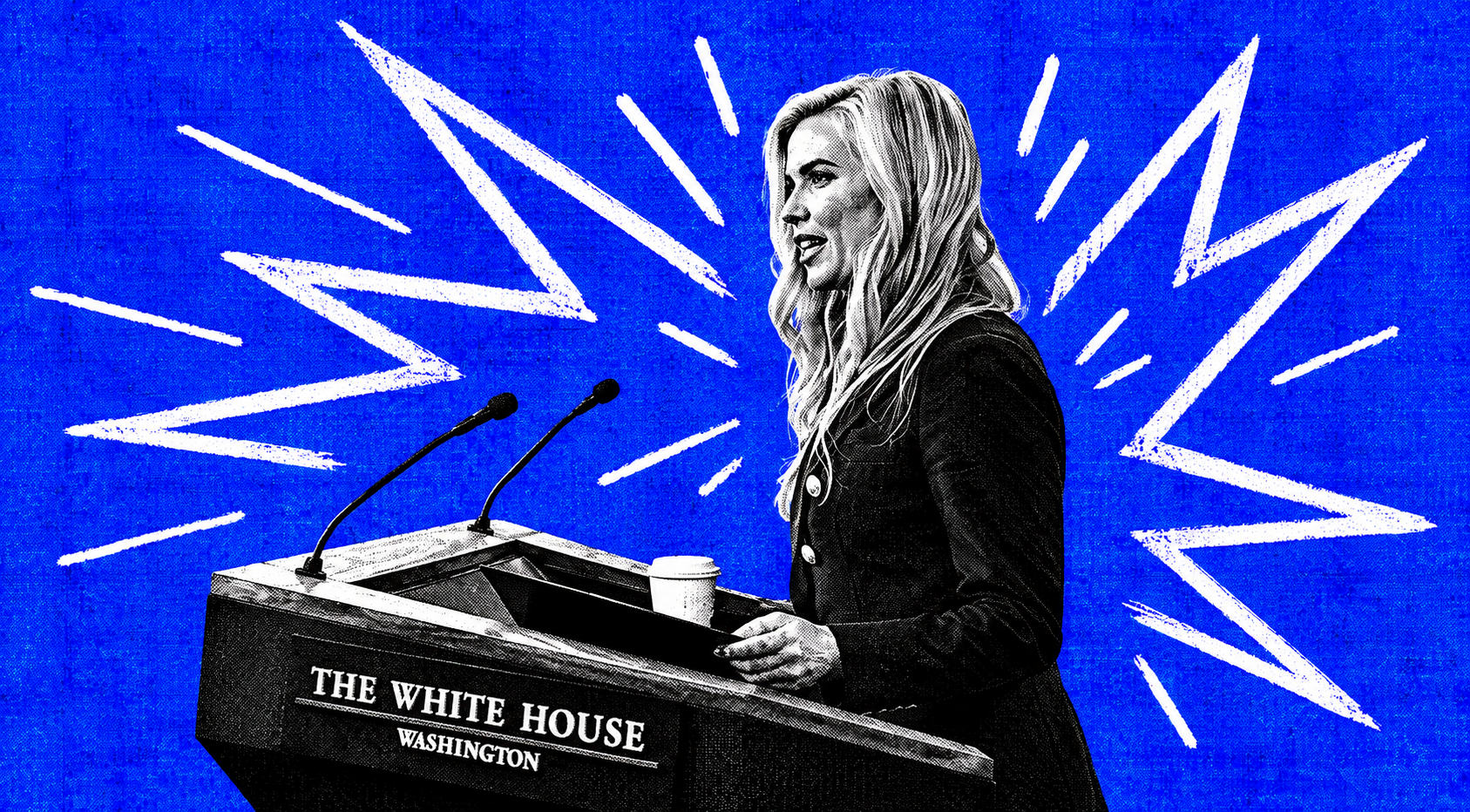
Katie Zacharia has a law degree. What nobody has been able to establish so far is whether she's licensed to practice law in the United States. Of all people, the White House's new press secretary, whose job is to answer questions, has been facing a question since her very first day that could be settled with a single document: Which state admitted her to the bar? The White House keeps offering explanations. A license to practice law is still nowhere to be found.
On Tuesday, October 13, Zacharia appeared before the White House press corps for the first time. She announced that Kimberly Guilfoyle had been asked to resign as U.S. ambassador to Greece. Donald Trump praised her performance afterward. He said he thought she was very good. On his way to his helicopter, however, he faced a less pleasant question. A reporter wanted to know which state Zacharia had passed the bar exam in. Trump stepped aside so she could answer for herself. The audio is muffled. She appears to say, "When I moved to China." Moving to Beijing, however, is no substitute for a license to practice law in the United States.
A reporter asks Trump's new press secretary, Katie Zacharia, which state she passed the bar exam in after Trump introduced her as "an attorney."
She appears to say: "When I moved to China."
During 18 television appearances, she reportedly cited her credentials as a lawyer. She also described herself that way on social media. A separate journalistic review found no current or expired U.S. bar admission under either her name or her maiden name, Black. The absence of a bar registration doesn't prove deliberate deception. But for someone who has so publicly presented her professional qualifications, identifying the state where she was admitted to practice law should be an easy question to answer.
Zacharia earned her bachelor's degree from Pepperdine University in 2007 and her law degree in 2011. The university confirmed both degrees. From 2011 to 2013, according to her professional résumé, she worked on the international practice team at the Zhong Lun law firm in Beijing. Her only other listed legal position was as general counsel at Fix California, an organization founded by Richard Grenell, from 2024 to 2025. Grenell is now part of the Trump administration. Neither organization responded to requests for comment. The White House said Zacharia had handled international legal transactions in China and possessed all the necessary qualifications to do so. It still provided no evidence that she was licensed to practice law in the United States.

Stephen Gillers, a law professor at New York University, made the crucial distinction unmistakably clear: A law degree alone does not make someone a lawyer. Bruce Green of Fordham University confirmed that only formal admission to practice law grants someone that status. In most U.S. states, that requires passing a bar exam and undergoing a character and fitness review. A university diploma certifies knowledge. A professional license allows someone to use that knowledge under a legally protected professional title. The distance between those 2 documents can span an entire career.
Leonard Niehoff of the University of Michigan warned of potential legal consequences. Many states prohibit the unauthorized practice of law, including falsely claiming to hold the necessary license, particularly when financial interests are involved. Green pointed out that even a possible foreign license would not justify misleading statements to an American audience. Anyone who simply calls themselves a lawyer in the United States without further explanation creates the impression that they're authorized to practice law there.
What the Records Establish and Which Questions Remain Unanswered
Central to the review is the official statement issued by the State Bar of California on October 13, 2026. The agency checked the names Kate Sharon Zacharia, Kate Sharon Black, and Katie and confirmed that it had no record of her being licensed to practice law in California. As the legal basis, it explicitly cited Section 6126 of the California Business and Professions Code. Among other things, that provision prohibits anyone without the necessary authorization from representing themselves as entitled to practice law. The statement does not establish that Zacharia personally violated this provision.
A review of other American bar directories also failed to produce any documented admission record. There is, however, a distinction between the absence of a publicly available record and definitive proof that a license was never issued. The information needed for a conclusive verification would be the state of admission, the admission date, and the registration number. So far, the White House has not released that information.
Another issue concerns Zacharia's employment at the Zhong Lun law firm in Beijing. Under the Chinese licensing rules explained by Donald Clarke and Lester Ross, foreign legal professionals can work there without being admitted to the Chinese bar themselves. Such employment does not establish admission to practice law in the United States. The White House's claim that Zacharia possessed all the necessary qualifications for her work at the time therefore still does not answer the question of whether she holds an American law license.
According to public records, Zacharia lives in California. The state bar explicitly confirmed that it had no record of a license for either Kate Sharon Zacharia or her maiden name, Kate Sharon Black. There was no record under Katie, either. The bar cited Section 6126 of California's professional licensing laws, which prohibits falsely holding oneself out as authorized to practice law. Whether Zacharia's specific statements constitute a violation of the law has not yet been established. The official statement does, however, remove any doubt that the California bar has no record of her ever being admitted to practice law in the state.
Her work in China doesn't explain the missing American license, either. Donald Clarke, a professor of Chinese law at George Washington University, made clear that Zacharia could not have taken the Chinese bar exam as a foreign national in the first place. The exam is restricted to Chinese citizens. Law firms such as Zhong Lun are allowed to employ foreign nationals. That employment, however, does not entitle them to represent clients in Chinese courts. Lester Ross of WilmerHale confirmed that foreign legal professionals who are licensed in another jurisdiction may practice the law of that jurisdiction in China and explain Chinese law. They are not permitted to practice Chinese law as attorneys.

Read also our article: Trump's New Spokeswoman Claimed the Abortion Pill Came From the Nazis' Gas Chambers
Trump has already given his new press secretary a glowing review. The legal experts are asking for something a little less ceremonial: verifiable authorization to practice law. Zacharia's university degrees are confirmed, and her professional positions appear on her résumé. Yet nobody has been able to establish the American law license her public descriptions of herself would lead people to believe she holds. A president can praise his press secretary as often as he likes. The state bar associations maintain their records regardless.
Updates – Kaizen News Brief
Alle aktuellen ausgesuchten Tagesmeldungen findet ihr in den Kaizen Kurznachrichten.
To the Kaizen News Brief In English


