
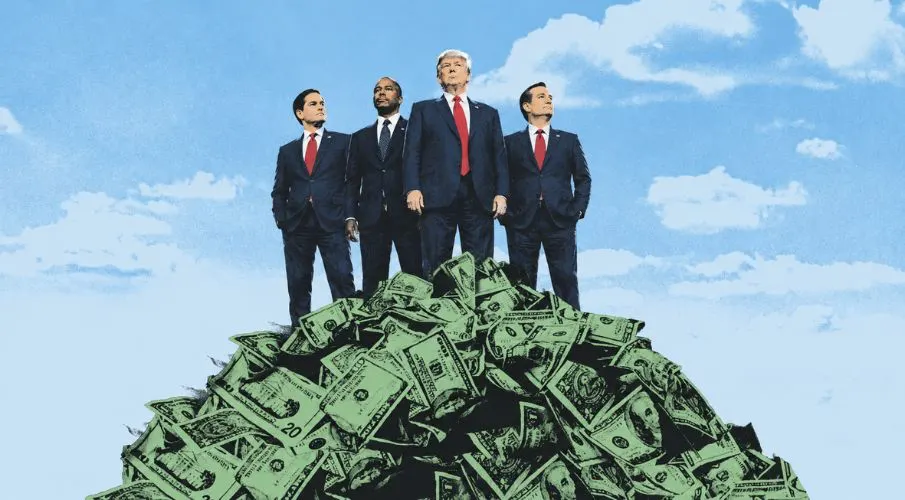
Three weeks before the U.S. midterm elections, Republicans are starting to pull campaign money out of districts that have been fiercely contested until now. The Congressional Leadership Fund, the biggest major Republican campaign organization for the House of Representatives, is canceling its advertising spending in 4 districts. At the same time, 16 other campaigns between Texas and Pennsylvania are getting additional funding. The decision says a lot about the party's troubles. Money is going wherever a seat still looks salvageable. Other candidates are left to fend for themselves. Republican campaign strategist Stu Sandler puts it plainly: You can tell where the parties are still seriously competing by following the money.
The situation in Iowa is particularly bitter. In the 1st Congressional District, Republican Rep. Mariannette Miller-Meeks is losing further advertising support from the organization. Her Democratic challenger, Christina Bohannan, is running against her for the 3rd time. Just 799 votes separated them in the last election. Medicaid cuts are putting pressure on health care in the region, while farmers are struggling with high diesel prices. Spending is also being cut off in New Jersey's 7th District. There, Tom Kean is fighting to hold his seat against Rebecca Bennett. Kean was absent from Congress for 4 months and only disclosed a mental health crisis after returning. He has also faced criticism over his support for Trump's tariff policies and the war with Iran. Just 2 years ago, he won by 5.4 percentage points.

How campaign money is now moving rapidly between individual congressional districts, and what that says about the political landscape less than 4 weeks before the election. One Republican campaign strategist summed it up: "Fires everywhere."
Together with districts near Cincinnati, Ohio, and in eastern Michigan, these 4 races had already consumed $13.3 million, more than 12 percent of the organization's spending so far. From now on, the focus will be on reinforcing districts Trump won by narrow margins in 2024. Expectations are being scaled back even around Las Vegas. A Trump-aligned organization canceled nearly $1 million in advertising for Marty O'Donnell, who is trying to defeat Democrat Susie Lee. Republicans had hoped Trump's tax exemption for tips would win over voters, especially in Las Vegas. Conservative politician David McIntosh now acknowledges that the economy is in bad shape, many voters are dissatisfied, and enthusiasm has faded. The failure to pass Trump's SAVE America Act has also disappointed the party's own supporters. Money certainly isn't the problem. According to Sandler, Republicans have never been this well-funded in a midterm election. What's disappearing is their confidence that all that money can actually deliver victories.
Democrats Suddenly Discover Districts They Had Long Since Written Off
As Republicans redistribute their campaign support, Democrats are trying to turn their opponents' difficulties into additional seats. Their House campaign organization now considers at least 12 more districts within reach, even though winning them seemed almost impossible at the beginning of the year. But they need money to make it happen. The goal is to raise $17 million by October 22 to finance another round of television advertising just before the election. The math is simple: The more districts Republicans have to defend, the more thinly their enormous campaign budget gets spread. What began as hopes for a few isolated surprises has turned into a much larger offensive. According to Democrats, that could mean winning at least 6 additional seats.
This effort is particularly clear in Ohio's 10th Congressional District. Republican Mike Turner, a former mayor of Dayton, has held the seat for 12 terms. He won by 18 percentage points just 2 years ago. Trump, however, carried the district by only 6 points in 2024. Democrats now believe Turner is vulnerable. Another striking detail is that he didn't start running television ads until late September, later than many other incumbents in competitive districts. The Republican campaign committee only began airing additional ads there this week. Apparently, even Turner's decades of experience in Congress can no longer protect him from suddenly having to fight for his seat.
If the fundraising drive succeeds, Democrats also plan to advertise in the Miami area, the suburbs of St. Louis, and around Little Rock, Arkansas. A Supreme Court decision in June makes it easier for them to put that money to work. The party can buy advertising jointly with candidates at the lower rates normally reserved for the campaigns themselves. Courtney Rice, communications director for the Democratic campaign committee, makes clear that the $17 million is needed to pursue additional opportunities. The campaigns already underway to reach the 218 seats needed for a majority are separate from that effort. That distinction alone shows how far expectations have changed in just a few months. Districts that hardly anyone wanted to invest money in before are suddenly attracting attention. Whether those investments actually translate into seats will be decided by voters on November 3.
Trump Won Nebraska by More Than 20 Points. Now Republicans Have to Send $15 Million to Defend It

Republican Representatives Tom Kean of New Jersey and Mariannette Miller-Meeks of Iowa are losing crucial financial campaign support as their electoral prospects worsen. Right: Don Bacon of Nebraska, who is not running for reelection in 2026.
Nebraska had long been one of the states where Republican senators could run relatively relaxed campaigns. Donald Trump won there in 2024 by more than 20 percentage points. Now, of all places, millions of dollars are being mobilized in that very state to protect Senator Pete Ricketts from defeat. His challenger is independent candidate Dan Osborn, who has Democratic backing. The Senate Leadership Fund, the major campaign organization aligned with Republican Senate leadership, announced a $15 million investment on Tuesday. That's the kind of money usually spent where control of the majority is genuinely at stake. Until recently, Nebraska was nowhere near that category.
Another $7 million is coming from the cryptocurrency industry, according to advertising spending reports. Fairshake, the group financed by that industry, has also decided to influence the race in Nebraska. At the same time, it increased its investment in Ohio's Senate race to a total of $45 million. There, Republican Senator Jon Husted is running against former Democratic Senator Sherrod Brown. Political convictions are being promoted in these campaigns with sums of money that could pay for hospitals elsewhere. Yet even that kind of spending doesn't guarantee a single additional voter.
Nebraska is hardly alone in this development. Kansas and South Carolina are also receiving additional support from organizations aligned with Republican Senate leadership. Trump won both states by double-digit margins in 2024. Neither state, nor Nebraska, was even included in the original $342 million advertising plan announced in April. Back then, Republicans were focused primarily on Georgia and North Carolina, where they wanted to capture Democratic seats. That plan has since been fundamentally rewritten. Money is being pulled out of earlier offensive targets and redirected toward defending supposedly safe Republican seats. The fact that a party has to spend such enormous sums in states its own president won comfortably says plenty about the uncertainty among its campaign strategists. The results of past elections are still there in the record books. It's the present the party has to pay for.
$342 Million and Still No Peace of Mind: The Fight for the U.S. Senate Keeps Getting More Expensive for Republicans

Back in April, Republican Senate leaders had built their campaign strategy around capturing Democratic seats. Georgia and North Carolina were among their most important targets. With only a few weeks left before the election, the distribution of campaign money looks very different. Republican organizations are investing additional millions in Kansas and South Carolina, even though Donald Trump won both states comfortably in 2024. Nebraska is now becoming expensive to defend as well. The original $342 million advertising plan has been reworked accordingly. The fact that Republican donors are rearranging their spending so late in the race shows just how little confidence remains in their earlier assessments.
Democrats are changing their strategy, too. Their main Senate campaign organization pulled advertising out of Georgia last week. There, Democratic Senator Jon Ossoff has a substantial fundraising advantage over his Republican challenger, Mike Collins. The money freed up is supposed to benefit other campaigns. Maine, New Hampshire, and Michigan are getting particular attention. So are Iowa and Kansas, along with Texas, Alaska, and Ohio. Democrats want to direct their resources wherever they see additional opportunities. While Republicans invest in places they previously considered safe, their opponents are looking for more targets to challenge. Both sides are finding that their decisions now come with an increasingly hefty price tag.
Senate Democratic Minority Leader Chuck Schumer put a question to his fellow senators on Tuesday that captures the campaign rather well. Would the unprecedented flood of Republican campaign money overcome what he described as the Democrats' advantage in candidates and policy positions? His assessment of the political climate is, of course, that of a man trying to lead his own party to a majority. But the financial decisions offer an unusually revealing look at the concerns on both sides. Republicans have enormous resources, yet they now have to protect congressional districts and Senate seats that long seemed secure. Democrats, meanwhile, are discovering additional opportunities but urgently need more donations to pursue them. Three weeks before the vote, decisions are already being made about which candidates will even have enough money left to reach their voters. The votes will be counted on November 3. Until then, the campaign organizations will be counting their millions.
Updates – Kaizen News Brief
Alle aktuellen ausgesuchten Tagesmeldungen findet ihr in den Kaizen Kurznachrichten.
To the Kaizen News Brief In English


