
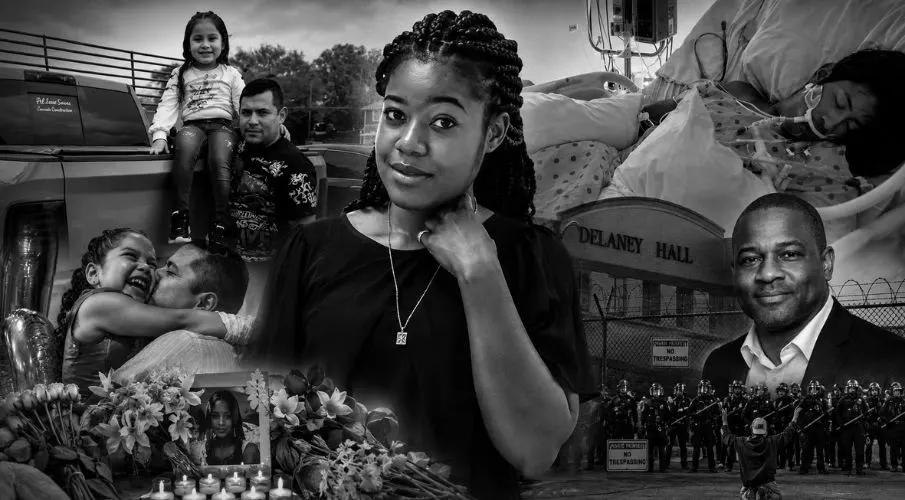
The vehicles pull up at the corner of 8th Street and Minnesota Avenue, and Elmer Omar Guevara Martines runs. He runs before he even has time to think about it, a house painter on his day off, with a few errands on his mind and raw fear in his legs. His shoes pound against the pavement while two men close the distance behind him. Someone yells for him to stop, but his legs refuse to obey. Glass shatters. Then he is lying on the pavement in Kansas City, a weight pressing down on his back, hands pinning him to the ground while somewhere in the chaos the tendons in his legs give way. What happens over the next few seconds puts him on an operating table and then into a hospital bed he cannot get out of. By nightfall, the man who made his living on his feet can no longer stand.

Gisela Ardon watches it happen from her workplace, a man on the ground, two Homeland Security investigators on top of him, ICE agents. She will later describe how he ran and how they caught him. His wife, Gracy Venegas, still knows nothing that afternoon. She spends hours trying to reach him by phone, and for hours no one answers, until the message arrives that divides her Sunday into a before and an after. His friend Ronnie Padilla later says Martines is still in the hospital and in severe pain.
It was a Sunday like any other, a trip outside, the kind everyone makes without ever imagining it could end differently. There are shops and repair businesses along that corner, people walking to work. Here, in broad daylight and in front of witnesses, a man was chased through the street as if he were game. The doctors can repair tendons and bones. The other wound will never appear on an X ray. Anyone who has been chased through the street and slammed to the ground carries that memory in their body forever, in every car that slows beside them and in every set of footsteps they hear behind them. A painter makes a living on his feet. He spends his days on ladders and scaffolding, and when someone tears the tendons in his legs apart, they take away not only his ability to walk, but also his livelihood.

Seven years ago, Martines came here from Honduras. No criminal record. No removal order. Somewhere inside a government office, his application for legal status is still waiting. He did exactly what is expected of someone trying to stay in the United States, and that is precisely what made him easy to find. When we later contacted ICE during our investigation to ask why he had been chased through a residential neighborhood, no answer ever came. The fear that made him run had been created by the agency itself through every arrest it carried out, and when that fear finally took hold, it was used against him.
In the moment they caught him, he stopped being a person anyone spoke to. He became a body to capture. A man who runs away is not a threat that requires shattered glass and broken bones. That is where the violence begins, long before the torn tendons, and it returns in every story that follows, in different places, always the same movement that turns a human being into an object.

Inside a detention facility in Lumpkin, Georgia, Prisciliano Trejo Ricano turns 29 years old. No cake. No visitors. He types out a message to the outside world, writing that inside this place you are nothing more than a number or a placeholder. Every morning and every night he coughs blood into a sink provided by CoreCivic, inside a building where every trip to a doctor depends on the very staff keeping him locked up. He has lived in the United States since he was 3 years old, and on his birthday he finds himself writing to strangers because the people who know him are hundreds of miles away.
In that same message, he does not write only about himself. He writes about the men around him, about people taken while they were at work or simply walking home, now being moved around like merchandise, one shipment leaves, the next one arrives. These are the words of a sick man describing a place that processes human beings like inventory.
The days can be counted. On July 6, according to investigative reporting, he asked for medical treatment. No one takes him to a hospital until July 13. By July 15, he is in a coma. The Department of Homeland Security tells a different story. According to his medication records, he received an over the counter cold medicine on July 10 and, three days later, saline solution and an antibiotic, along with pain medication, before finally being taken to the emergency room on July 14. Somewhere between those two accounts, a man who was coughing up blood and desperately needed a hospital simply disappears.
A medical entry on a calendar is not the same thing as medical care inside a human body. If a man coughing up blood is handed cold medicine, someone has documented an appointment while ignoring the emergency. As long as Trejo remained inside Stewart, the facility decided whether he would see a doctor and when. It kept making that decision until his symptoms could no longer be explained away.
They held him hundreds of miles from home, far from the Durham, North Carolina area where he belonged. Distance is a quiet weapon. It separates a person from everyone who would have noticed his decline and raised the alarm. On July 16, his family learns he is in intensive care. They get into a car and drive four to five hours. When they arrive, they are not allowed to see him because he is still in government custody. Even intubated and unconscious, he is treated as a detainee, and anyone trying to reach him must first get past the government. Only after they succeed in forcing his release are they finally allowed to stand beside his hospital bed.

On July 24, 2026, he dies
Doctors diagnose him with acute leukemia. The government releases him while he is still fighting for his life, then announces that once its custody ended, so did its responsibility. On July 24, he dies. His body does not obey paperwork. A single death is divided into two entries, an illness while in custody and a death afterward, and the second entry no longer counts as a detention death. Others had already died at Stewart before him.

Inside Delaney Hall in New Jersey, a detention facility operated by the GEO Group, Edwin Jovanny Lopez Cornejo felt one of his hands go numb, followed by one side of his face. Anyone experiencing that thinks of a stroke and reaches for a phone. The ambulance did not arrive until the following day. With a stroke, every minute matters, and after an entire night, the damage a timely doctor might have prevented has usually already been done.
Edwin Jovanny Lopez Cornejo died on August 1, 2026.
His mother, María Cornejo, was left without medical records and without answers about what had happened to her son, while his 12 year old daughter was denied the chance to visit him. He was not the first person to die inside Delaney Hall. Before him, Jean Wilson Brutus had already died there.

Jean Wilson Brutus, died on December 12, 2025
Delaney Hall and Stewart are not government agencies. They are businesses. The GEO Group profits from one. CoreCivic profits from the other. Both companies make money from every occupied bed, every single night. A doctor costs money. An empty bed costs revenue. There is no negotiating between that arithmetic and a man pleading for help.
There is a point beyond which nothing belongs to a person except their own body. Some detainees inside immigration custody stopped eating because it was the last form of control they still possessed. At least 10 of them were force fed. They were strapped down while a tube was pushed through their nose into their stomach so their bodies would receive what they themselves refused. At Port Isabel, a Kurdish asylum seeker lived with that feeding tube for nearly eight months, every single day, right up until the machine deported him.
A hunger strike is the final sentence spoken by someone who has had everything else taken away. The feeding tube is the answer from a government that refuses to allow even that final sentence to stand. It reaches all the way into the stomach of someone whose only possession left was the word no.

On a freezing day, the doors of a detention facility in Pittsburgh open, and Daphy Michel steps out into the cold. An electronic ankle monitor is strapped to her leg. In her hand is a cellphone with an expired service plan that cannot reach anyone. The ankle monitor reports her location to a government that knows exactly where she is and does nothing. Without money and without any way to get help, she is left alone in the freezing weather where no door opens for her. Eventually she stops walking. Later, she is found frozen to death. Authorities classify her death as a homicide. Her family is preparing a lawsuit against the United States and others involved.
Daphy Michel died on March 2, 2026.

Read also our article: A Death the Medical Examiner Calls Homicide
A release from detention sounds like freedom. Here, it meant leaving a human being out in the freezing cold, tracked by an electronic ankle monitor and cut off from any chance of rescue by a dead phone. This death, too, falls into the space beyond detention, the place where the government claims its responsibility ends. Once again, the simple phrase "released from custody" erases the damage from the official books.
The machine does not stop at prison walls. It knocks on front doors. A program that officially exists to verify the safety of migrant children has set out to visit 350,000 young migrants at their homes. The people hired for the job are not child welfare workers. They are 18 private companies whose business is tracking down people who are trying to avoid arrest. The public face of the program was a young woman from Honduras named Nicole. An internal Department of Homeland Security audit identified roughly 31,000 incorrect addresses, meaning 31,000 homes where the wrong families could end up answering the door.

Somewhere, a child opens the front door and finds men outside whose profession is hunting people. The address may have been wrong. The fear left behind is not. A program that carries the name of protecting children while employing bounty hunters reveals, by its very design, what it is really about. Not protecting. Finding.
In every one of these stories, a human being eventually becomes nothing more than a number entered into the correct column of a spreadsheet. Trejo wrote it himself from inside detention, saying that in there you are nothing more than a number or a placeholder. He was not describing only himself. On one side stands a system of vehicles, databases, and private corporations that refuses to answer even the simplest questions. On the other side stand a painter lying in a hospital bed and a child turned away at the door. Between them there is no balance, only the question of what such a system becomes capable of when no one is ever held accountable.
What we know about these people did not come from the government, because the government chose to remain silent. It came from investigative reporting, official records, and family members, from people who refused to look away and refused to stay silent. Gisela Ardon remained standing at her window and watched. María Cornejo continues demanding the records she has been denied. The families of Trejo and Daphy Michel are sitting down with attorneys, preparing lawsuits. And Prisciliano Trejo Ricano left behind, in the final words he wrote from detention, a testimony that outlived him.
Elmer Omar Guevara Martines is lying in a hospital in Kansas City, not knowing whether he will ever walk without pain again. Prisciliano Trejo Ricano and Edwin Jovanny Lopez Cornejo are no longer lying in any hospital bed, and neither is Daphy Michel. Their names do not appear in the statistics a government chooses to present, and yet every one of these things happened, on specific dates, to people whose names we know. The rest, everyone can piece together for themselves.
Updates – Kaizen News Brief
All current curated daily updates can be found in the Kaizen News Brief.
To the Kaizen News Brief


Das Alles passiert unter den Augen US-Amerikanischer Bürger.
Unter den Augen der sogenannten demokratischen Welt.
Da fragen wir uns, wie 1933-1945 geschehen konnte?
Wir sehen es, jeden Tag.
Damals war der Informationsfluss viel langsamer und weniger ergiebig.
Nach Hitler sollte aber doch Jedem klar sein, dass man Faschismus nicht aussitzen kann.
Das es Faschismus und Rassismus in jedem Land gibt.
Die Frage ist nur, wie man damit umgeht und dagegen hält.
Denn diese ICE Maschinerie mit ihren willfähigen Helfern unterscheidet sich kaum noch von der SS und den KZ der der Nazis.
Muss es wirklich erst noch zu Massenvernichtung kommen?
Aber selbst dann.
Es ist Keiner, außer die US Amerikaner selber, in der Lage dem Einhalt zu gebieten.
Sanktionen würde Keiner verhängen.
Militärisch vorgehen schon gar nicht.
Ich bin wütend, traurig und frustriert gleichermaßen.
Wo soll das nur hinführen?
Und MAGA jubelt.
Behauptet, wer legal kommt, sich an alle Regeln hält, dem passiere nichts.
Was für ein Bulls**t.
Unter diesem Regime ist Niemand sicher, der bicht männlich, weiß und MAGA ist.