
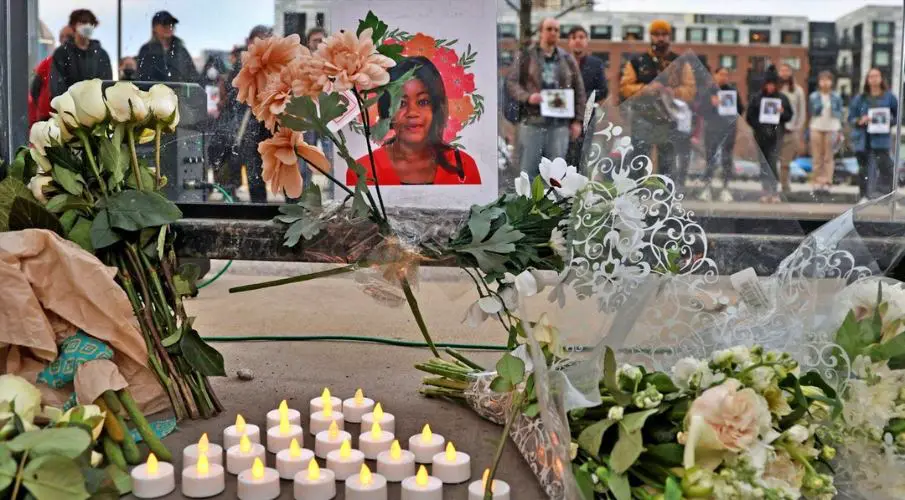
Daphy Michel, thirty one, an asylum seeker from Haiti, severely mentally ill and untreated, froze to death after being released from ICE custody at a bus stop in Pittsburgh. The medical examiner describes her death as a homicide caused by the act or omission of another. The family plans to sue.
It is June, and the death discussed here happened months ago, in winter. But only this Friday did the Allegheny County medical examiner issue the ruling, and it carries enough weight to place this case before us once again. It is one of those cases that does not let go. According to the explicit ruling of the medical examiner, the death of an asylum seeking woman from Haiti, who had been released from federal custody shortly beforehand, now carries a name: homicide.

Daphy Michel, thirty one years old, died on March 2. She was found at a bus stop in Pittsburgh. The Allegheny County Medical Examiner’s Office determined hypothermia as the cause of death, and the fact that it classified the manner of death as homicide means the death was caused by the actions of another person, without assigning criminal liability. Michel came from Haiti and sought asylum in the United States after crossing the southern border in 2022, says Joseph Patrick Murphy, the family’s attorney. She had been allowed to remain for urgent humanitarian reasons, but she did not live to see the hearing that had been scheduled for two weeks after her death.
At the time of her release on February 27, she was considered a vulnerable adult, according to the medical examiner’s report, suffering from severe untreated mental illness and unable to speak the language. The previous summer she had been arrested after shouting at imagined people as a result of her illness. She spent six months in Washington County Jail, where she underwent multiple psychiatric evaluations while awaiting her first hearing. Federal Judge Eric G. Porter stated that he could not continue holding her simply because she had threatened imagined people. Afterward, ICE took her into custody in her cell and placed an ankle monitor on her before transporting her forty kilometers to Pittsburgh, where she remained at a bus stop for days during winter.

She had been wearing clothing appropriate for September, and it was February. The weather overwhelmed her, and she was exposed to prolonged hypothermia. A homicide finding is not the same thing as an indictment. It means that someone did something, or failed to do something, that caused her death. The family will now file suit against ICE. They say it is not comfort, but the last thing they can still do for Daphy, to warn others and prevent such cases from continuing to happen in America. Those are the words of a devastated family speaking to us.
The Department of Homeland Security disagrees. Of course. ICE had nothing to do with this woman’s death, spokesperson Lauren Bis wrote in an email, in capital letters, saying she died three days after her encounter with ICE. She described Michel as an illegal alien from Haiti against whom removal proceedings had begun after her arrest. Upon release, Michel had all her belongings with her and a fully charged phone, and public transportation was available. One day after her death, ICE learned that her ankle monitor had allegedly been tampered with, a claim that later proved false, but employees of the medical examiner’s office had refused to speak with ICE agents at all. ICE called the US Marshals Service, which retrieved the ankle monitor but was given no information about Michel’s condition. ICE learned of her death through news reports.
Sara Innamorato, Allegheny County Executive, called Michel’s death a tragedy that likely could have been entirely avoided with a little humanity. Representative Summer Lee of Pennsylvania said the death was preventable, that Michel deserved care and shelter, access to her language, and medical assistance. Meanwhile, ICE no longer reports deaths of detainees if they die within thirty days of release, ending a rule established in 2021. Public health experts say the change will result in fewer recorded deaths than actually occur without addressing failures in medical care.

What remains is a homicide without anyone one could call a murderer, a death brought about by the actions and omissions of many and for which in the end nobody feels responsible. The language of the agency turned a sick woman into an illegal alien and a charged phone into a rebuttal. The ankle monitor knew where her body was, but not that it was freezing. A judge released her, and ICE took her back into custody while she was still in her cell only to leave her forty kilometers away in an unfamiliar city, dressed for September and living through February, with a bus stop as her final address. And while a person dies this way, the agency decides that such deaths will no longer be counted, so the number falls while the dying remains. With a little humanity, someone said, this could have been avoided. It was the smallest thing they withheld from her, and it cost her life. She came seeking refuge, and they gave her the cold.
Updates – Kaizen News Brief
All current curated daily updates can be found in the Kaizen News Brief.
To the Kaizen News Brief In English


Diese Unmenschlichkeiten lassen mich immer unfassbar zurück. Denke,wie sind die Verantwortlichen in ihrem Alltag? Genau so völlig empathielos, brutal. Unterstützung soweit mir möglich für alle die dieser Haltung entgegentreten
…ja, ein sehr schlimmer fall, leider haben wir von dieser art 7 weitere auf dem tisch
Ganz furchtbar 😞
So unmenschlich 😞
Das erinnert mich an den alten Mann. Der blind (? Oder war es taub) war und irgendwo im Winter abgesetzt wurde.
Auch er erfror 😞
Und wer weiß, wie viele Fälle es noch gibt, die gar nicht publik werden.
…ja, die akte liegt auch bei uns auf dem tisch