
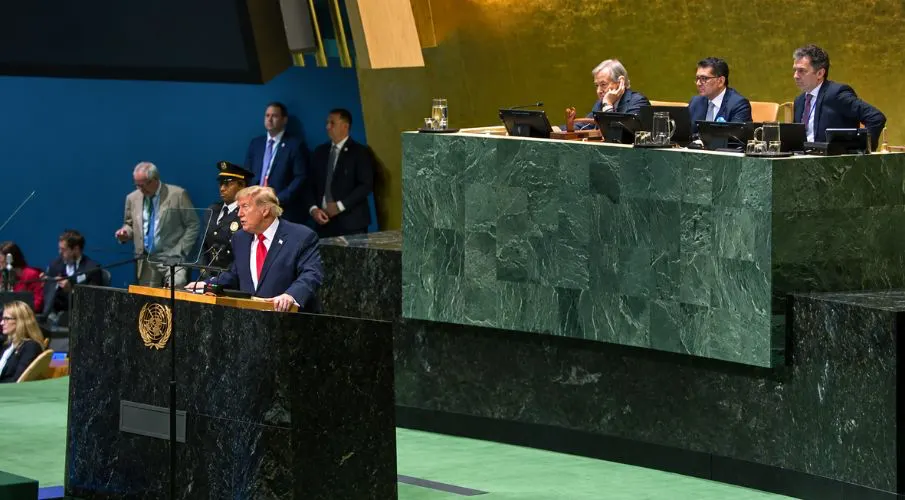
New York City (KB) - The United Nations podium was built to end wars. From that podium, Donald Trump threatened to wipe out a country. He entered the building without cameras showing him riding the escalator up to the General Assembly Hall, a press boycott triggered by the expulsion of a major news network from the White House press pool. The escalator worked this time. The year before, it had stopped while Trump and First Lady Melania Trump were riding it, and the world body had made sure that would not happen again.

He took the podium as the second speaker, in keeping with tradition. Before him, António Guterres had delivered his final address as secretary-general, warning that the fault lines in the world were growing deeper and that the United Nations was being forced to answer questions about why it was still needed. “The world does not need a weaker United Nations,” he said. “It needs a U.N. strong enough to face the world as it is, and determined enough to build the world as it should be.” His term ends in December, and a successor takes over in January. Seven candidates are competing for the job, with no clear front-runner in sight. One secretary-general leaves office urging the world to be saved, while the next man at the podium wants it to submit to him.
Trump’s prepared remarks, distributed by the White House, indicated that he would defend the U.S.-Israeli war against Iran as necessary to eliminate its nuclear capabilities. The draft included this line: “Just imagine if such a vile regime were ever empowered to carry out large-scale terror attacks from behind a nuclear shield.” What he actually said went further than what was on paper. The prepared remarks justified one war; the speech threatened the next.
The General Assembly had opened amid numerous conflicts, with climate disasters and concerns about artificial intelligence weighing on those gathered. There were 71 heads of state and 45 heads of government, while hundreds of motorcades brought Midtown Manhattan to a standstill. Allies bearing the consequences of the Iran war are now openly questioning whether Washington can still be counted on. That doubt follows him into the hall like a shadow his superlatives cannot drive away.
The real business went on around the speech. Trump met with British Prime Minister Andy Burnham and Japanese Prime Minister Sanae Takaichi that day, followed later by Ukraine’s President Volodymyr Zelenskyy. He planned to sign a security agreement concerning Greenland and sit down with leaders from the Gulf states. Others will speak as well, including France’s Emmanuel Macron in the final year of his presidency and Jordan’s King Abdullah II, along with Turkish President Recep Tayyip Erdoğan and the emir of Qatar. Xi Jinping is absent. He is traveling to Washington on Thursday to meet Trump, and that meeting will likely overshadow the speeches in New York. India’s Narendra Modi and South Africa’s Cyril Ramaphosa are staying away as well.
The week’s agenda includes climate change and artificial intelligence, along with the wars in Ukraine and the Middle East. Ahead of Zelenskyy’s address on Wednesday, European foreign ministers will discuss the war and food security. France and Britain are organizing a smaller meeting on a two-state solution, with Canada taking part, a pale version of last year’s major conference.

He did not start with the world. First, he praised his economy and lashed out at the previous administration. Then he boasted about his immigration policies and what he sees as the low crime rate in his own country. A campaign speech in formal attire. The audience in front of him would have preferred to hear something else: how American power can be reconciled with the principles the country has long claimed to uphold. Instead, it got a list of superlatives, an economy envied by the world and the strongest military, topped off with the claim: “Two years ago our country was dead, and now we have the hottest country anywhere in the world.” Before a hall where war and peace were supposed to be discussed, he delivered an account of his own greatness. The principles the audience wanted to hear about never came up.
“While others have talked, I have acted,” he said, just as he had a year earlier. Back then, he had falsely claimed to have ended 7 wars and demanded the Nobel Peace Prize for himself. Since then, he has started a war of his own choosing against Iran that has shaken the Middle East and the global economy. Yet before the General Assembly, he still declared: “I have made peace.” He called it peace when it was a war he himself had started. He described those present as great world leaders, a gentler approach than the year before, when he had told them their countries were going to hell. The pleasantries cost him nothing. The threat came later.

Then came Iran. The world’s biggest sponsor of terrorism, he called it, the bully of the Middle East whose time was now over. The military had completely obliterated Iran’s nuclear program in June 2025. A few sentences later, Iran was building missiles capable of reaching Europe and using them as cover for a possible breakthrough toward a nuclear bomb. He left unexplained how a completely obliterated program could still be building missiles. The contradiction does not bother him; it feeds his next threat. A program that is both destroyed and dangerous justifies both the triumph and the next strike. As he spoke about Iran, the camera caught the stern expression on an Iranian representative’s face.

“I have a big decision to make,” he said. Either reach a deal with Iran or, in his words, “annihilate the Islamic republic and do it quickly, never giving them a chance to kill and destroy people and countries again.” The annihilation of an entire nation, announced from the podium of the United Nations, has a name under international law: a war crime. Earlier this year, he had threatened online to wipe out Iranian civilization, prompting legal experts to raise concerns that he was considering acts that could amount to war crimes. The hall, built to stand against the scourge of war, heard a man threaten the end of a people, and most remained seated. Nobody stood up to challenge those words. Immediately afterward, he softened his tone and called on member states to join in economically strangling Iran. If that worked, he promised, oil prices would plunge. First the end of a people, then the price of oil, all in the same breath.

Large parts of the Iranian delegation left the General Assembly.
He brought the election campaign into the threat. “They’re waiting to see how I do in the midterm election,” he said of Tehran, which he believed would make a deal after the American elections. Russia and Ukraine were heading toward a resolution, he said. They had had enough, and the Iran conflict would end, one way or the other. His comment about the midterms served a purpose. Voters were not supposed to be surprised if the war continued, or let it keep them from going to the polls. The war became an argument for the campaign, the dying a footnote to it.
“To the victor belong the spoils,” he said, celebrating his military operation in Venezuela. He spoke just a few miles from the prison where Nicolás Maduro has been held since the United States seized him in January. Since then, the Americans have expanded their control over Venezuela’s oil. His line about the spoils breaks a rule that American presidents had observed for generations: that their military operations abroad were not about material gain, least of all foreign oil. What they had concealed, he said openly: the spoils are the point. A superpower takes off its disguise. The old hypocrisy was at least a nod to decency.

He also put Gaza on his list of conflicts he had settled. A year ago, he helped negotiate a ceasefire there, including the release of Israeli hostages. Israel still occupies large parts of the territory and continues to carry out attacks there, humanitarian conditions remain dire, and the plan for Hamas to disarm and for Israel to withdraw has been stalled for months. He claimed the peace while the tanks remained. On Greenland, he announced 2 major military bases, which we had already reported on yesterday. A 1951 treaty would have allowed him to do that at any time. He did not say why the United States had waited. During the Cold War, the Americans maintained more than a dozen bases there at one point. What he presented as a favor was something he could have had long ago.
He promised Cuba the end of its regime. “Communism will never be coming to America, but freedom will be coming to Cuba,” he said, adding that no haven for foreign adversaries would be tolerated on America’s doorstep. As he predicted the government’s downfall, the Cuban delegation stood up and left the hall. An empty block of seats remained as he kept talking.
He took personal credit for the United Nations’ financial troubles. He said he had cut its budget by around 15%, forcing the organization to eliminate 4,000 jobs. No country contributes more money to the world body than the United States, and his cuts hit humanitarian programs. The Americans have also withdrawn from several of its agencies, including the World Health Organization and UNESCO. He bragged about weakening the very institution in which he was standing, while the poorest people paid the price. A man tearing the roof off his own house and congratulating himself for it.
On artificial intelligence, he rejected any globalist plan to control it. From now on, it should be called superintelligence, he said, and whether the name caught on would be a test of his power, as he himself put it. To control what something is called is to control how people talk about it. He blamed warnings from leading experts about the dangers of the technology on the same people who had promoted what he called the Russia hoax. “We will only encourage super intelligence,” he said. “We’re going to encourage it, not rein it in.” He was equally proud of having stopped the first global levy on shipping emissions. He had been forced to intervene against the International Maritime Organization, he said. The year before, trade and visa threats from Washington had helped. Had the measure passed, an entire industry would have had to pay for its pollution for the first time. He called the rule that would have applied to everyone expensive and got rid of it.
The hall applauded once. Trump praised First Lady Melania Trump’s efforts to bring abducted Ukrainian children back to their families, and that drew applause. Between 2 threats, a moment of emotion for a lie, and the room went along with it.

Our investigations into Ukrainian children abducted to Russia show just how difficult it is to bring them home and how little the victims gain from politicians claiming credit for themselves. The children were brought back without Melania Trump’s involvement. It was not her achievement, even though Trump credited his wife for it before the UN General Assembly.
Also read our investigation from December 7, 2025: From Russia to Trauma – Russia’s Attack on Ukrainian Identity and Melania’s Claim

Volodymyr Zelenskyy’s face said it all as Trump praised his wife for her supposed involvement in bringing abducted Ukrainian children home, and the hall applauded.
Finally, he turned on the International Criminal Court. He demanded that a court meant to hold the powerful accountable simply dissolve itself, calling it a rogue institution. His administration has hit it with sanctions this year, targeting its president and chief prosecutor, along with 9 judges. Some see it as a tribunal claiming authority over sovereign nations; others see it as a bulwark of the rules-based order his administration is undermining. The same thread ran through the entire speech. Every restraint that might limit power was an obstacle to him, the court as much as the shipping regulation, and he promised to smash them. Earlier this year, he had said in an interview that he did not need international law. The only limit on his power was “my own morality. My own mind. It’s the only thing that can stop me.”
One simple lesson ran through the speech. Power does not ask permission. It takes what it wants. When the law stands in its way, the law gives way.
The institution in which he spoke rests on the idea that power must submit to a law above it. The man at the podium recognizes no limit but his own. A man like that despises the United Nations and still needs its audience. Guterres had called for a United Nations strong enough to face the world as it is. His answer came from a president who would rather face it alone, a threat on his lips and the applause of the hall behind him. He offered up his own will and called it peace.
Updates – Kaizen News Brief
Alle aktuellen ausgesuchten Tagesmeldungen findet ihr in den Kaizen Kurznachrichten.
To the Kaizen News Brief In English


Trump trat in seiner Rede Alles mit Füßen.
Allianzen
Demokratien
Den Sinn der UN
Den Sinn des Internationalen Strafgerichtshofes
Er drohte mit Auslöschung eines ganzen Landes
Dazu betrieb er unverholen Wahlkampf
Und Alle im Saal blieben.
Keine äußerts Kritik, Keiner ging.
Man lies es ihm, wieder einmal, durchgehen.
Ich frage mich wirklich, wozu die UN überhaupt noch gut ist.
Die letzten Jahre wurde sie immer mehr zu einem zahnlosen Papiertiger.
Und Melania 🤬🤬🤬
Das war ein medienwirksamer Brief. Fraglich ib sie ihn selber geschrieben hat, oder ein PR-Mitarbeiter.
Melania interessiert sich nur für Melania.
Es gab noch nie eine First Lady, die so wenig präsent war, die keinen eigenen Job hat bzw die keine Organisationen aktiv leitet/unterstützt.
Und wenn sie mal in der Öffentlichkeit spricht, versteht sie Keiner.
Über 20 Jahre in den USA und solch mieses Englisch.
Aber Trump zieht über Migranten her, die nach 6 Monaten nicht gut englisch sprächen.
Alles in Allem war es ein typische Trump Show und keiner wagte Widerspruch.
Due Welt duckt sich mal wieder weg.
Traurig.
…eine ganz bedenkliche Rede, deren inhalt eigentlich jeden betrifft
Mich würden Kommentare von Ihnen zur Rede vom Präsidenten aus Brasilien Ignatio Lula da Silva interessieren. Dieser steht am 4.10 vor einer neuen Präsidentenwahl. Hat vor der UNO gesprochen.