
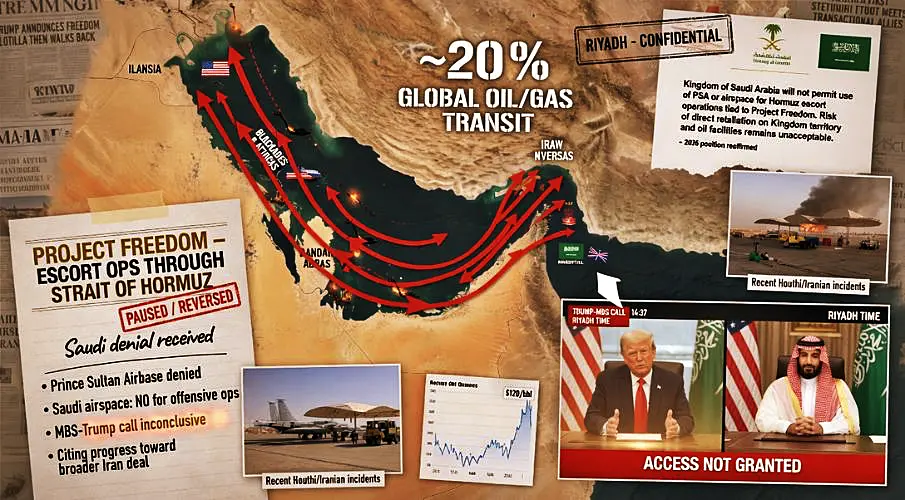
The situation surrounding the Strait of Hormuz is once again spiraling out of control. While American and Iranian forces engaged in direct clashes around the Strait of Hormuz again on Thursday, it simultaneously emerged that Saudi Arabia had previously denied Donald Trump access to its airspace and American military bases. That exact decision apparently forced the White House to abruptly halt the highly publicized naval operation “Project Freedom.”
According to American military officials, Trump planned to deploy American warships to escort commercial vessels through the blocked Strait of Hormuz. Officially, the operation was intended to protect stranded tankers and their crews. But without Saudi support, the plan was militarily difficult to execute. Protecting American destroyers would have required extensive air operations, including fighter jets and attack helicopters.

Saudi Crown Prince Mohammed bin Salman reportedly denied the use of Saudi military bases and Saudi airspace, according to multiple sources. The decision is said to have deeply shocked American government officials. Trump halted the operation only a short time later and suddenly began publicly speaking about “progress” in peace talks with Tehran. In reality, developments behind the scenes now paint a completely different picture from the White House’s public rhetoric. As recently as March, Mohammed bin Salman reportedly urged Washington, according to several people familiar with the discussions, to continue strikes against Iran in order to weaken or even overthrow the Iranian regime. Now, however, Riyadh’s position appears to have shifted significantly.
Saudi Arabia is now apparently attempting to prevent further escalation itself. Mediation talks between Washington and Tehran continue through Pakistan. Iranian Foreign Minister Abbas Araghchi remains in regular contact with Saudi and Pakistani mediators. According to Iranian officials, discussions currently revolve around a provisional thirty day plan: the United States would ease its blockade of Iranian ports, while Iran would once again allow free passage for civilian ships through Hormuz. Parallel broader peace negotiations would then begin.
But while negotiations continue behind the scenes, the military situation is once again openly escalating.
On Thursday, Donald Trump personally confirmed that American and Iranian forces had directly fought each other in the Strait of Hormuz. According to US Central Command, Iran attacked three American destroyers with missiles, drones and fast attack boats. The United States reportedly intercepted every threat and subsequently bombed Iranian missile positions, drone launch sites and command centers.

Trump later publicly celebrated the strikes. Iranian drones had been “burned out of the sky,” he declared. Missiles had been “easily shot down.” Trump spoke almost triumphantly about the destroyed targets. He once again referred to Iran’s leadership as “crazy people” and openly threatened far harsher attacks if Tehran did not accept an agreement “quickly.”
At the same time, however, Trump claimed that the ceasefire with Iran still remained in place. During an unannounced appearance at the Lincoln Memorial, he told reporters that Iran had “played games” with the United States today, after which Washington had “knocked the hell out of them.” Nevertheless, an agreement was still possible. Iran now supposedly wanted a deal more than the United States itself.

Iran, meanwhile, describes the events completely differently. According to Iranian military officials, the United States first attacked an Iranian oil tanker that had been heading toward the Strait of Hormuz. Only afterward, Tehran says, did Iran attack American warships. A spokesman for the Revolutionary Guards openly stated that Washington had violated the ceasefire.
At the same time, explosions were reported from several Iranian cities. Bandar Abbas, Minab, Qeshm Island and parts of Tehran were reportedly affected. Air defense systems in the capital have been activated. Residents of Tehran described explosions that shook their homes and triggered new panic. After several weeks of relative calm, fears of a full resumption of the war are now once again growing inside Iran.
For Saudi Arabia, the situation is becoming increasingly dangerous. Although the kingdom can now redirect part of its oil exports through pipelines, a major regional war still represents an enormous risk for Riyadh. That is precisely why Mohammed bin Salman now apparently seeks to avoid military adventures and instead focus on stability and diplomacy. The crown prince’s economic transformation plans depend directly on the region not descending fully into war.
At the same time, the crisis increasingly demonstrates how strained relations between Washington and one of its most important allies have become. Behind the scenes, frustration over Trump’s unpredictable Iran policy is reportedly growing, according to multiple accounts. Decisions shift within days or even hours, while allies often barely know what strategy the White House is still pursuing. As American warships continue operating near Hormuz and both sides once again exchange missiles, the ceasefire now appears to exist only on paper.
To be continued ...
Updates – Kaizen News Brief
All current curated daily updates can be found in the Kaizen News Brief.
To the Kaizen News Brief In English


Wer nur droht, erpresst und ständig seine Meinung ändert und Partner beleidigt, ist kein verlässlicher Partner.
Saudi Arabien hat seine Konsequenz gezogen.
Nicht, dass ich das saudische Regime Guthrie, aber die Konsequenz ist gut.
Ob Trump nun vermehrt Saudis ausweist?
Wäre ihm zuzutrauen.
Zitat: „….Während sich amerikanische und iranische Streitkräfte am Donnerstag rund um die Straße von Hormus erneut direkte Gefechte lieferten,…“
Damit ist es ein aktiver Krieg, oder?
Wann greift endlich die Konsequenz der Einbindung des Kongresses?