
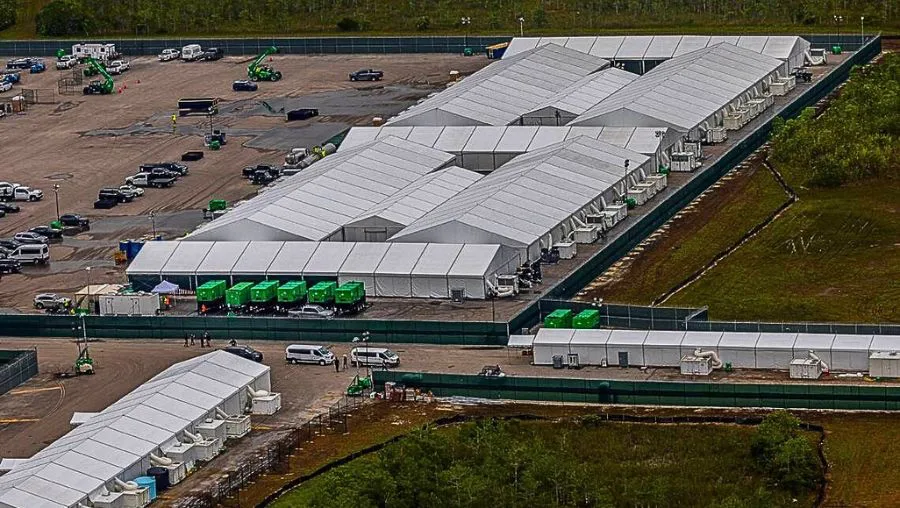
Florida’s most expensive swamp pit is closing its gates. The Trump administration is quietly trying to shut down the Everglades camp that Kristi Noem celebrated only months ago as the model for a nationwide network of deportation prisons. The official reason - too expensive. The irony almost writes itself, because the very woman who once sold the place as a “cost saving measure” is now watching from a distance as her monument suffocates under its own bill.

One million dollars per day. That is how much the first state operated deportation camp in the United States consumes, a favorite project of Florida Governor Ron DeSantis. Calculated across a full year, the total reaches roughly 450 million dollars, and Florida is still waiting for the promised reimbursement from Washington. Federal money is arriving slowly, if at all. In April, nearly 1,400 people were being held inside the camp, two thirds of them without any criminal conviction whatsoever. Locked up because they could be locked up.


Noem, now 54, was removed from her post as Homeland Security secretary in March after an advertising campaign she pushed ended up costing taxpayers several hundred million dollars.

Before that, however, she walked through the facility last summer together with Trump and DeSantis as if it were some kind of architectural showcase. Trump praised the place, encouraged other states to copy it, and traveled the country claiming that costs per bed were far lower than under the Department of Homeland Security’s old contracts. Today we know the opposite was true.
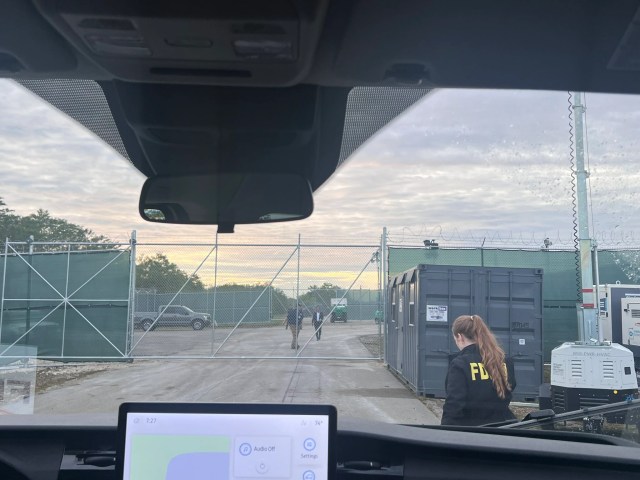
Our investigations, which later became part of the court proceedings, painted a completely different picture than the official austerity narrative. There was a procurement file, passed internally between agencies and contractors, issued on July 10, 2025 by Florida’s emergency management agency DEM, addressed to Critical Response Strategies LLC. At the bottom of the table sat a figure that never appeared in any press release - 78,525,978 dollars. Address of the facility: 54575 Tamiami Trail, Ochopee, deep inside the Everglades. Listed there were more than 60 separate positions, totaling over 180,000 labor hours, every role individually calculated down to the cent.
Anyone reading the contract stumbled over the hourly rates. A senior ICE enforcement officer, internally labeled a CO Captain, collected 78 dollars per hour in overtime, ultimately totaling 5,690,880 dollars. An Intake Supervisor approached one million dollars. The person managing identification badges earned 57 dollars an hour - more than many nurses in Florida make after ten years on the job. For a role called Plans Review, whatever that was supposed to mean, 1,480,000 dollars were budgeted for 1,000 hours - 185 dollars an hour. Corrections Officers on overtime, 2,288 hours at 63 dollars each, totaled 14,414,400 dollars.
See also some of our investigations: A Place Called Ochopee – How Alligator Alcatraz Devours Millions, Torments Human Beings, and Is Handsomely Rewarded for It
The Swamp Camp of Horror – How Trump’s “Alligator Alcatraz” Became a Humanitarian Catastrophe
Research Shows: Hell Has a Name - Trump
Camp 57, Mustang Republic, Alligator Alcatraz and the Crusade of Deterrence
Self-Consumption in a State of Emergency - America Loses Its Last Sense of Shame
For comparison - teachers and social workers in Florida earned between 20 and 28 dollars an hour, often less. They taught children, dealt with broken families, kept society functioning. In Ochopee, meanwhile, people were processed, booked and guarded at rates that made every reference to budget shortages sound like a bad joke.

The camp was opened hastily on July 3, on an abandoned runway in the middle of the swamp, filled with giant tents and cages holding 35 to 38 detainees each. By August, Federal Judge Kathleen Williams halted operations because environmental reviews had never been completed. Florida simply erected the place and hoped nobody would look too closely.

Read also our article: The End of Alligator Alcatraz - A Court Ruling as a Signal for the Rule of Law and Environmental Protection
Then things became worse. In December, Amnesty International released a report about what detainees called “the box.” A two foot by two foot cage where people were chained to the ground by both hands and feet under the Florida sun, unable to sit or move. The CIA used a comparable torture method in its black sites after September 11, including against Abu Zubaydah, the longest held prisoner in the so called war on terror and the first man the agency waterboarded. A Cuban detainee who spent eleven days in the camp told Amnesty International it was a copy of Guantanamo and that the conditions were inhumane. Amnesty itself openly described the treatment as torture.
Lawsuits continue piling up. Allegations of abuse, groping and unlivable conditions. Human rights groups are no longer the only critics. Discomfort is also growing inside the system itself, otherwise there would not now be an attempt to quietly dismantle the entire operation.
And that is the real point. It was not the torture reports that brought down the camp. Not the lawsuits. Not the images of chained men inside cages. What killed Alligator Alcatraz was the invoice at the end of the month. One million dollars per day. That is what it costs to maintain a performance in which a governor, a cabinet secretary and a president march through swamp land pretending they found a solution. They never did. What they had was a stage set, financed on borrowed money, operated on the backs of 1,400 people, most of whom had committed no crime except crossing the wrong border at some point in their lives.
Noem is gone, and now the camp follows her. The only remaining question is who pays the bill - and who gives the people in the box those lost months of their lives back.
Updates – Kaizen News Brief
All current curated daily updates can be found in the Kaizen News Brief.
To the Kaizen News Brief In English


Diese Regierung und ihre Mitläufer bereichern sich auf Kosten der arbeitenden Bevölkerung. Mal sehen, wie lange diese das mitmachen.
…leider, aber, alles wird aufgedeckt, ohne wenn und aber, einschüchtern läuft nicht
Ich bewundere euren Biss. Man hat aber immer noch das Gefühl, dass viele die Augen verschließen, oder meinen, selbst zu profitieren.
Den Menschen muss man nicht nur ein halbes Jahr zurückgeben. Ihnen muss man ein Leben zurückgeben. Es ist nicht anzunehmen, dass sie jemals wenigstens finanziell entschädigt werden, psychisch kann dieser Schaden nicht wieder gutgemacht werden.
Noem trägt keine echten Konsequenzen, sie fiel weich.
DeSantis trägt keine Konsequenzen.
Spart man das verpulverte Geld eben in Florida an anderer Stelle
Trump trägt sowieso keine Konsequenzen.
Was ist mit all den Typen, die da willfähig und begeistert mitgemacht haben?
Erwartet da irgendeinen eine Konsequenz? Wahrscheinlich nicht 😞 und falls doch, wird Trump auf Bundesebene oder DeSantis auf Staatenebene eine Begnadigung aussprechen.
Es waren die Kosten, nicht die Menschenrechtsverletzungen, die zur Schließung führten.
Das muss man erstmal sacken lassen.