
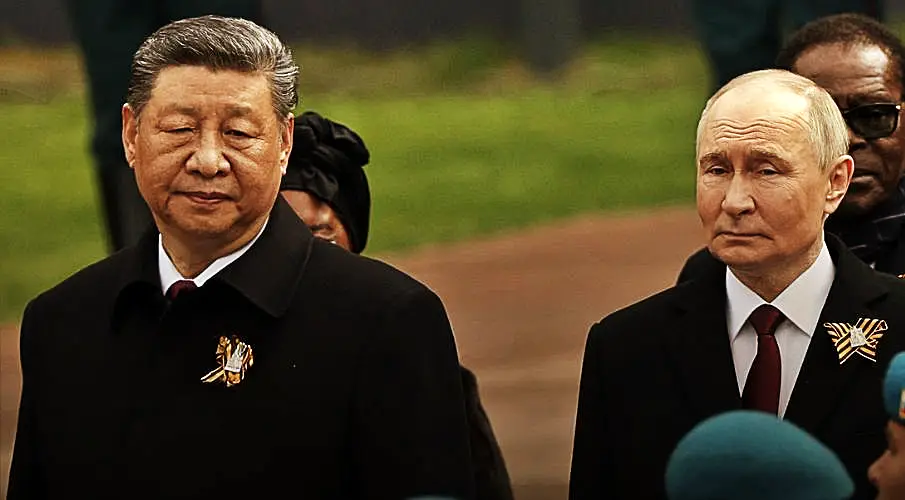
The movement is not loud, but it is there. While Russia occupies militarily, China is building connections in the background that will last. Thousands of mobile network stations with Chinese technology are now operating in the occupied territories of Ukraine. Banks are handling cash in yuan locally. Delegations travel back and forth, cautiously, without much attention. Officially, Beijing recognizes neither the annexation of Crimea nor the so called people’s republics. In practice, however, a network is emerging that is becoming increasingly questionable.

The starting point goes back years. Even before the annexation in 2014, Ukraine, together with a Chinese company, planned the construction of a deep sea port in Crimea. Behind the project was Wang Jing with his company Beijing Interoceanic Canal Investment Management. Three billion dollars were to be invested, and the port was intended to become part of a new trade route. With the upheaval in Kyiv and the Russian takeover of the peninsula, the project collapsed. China withdrew, at least officially.
After that, it remained announcements for a long time. Only after 2022 does something begin to move. Russia’s economic dependence on China grows, and with it the willingness to explore new paths. Reports of possible infrastructure projects are increasing, even if they are usually denied. At the same time, concrete indications appear that can no longer be dismissed. A cargo ship belonging to Guangxi Changhai Shipping repeatedly calls at the port of Sevastopol, its transponder switched off. Officially, this voyage does not exist, but in reality it is recorded.
China is not proceeding openly. Large state owned corporations are keeping their distance, the risk of sanctions is too high. Instead, smaller companies appear, often mediated through individuals. One example is Zhang Jingwei, a doctoral student at a university in Rostov. He connects Chinese companies with projects in Donbas while simultaneously working on drone technologies. This form of mediation makes it possible to conduct business without state structures being directly visible.

In Donbas itself, this cooperation becomes tangible. The Karan quarry in the Donetsk region is being put back into operation after lying idle for years. Chinese companies are supplying machinery, equipment, and technology. The material from this quarry is then used for construction projects in the occupied territories. Russia speaks of reconstruction. In reality, structures are being created that are economically tied to China.

Investigations reveal the connection: behind the project is the company 安玛工程设备(河南)有限公司 from Henan province. An associated phone number leads to a WeChat profile in Zhengzhou, registered under the name Hengji Li. He is considered the legal representative of the company and appears in a group photo together with the so called prime minister of the DPR, Yevgeny Solntsev. The connection is therefore not only economic, but also personally visible.
In the Luhansk region, one of the few profitable coal mines is being operated with Chinese technology. Deliveries come directly from China, no longer via European intermediaries. At the same time, new dependencies are emerging that cannot be resolved in the short term.
The political dimension is also becoming visible. Representatives of the occupied territories travel to China, take part in forums, and deliberately seek contacts with companies and local authorities. Official contracts are rarely published, but cooperation is growing. For the local authorities, this means influence. For China, it means access to markets, resources, and infrastructure.
Elsewhere, it also becomes clear how this presence is being built. In the fall of 2023, a delegation from China travels to Mariupol. Officially, they are described as bloggers. On the ground, a different picture emerges. Among them is the singer Wang Fang. She performs on the ruins of the drama theater and sings a Soviet song from the Second World War. Exactly there, where on March 16, 2022, a Russian bomb struck. Civilians had taken shelter in the building, many of them children. In front of the entrance stood a clearly visible word, written large on the ground. Children. Estimates of the dead range from several hundred to more than a thousand.

After the trip, a press conference follows. Wang Fang does not speak there about the attack, but about alleged crimes by Ukrainian forces against children. Sitting next to her is Zhou Xiaoping, her husband, a politically influential figure from China. The place remains the same. The story made from it is a different one. Political connections are also forming. Representatives of the occupied territories travel to Harbin, take part in forums, and speak about cooperation in construction and industry. Official contracts remain rare, but contacts are being established. In the Zaporizhzhia region, there is open discussion about supplying grain to China. The language is cautious, the direction is clear.
Amid these developments, details repeatedly emerge that sharpen the picture. A Chinese investor travels to Melitopol to secure a cherry processing facility after local actors attempt to take it over. In another case, it turns out that supposed Chinese investors are in fact from Russia. This shows how opaque the structures are, but also how important the name China has become for local politics.

Viktor Medvedchuk remains a central figure in the background of these structures. After his transfer to Russia in 2022, he has stayed outside Ukraine and operates from exile with close ties to Moscow. His networks in energy and raw materials trading continue to serve as an interface through which resources from the occupied territories are organized and marketed externally. Through these structures, coal is among the goods that reaches China as Russian product, while vehicles and technology are delivered to the region in return.
In the background stands a larger objective. China is seeking access to resources located in these territories. Lithium, titanium, zirconium. A significant portion of these deposits lies in regions currently under Russian control. Russia alone cannot fully exploit these resources. China can. Added to this is the strategic location. The planned connection from Rostov through Mariupol and Melitopol to Crimea can be linked to larger trade routes. For China, this is part of a network connecting Europe and Asia. Every section that is controlled or influenced strengthens this position. For now, the engagement remains limited. But it follows a clear line. Step by step, economic dependencies, technical links, and political contacts are being created. While Russia secures control militarily, China is building structures that will last longer.
The war creates the conditions for this. That is precisely why these developments must be researched, documented, and exposed, even if the effort required exceeds anything that normal reporting demands. Because one thing becomes clear in this war with a clarity that needs no interpretation - resources are flowing to the front. Not into reconstruction. Not to the people who live in what remains. It is exactly this “abyss” that China is exploiting. Quietly, without major announcements, but with a growing presence. And the longer this condition persists, the stronger this influence becomes.
To be continued ...
Updates – Kaizen News Brief
All current curated daily updates can be found in the Kaizen News Brief.
To the Kaizen News Brief In English


Das ist ja interessant und super recherchiert.
Schade, dass das nie den Weg in die Medien findet.
Wahrscheinlich lesen es nicht einmal die Staatschefs in Europa, in der Nato.
China expandiert.
Leise, aber unaufhaltsam.
Es erklärt, warum China kein Interesse daran hat, dass die Ukraine besetzte Gebiete zurück bekommt.
Russland ist als abhängiger Partner weitaus besser, als eine unabhängige (vielleicht dem Westen zugewandte) Ukraine.
Aber Trump bittet seinen Buddy Putin zum G20.
Während Putin und Xi eine Allianz schmieden, die alles bisher da gewesene übersteigt.
Und Europa ist blind.
Bekommt sehr wahrscheinlich gar nichts davon mit.
Die Aufdeckung dieser Strukuren ist aufwändig und komplex.
Dennoch werden die Ergebnisse aus solchen hervorragenden Recherchen ignoriert 😞
..leider, und besonders diese information sind grundlagen für möglich verhandlungen, gespräche usw… leider alles schema F und das ist das problem, eine bremse für vieles, aber wir werden weiter das ausheben …