
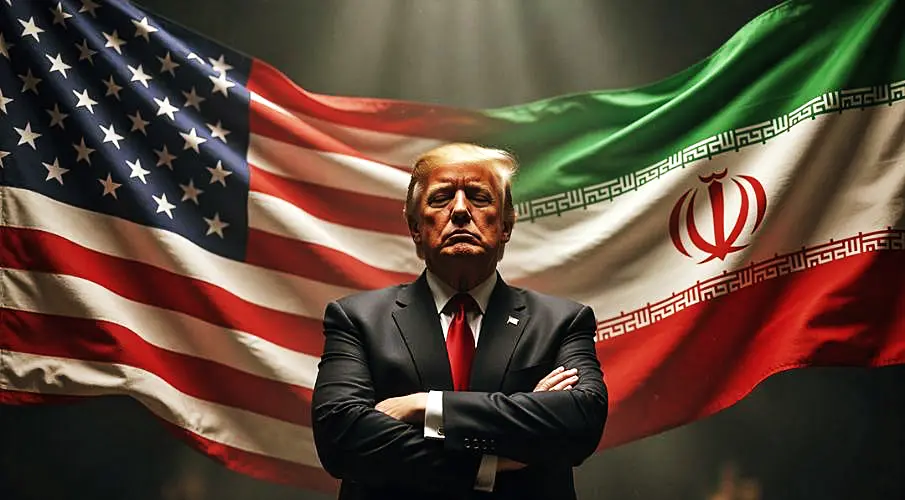
Steve Witkoff and Jared Kushner were ready. The bags were packed, the flight to Islamabad scheduled, Pakistan had kept its capital on high alert for almost a week for guests who were supposed to arrive. Then Trump said no. You are not making an 18 hour flight there. We have all the cards. They can call us anytime, but you are not going to make 18 hour flights just to sit around there and talk about nothing.
Islamabad locks down twice, clears hotels, blocks roads, deploys thousands of security forces - for men who never arrive. What Trump is doing here is not a negotiating style. It is the staging of a country that gave everything and got nothing in return except an empty runway.
A sentence that lands. And that reveals more than any diplomatic formulation ever could.
Ten minutes after the cancellation, Trump tells journalists on his way to Air Force One that Iran sent a new proposal. The first paper could have been better, he says. The second was much better. They offered a lot, but not enough. What exactly was offered, he does not say. What he does say is that one of his conditions remains unchanged - Iran will not have a nuclear weapon. The rest remains in the fog, deliberately, because in this game uncertainty is a tool and not an accident.

In Islamabad, they waited in vain for Witkoff and Kushner
What this Saturday shows is something that runs through the entire set of negotiations like a thread that no one officially wants to name. Trump does not negotiate through presence. He negotiates through absence. The cancellation is the message. The withdrawal is the pressure. Whoever cancels the flight before the plane takes off signals that he can wait, and whoever can wait holds the stronger position - or at least believes he does.

For Pakistan, this is the second humiliation within a week. JD Vance had already canceled his flight to Islamabad at the last minute, and the city had remained on high alert for days for a man who never came. Now the same with Witkoff and Kushner. A capital of 250 million people, a nuclear power, a mediator that gives everything - and the announced guests do not show up. Pakistan’s prime minister Shehbaz Sharif speaks by phone on Saturday with Iran’s president and then writes on X that the conversation was constructive and that Pakistan remains an honest mediator. A sentence meant to show resolve and above all shows how difficult this role is right now.
Iran’s foreign minister Abbas Araghchi was in Islamabad, spoke with Pakistani representatives, and then traveled on to Oman. Direct talks with American representatives were not planned. After his departure, he wrote on X that he had conveyed Iran’s position on a workable framework for a lasting end to the war to Pakistan’s leadership. Then he added that he would still have to see whether the United States was truly serious about diplomacy. A sentence that after Trump’s cancellation is no longer a rhetorical question, but a real one.
Trump said he also canceled the trip because his negotiators would not be speaking with the leader of the country. No meeting with the leader, no flight. A logic that would work if Iran currently had a leadership structure as clear as Trump imagines. But that is exactly the problem Trump himself has publicly described - Iran’s leadership is divided, no one knows who is in charge, not even them. Several Iranian representatives publicly rejected that on Thursday. What remains is a negotiation in which one side wants to speak with the leader of the other while at the same time stating that this leader does not exist in a clear form.
The core questions are the same ones that have occupied Western negotiators for more than a decade. How far Iran is allowed to run its uranium enrichment program. What happens to the existing stockpile of enriched uranium. Washington delivered a written document to Tehran this week outlining possible points of agreement as a framework for more detailed talks. But the framework itself is not yet a picture. And as long as the Strait of Hormuz remains closed, through which one fifth of the world’s oil supply flows, the global economy also remains in a state that fluctuates between nervousness and real damage.
The American military has struck thousands of targets over the course of this war and demonstrated capabilities that few doubt. But Iran’s leadership still stands and American war stockpiles are being depleted.
See our article: All In - While Pakistan organizes talks, this war is draining American stockpiles
The strait remains under Iranian control. The oil price reacts to every sentence Trump posts on Truth Social. And Witkoff and Kushner are sitting at home because their boss decided that an 18 hour flight is too much for a conversation he considers not good enough. We have all the cards, Trump says. Ten minutes after the cancellation, a better offer arrived. Maybe that is even true. There is no confirmation. But whoever has all the cards and still keeps waiting eventually has to ask what he is actually waiting for.
Updates – Kaizen News Brief
All current curated daily updates can be found in the Kaizen News Brief.
To the Kaizen News Brief In English


Trump hat die Büchse der Pandora geöffnet, die Welt hält den Atem an und Alle versinken im Chaos! Dieses perfide Spiel mit der Weltwirtschaft und der Angst, die Fassungslosigkeit der Menschen und das Machtspiel zweier Regierungen macht jeden weitere Staat zum Statisten- und wir können nichts dagegen tun. Mich beschleicht das Gefühl, das genau dieser Sachverhalt dem Wahnsinnigen im weißen Haus mehr als gefällt. Er hält sich für Gott und niemand kann ihn davon abbringen.
,,,und deshalb muss die europäische Politik schnell wieder erwachsen werden, denn Trump und die USA verdienen gut an der aktuellen Lage
Ebenso verdient Putin und profitiert von den gelockerten Sanktionen.
Europa eiert weiter rum.
Es wird diskutiert, geplant.
Leider ohne echte Substanz.
Und vor allem ohne Konsequenzen.
Und wieder werden Trump und seine Entourage gut Geld verdienen 🤬
Trump orchestriert die Märkte und sahnt ab.
Das kann er noch.
Pakistan ist ein gedemütigter Vermittler.
Die Menschen in Islamabad zahlen den Preis direkt.
Zu behaupten, dass man die Gespräche nicht stattfinden lässt, weil man mit keinem Führer spricht …. nun ja, wenn hätte Trump hingeschickt? Wittkoff und Kushner.
Wisst Ihr ob in Uslamabad für die Bevölkerung jetzt wieder Normalität, ohne die ganzen Soerrungen, einkehrt?