
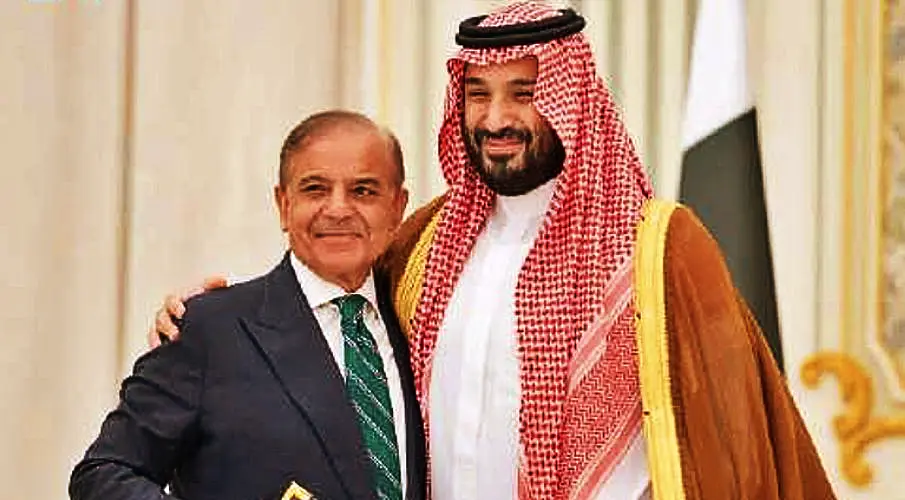
While JD Vance is negotiating with the Iranian delegation in Islamabad on April 11, 2026, Saudi Arabia’s Ministry of Defense announces on X that Pakistani forces - including fighter jets - have arrived at King Abdulaziz Air Base in the Eastern Province. Pakistan itself says nothing. No statement and no explanation. The silence is part of the message. The timing is not a coincidence. It is pressure. On Iran, on the negotiations, on everyone sitting in that room at that moment believing Pakistan was a neutral host. It is not only military. It is a staging of power at a moment when every move is being watched.

What lies behind this? A defense agreement the Pakistani public has never been allowed to read, that was never put before parliament, yet is now pushing the country to the edge of a war it is simultaneously trying to prevent. The Strategic Mutual Defense Agreement - SMDA - was signed on September 17, 2025, by Saudi Crown Prince Mohammed bin Salman and Prime Minister Shehbaz Sharif. Internal documents in our possession, which we have analyzed, show how this pact came into being, what it demands, and what it is costing Pakistan. It is more than a military instrument. It is a message. To the region. And to Washington.

Further current Kaizen Blog investigations:
The history of this agreement begins in 1982. A confidential contract between Islamabad and Riyadh, at the time still limited in its obligations. In 2005, a revised version follows, the Military Cooperation Agreement, regulating training, equipment and technology transfer. Pakistan commits to nothing that resembles war. That changes in 2021. A new clause lands on the desk of Imran Khan: Pakistan commits, upon request, to support Saudi forces - against any threat affecting the security, sovereignty, territorial integrity or interests of the Kingdom. The wording is broad. It covers everything. It excludes nothing.
Khan hesitates. For almost a year. He knows what such a commitment means, and he does not want to sign it. Media commentators close to the military attack him publicly for it. Army Chief Qamar Javed Bajwa travels repeatedly to Riyadh to repair the relationship. In April 2022, Khan is removed from office in a covert military coup. In February 2024, the interim government installed by the army signs the clause - quickly, quietly, without parliamentary debate. The negotiations for this new line had already been running in the background for months. The step was prepared, not improvised.
Within Pakistan’s military leadership, however, the debate over this step is far from over. Internal documents and investigations show: officers are concerned that the wording is too vague. That it could force Pakistan to defend Saudi interests even outside the Kingdom. That it does not distinguish between conventional and nuclear forces. That Saudi Arabia owes no equivalent obligation in return.
These concerns flow into the SMDA of 2025. The new agreement is intended to be more narrowly defined - limited to Saudi territory, clearly conventional. But its full text is not part of the leaked documents. What is known: the joint press release states that an attack on one of the countries is considered an attack on both. At the same time, the role of the United States remains untouched. Military bases, air defense, fleets - all of that remains in place. The pact replaces nothing. It complements. And that is precisely where its real significance lies.
The Iran war, which has been ongoing since February 28, 2026, has suddenly made this pact real. Iran strikes Saudi military bases where US troops are stationed. On April 6, an Iranian strike hits the Jubail petrochemical complex - one of the largest industrial complexes in the world, responsible for an estimated seven percent of Saudi Arabia’s gross domestic product. Ten percent of Saudi export capacity has already been lost.
Pakistan has quietly begun to act in this context. Open source intelligence had already documented military transports in December and January. The deployment of fighter jets is now official - from the Saudi side. That Pakistan is stationing troops on the other side of the conflict on the same day its delegation is negotiating a ceasefire in Islamabad is not a minor inconsistency. It is a contradiction that places the country in an almost unsolvable position.
A member of Pakistan’s military apparatus put it this way at the end of March: “The Saudi pact is becoming a problem for us. It was supposed to mean money in exchange for deterrence. But we have received no new Saudi investments, and deterrence has failed.” Pakistan’s economy is fragile. The United Arab Emirates recalled a loan a few days ago. Saudi Arabia and Qatar stepped in - five billion dollars to stabilize Pakistan’s foreign currency reserves. The Kingdom also holds more than five billion dollars in deposits at the Pakistani central bank.
The pact is, in its most honest reading, a transaction: security guarantees in exchange for financial assistance. The fact that this exchange could now pull Pakistan into a war in which it would stand on the side of a coalition deeply unpopular among large parts of the Pakistani population turns the situation for Islamabad into a nightmare with multiple open fronts. At the same time, it is part of a larger picture: Saudi Arabia is expanding its security network because trust in US protection is no longer a given.
Pakistan is already fighting a hard border war with Afghanistan. India, its main strategic rival, maintains close relations with Riyadh. A confrontation with Iran would mean: enemies in the east, west and north. Added to this is the domestic population. Pakistan has a large Shiite minority. When Army Chief Asim Munir meets Shiite leaders at the end of March who express concerns about the war, he says: “If you love Iran, go to Iran.” Syed Ahmad Iqbal Rizvi, deputy chairman of the Muslim Unity Movement, responds publicly: “We love our country. But this war is a war between right and wrong. We stand on the side of what is right, on the side of Iran.”
These are not outsiders speaking. These are people who live, pray and vote in Pakistan
Military experts who provide information anonymously assess the Pakistani troop deployment in Saudi Arabia as largely symbolic. Iran is not planning a ground invasion of the Arabian Peninsula. Pakistan’s contribution to missile and drone defense would be marginal compared to what the United States already provides. And the current agreement is purely defensive - Saudi Arabia cannot ask Pakistan to carry out a counterattack on Iran, not even from Saudi territory.
What remains is the political weight of the moment. Pakistan is both mediator and contracting party. It sits at both tables. It has communicated to Tehran - Foreign Minister Ishaq Dar said it publicly in March - that it has a defense agreement with Riyadh and that Iran should respect it. At the same time, it is trying to end a war it could be drawn into by that very agreement.
Prime Minister Sharif had announced a ceasefire on April 8 - formally, in capital letters on X. It later turned out that the text had been approved by the American side. The original version carried the heading: “Draft - message from the Pakistani Prime Minister on X.”

The negotiations collapse last weekend. The American delegation leaves Islamabad without an agreement
Dar then declares that Pakistan will continue. Continue mediating, continue building bridges. “Pakistan was and will continue to play its role in enabling dialogue between Iran and the United States.” It sounds like obligation. It also sounds like a country that has no other choice - because the pact that brought it money now demands that it stop a war before that same pact consumes the country itself.
This investigation, like all of our investigations, comes at a cost. Not only money - time, access, sometimes safety. The information analyzed here was not found through a search query. It exists because risks are taken - to then verify it, classify it, understand it.
Further current Kaizen Blog investigations:
Iraq fights on both sides - and no one knows how this will end
The great ground war narrative - the hour of the TV alarmists
Without this work, the public remains dependent on what governments want to tell it. Official statements. Press releases. Half sentences that conceal more than they reveal. In moments like this - when states sign agreements in secrecy that decide on war and peace - the difference between what is said and what actually happens is often everything.
Independent journalism does not need heroes. It needs people who read it, share it - and if possible, support it. If this work matters to you, we appreciate your support.
Updates – Kaizen News Brief
All current curated daily updates can be found in the Kaizen News Brief.
To the Kaizen News Brief In English


Danke für diesen überaus interessanten und, wie immer, gut recherchierten Bericht.
Dazu hört man hier in den Medien rein gar nichts.
Wer ein wenig die „Geschichte“ des Nahen Osten kennt, weiß, dass Pakistan nicht nur ein neutraler Staat ist, der sich für Verhandlungen anbietet.
Euer Bericht zeigt Verbindungen, gekündigte Verbindungen, die Nähe zu den USA.
…danke, eine sehr aufwendige recherche, mit vielen steinen die in den weg flogen und brisanter als viele vermuten würden
Vielen Dank dafür
gerne