
Kumzar/Islamabad – The USS Spruance fires three shots into the engine room of an Iranian cargo ship.

Before that, for six hours, the U.S. Navy had warned the Touska, an Iranian cargo vessel under Iranian flag, loaded in Malaysia, on its way to Bandar Abbas. The Touska did not respond. Then came the final radio call, delivered like a countdown: Clear your engine room, we will open fire. Then the smoke. Then the boarding. The United States calls it proportional and professional. Iran calls it piracy and announces a swift response.

With that, the ceasefire that expires on Wednesday is not just under pressure. It is barely recognizable. Iran’s Foreign Minister Abbas Araghchi tells his Pakistani counterpart Ishaq Dar that Washington is showing bad intentions and a lack of seriousness in diplomacy. The demands and the threats against Iranian ships and ports are clear signs that the Americans are not acting in good faith. Iran’s President Masoud Pezeshkian goes further and warns in a call with Pakistan’s prime minister that U.S. actions have driven mistrust in Tehran so far that there is now fear Washington will betray diplomacy once again, as it has before. Iranian state media report on Sunday, without naming official sources, that the planned second round of talks in Islamabad may not take place. From the Iranian side there is no response to Trump’s announcement of new negotiations.

And then Iran’s First Vice President Mohammad Reza Aref says openly what until now sat between the lines. On X he writes that global fuel prices can only stabilize if economic and military pressure on Iranian oil exports stops. One cannot restrict Iran’s oil exports and at the same time expect free security for others. The choice is clear: either a free oil market for all or the risk of significant costs for everyone. A sentence that sounds less like diplomacy and more like a bill Tehran is placing on the table for the world. Whoever turns off our tap will pay for it.

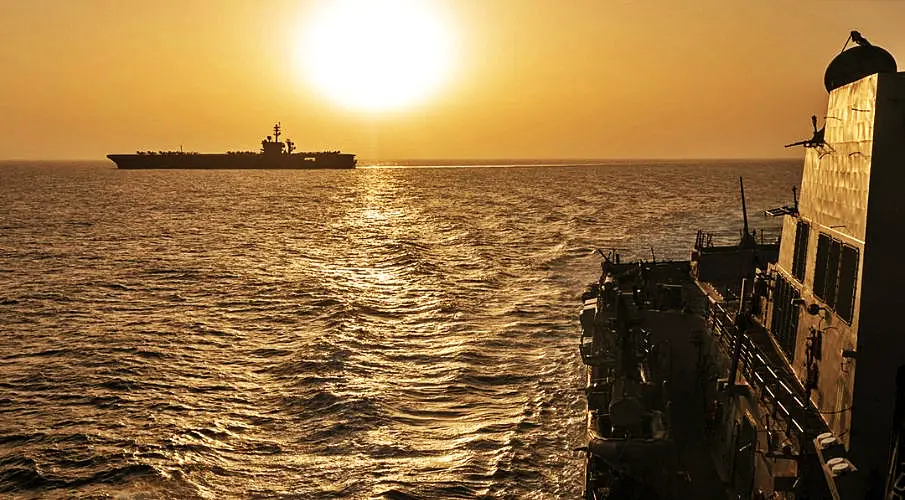
The USS Abraham Lincoln CVN-72 moves through the Arabian Sea as the United States blocks Iranian ports and the coastline. More than 10,000 American soldiers, over 12 ships and more than 100 aircraft are enforcing the blockade in regional waters and ensuring that no vessel violates Mr. Trump’s order.
At the same time, oil prices rise at a speed that shows how thin confidence has become. U.S. crude jumps 6.4 percent to 87.88 dollars per barrel. Brent climbs 6.5 percent to 96.25 dollars. On Friday, prices had still fallen by more than nine percent after Iran’s foreign minister said the Strait of Hormuz was open again for commercial shipping. Two days of hope, then a collapse back into reality. The market no longer reacts to words. It reacts to gunfire. And Aref’s statement is likely to push it higher on Monday.
And it does not stop with the Touska. Trump himself writes on Truth Social that Iran has fired on ships in the strait, including a French and a British vessel. The French shipping company CMA CGM confirms that one of its ships, the CMA CGM Everglade, was targeted with warning shots. The International Maritime Organization IMO confirms the incident and places it north of Kumzar in Oman - the container ship was damaged, there were no injuries and no pollution.
Since March first, the IMO has counted twenty four incidents in the Strait of Hormuz and across the Middle East. That shots were fired off Kumzar is not disputed.
But what exactly happened, how it happened and what followed, no one is saying. France’s foreign ministry says it has no information to share. CMA CGM declines further comment. The incident is confirmed, the circumstances remain withheld - as if even the truth about a warning shot off the Omani coast is too dangerous to be spoken. The radio traffic suggests an attack on the French vessel.
Our investigation on this case is not yet complete.
America’s energy secretary Chris Wright is asked when gasoline prices might fall below three dollars per gallon again. His answer: maybe next year. But prices have likely already peaked. A sentence worth remembering, because in a week it will either be forgotten or quoted, depending on whether the Touska was the last incident or the first in a new series.

At the edge of this day, almost unnoticed, images appear showing an Israeli soldier in southern Lebanon smashing a statue of Jesus with a sledgehammer. The Israeli army confirms the footage and says the behavior is inconsistent with the values expected of its soldiers. An investigation is underway. In the same southern Lebanon, where Israeli forces continue to occupy a kilometers deep strip, the army reports having killed a fighter who crossed a line. A map is released showing where Israeli forces will remain - five divisions, a strip of land covering dozens of Lebanese villages, most of them destroyed. Alongside that, a naval presence off the coast. The ceasefire holds, but it holds like a rope pulled from both sides.
And in Israel itself, Benjamin Netanyahu again requests a delay of his testimony in the ongoing corruption trial. Security reasons, as with every previous request since 2024. The prosecution rejects it. A prime minister fighting a war while standing trial and trying to buy time in both, time he does not have.

Islamabad prepares: The city administration of Islamabad ordered on April 19, 2026 that access to the so called Red Zone - the government and security district - will be fully closed on April 20. All authorities, offices and schools located there - both public and private - are instructed to work from home if possible to avoid disruption. The notice was distributed to numerous government bodies, security agencies and media outlets to ensure broad awareness of the measure.
It remains to be seen whether the talks will take place.
The day ends without clarity and without direction. The Touska lies under American control somewhere in the Gulf of Oman. Iran has announced its response, but not yet delivered it. The negotiations that might have begun tomorrow stand on a knife edge narrower than the strait itself. And the oil price, that incorruptible seismograph of fear, points upward as if it knows something the diplomats are not yet willing to admit.
To be continued ...
Updates – Kaizen News Brief
All current curated daily updates can be found in the Kaizen News Brief.
To the Kaizen News Brief In English


Und es gibt viele Profiteure, die Öl günstiger am Freitag gekauft haben… und nun teuer verkaufen können.
So füllen sich einige Wenige die Taschen auf Kosten der Weltwirtschaft und auf Kosten von Menschenleben.
MAGA glaubt die Lügen zum Benzinpreis. Obwohl die Realität an den Zapfsäulen anders aussieht.
Danke für Eure wertvollen Recherchen.