
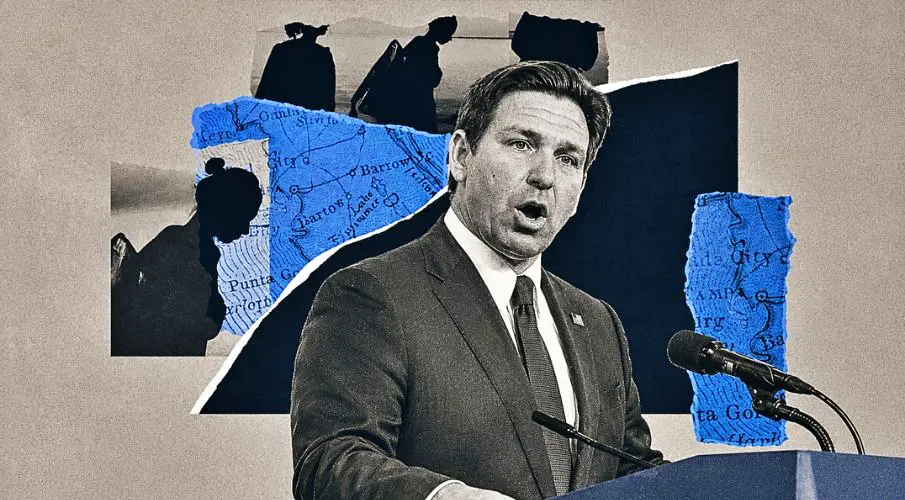
In Florida, the DeSantis administration is forcing cities that do not want to cooperate with immigration authorities into 287(g) agreements by threatening removal from office. Many residents want out, their representatives say they have no choice, and a law that orders no one to do anything is making everyone comply.
Under the Florida sun, about twenty-five people gathered one Sunday at the entrance to the Pinellas County jail and placed cardboard signs in the grass saying that immigration authorities were holding people there. For a year they have come every weekend to protest the sheriff’s cooperation with the agency. One waved an upside-down flag, some drivers honked in support, one woman gave the demonstrators the finger and sped away. They prayed for those detained as a white transport van turned into the jail entrance.

At the start of his second term, President Trump called by executive order for local police to cooperate with ICE under the so-called 287(g) agreements, which grant police departments and jails powers normally exercised by immigration authorities. Officers may act during traffic stops and execute immigration warrants inside jails, and they may question people about their immigration status. No state embraced the call more enthusiastically than Florida. By April 2025, more than half of all such agreements nationwide were located there, second only to Texas in total numbers. A law passed by the Republican majority in the state legislature last year requires county jails to participate. But the text says nothing about cities and their police departments.
Read also our article: Investigations reveal: Bounty list - How ICE pays local police for arrests, even involving children
Cities are therefore not required to participate, yet they are pressured into doing so. In Fort Myers, where the city council deadlocked three to three and thereby avoided the agreement, a threatening letter arrived from Attorney General James Uthmeier. The deadlock constituted a serious and immediate violation of Florida law, he wrote, and he threatened every available civil and criminal consequence, from contempt proceedings to removal from office by the governor. The council ultimately agreed. Three months later, the city commission of Key West received the same message after voting six to one to withdraw from the agreement. This unlawful sanctuary policy would not be tolerated in Florida, Uthmeier wrote, and they could either stop obstructing the law or face the consequences. Key West quickly reversed course.

The governor held a press conference in Miramar to announce what he called the largest immigration operation in Florida’s history. Ron DeSantis forced local police into line with the federal government, even where officials believed otherwise, says David A. Harris, a law professor at the University of Pittsburgh who has studied the effects of 287(g), putting local officials into an impossible position. In Pinellas County, Sheriff Bob Gualtieri also advised police chiefs to sign, saying the new law imposed obligations on everyone and that failure to comply could result in removal from office by the governor. He declined to be interviewed.
Yet the law itself had left the door open. When the mayor of South Miami asked a court to clarify whether the law also applied to cities, state attorneys acknowledged that a city did not violate the law simply by refusing to participate, as long as it did not vote against an agreement. Dozens of cities therefore stayed out of the program. The law orders no one to do anything. It merely threatens, and the threat is enough.
This is about far more than ICE, says Leo Gonzalez of the Tampa Bay Immigrant Solidarity Network, which collected more than nine hundred signatures against 287(g). They realized that these agreements were the largest funnel through which the state channels people into immigration detention.
One person who understood this early was Courtney Prokopas from Gulfport, who leads the League of Women Voters immigration justice working group there. She had come from Chicago six years earlier to care for her grandmother during the pandemic and stayed. When her grandmother died, she considered leaving, but after the storms of 2024 devastated the city, she saw residents come together to rebuild and decided to remain. When she learned that Gulfport had also joined 287(g), she said she was outraged. What mechanism, she asked, had made this possible.
Until January, in the middle of the siege of Minneapolis, almost no one asked about the agreement. Then more than twenty residents stepped up to the microphone at a council meeting, where usually only a handful speak, and the council scheduled a hearing. Police Chief Mary Farrand, who had signed in February 2025 after consulting with the city manager, gave those present a presentation in which she praised Key West’s decision to remain in the agreement. The law, Section 908.104, requires every agency to support enforcement of federal immigration law to the fullest extent possible, and anyone violating it could be removed from office by the governor. Her officers had not carried out a single arrest for ICE since signing, she said, yet she preferred the agreement over what Minneapolis had experienced because she did not want someone else to come and do it for them.
That was the language of caution. Mayor Karen Love pushed back, saying that when the agreement had been signed in February, they had not yet known what they know now and had not yet seen what she described as disturbing behavior by ICE in other cities. If she had to choose between ICE and her own police department, which knows the residents and is there for them, she would always choose her own, and she had not been elected to fight the battles of the state and federal governments. From the audience people shouted that she should stand on the right side of history and remember whom she represented. Vice Mayor Marlene Shaw later said it was difficult when decisions were being made by people who neither know nor understand the community.
For Prokopas, remaining in the agreement was a disappointment. She said she had nothing to lose because she was neither on the council nor mayor, but in these small towns with short terms and modest pay, anyone who stood up for residents and was then removed by DeSantis would be elected back by the whole town and become a folk hero.
For Prokopas, remaining in the agreement was a disappointment. She said she had nothing to lose because she was neither on the council nor mayor, but in these small towns with short terms and modest pay, anyone who stood up for residents and was then removed by DeSantis would be elected back by the whole town and become a folk hero.

In neighboring St. Petersburg, tensions rose as well. In February, residents lined up at the council microphone, among them Reverend Andy Oliver of Allendale United Methodist Church, known for supporting immigrants and unhoused people, including queer communities. Being removed from office is not the worst thing, Oliver says, human rights violations are far worse. Outside the church last year appeared signs reading “Abolish ICE” and “ICE does harm.” During a service in May, Oliver spoke about the detention facility in the Everglades that had been called Alligator Alcatraz, welcomed its closure, and criticized the state for using hurricane relief funds to operate it. Sixty years ago, he said, queer predecessors resisting police at the Stonewall Inn had a brick in their hand, today people have a phone. Screens displayed the numbers of House Speaker Daniel Perez and Senate President Ben Albritton along with a voicemail script stating that emergency funds belong in real emergencies like storms, not in cages for people. The congregation pulled out their phones. Before that, church member Lynne Hensley had said from the podium that the problem was not only far away in the Everglades, it was here, in their own city, in the decisions of the mayor and police chief.
Read also our article: The Next Defeat: Alligator Alcatraz Shuts Down for Good - Noem’s Prestige Project Chokes on Its Own Price Tag
Mayor Ken Welch and Police Chief Anthony Holloway did not respond to requests for comment. Spokesperson Yolanda Fernandez stated that Holloway had signed because Section 908.104 required it. The department had recorded twenty-six encounters under 287(g) since August, and if officers discovered an immigration detainer during an arrest, they notified ICE and waited one hour for agents to arrive. The council had never voted on the agreement. Richie Floyd, the vice chair, said he wished the city had never signed because other communities had escaped it and nothing good had come from it so far.
287(g) is only one of the ways DeSantis challenges the authority of Florida’s more progressive cities. A new law taking effect in January prohibits cities from promoting diversity programs, which could affect St. Petersburg’s support for Pride Month, whose parade is among the largest in the South. The year before, Florida’s transportation agency had rainbow and “Black History Matters” street markings removed. Floyd said he did not want St. Pete to change and wanted everyone to continue feeling welcome there.
So far, no city with an active agreement has succeeded in withdrawing, and the movement, Gonzalez admits, appears stuck. The next step is to force candidates for local office in November to take a position. An ACLU report from February, “Deputized for Disaster,” found countless cases in Florida of harassment and suspicion directed at citizens and noncitizens alike, along with a climate of fear and serious violations of civil rights. Many immigrants, Gonzalez says, returned to their countries out of fear, while others only left home for work, shopping, and church on Sundays, and Latino-owned businesses reported falling customer numbers. Yet this damage is not measured because the state has no interest in revealing it.
That may be the most refined invention of this form of power. It does not order, it threatens, and it leaves the dirty work to local police so that no one can say an outsider came. Anyone who leaves the house only for work out of fear appears in no statistics, and uncounted harm is the most convenient kind. The people at the jail gate know this and keep praying, because a sign in the grass is not a brick and not a phone, but it names what others do not want measured.
Updates – Kaizen News Brief
All current curated daily updates can be found in the Kaizen News Brief.
To the Kaizen News Brief In English


Wenn die Furcht über Gesetz und Moral regiert.
Wenn die eigene Machtposition wichtiger ist, als das Richtige zu tun.
Florida, ich habe den Bundesstaat früher geliebt.
Seine Menschen, die Natur.
Aber mit DeSantis war für mich Schluss damit.
Zu sehr lief ihm ein Großteil der Einwohner hinterher.
Verhalf ihm zum Gouverneursposten, schaffte Mehrheiten.
Mehrheiten, die jetzt genau so etwas ermöglichen.
Ich mag anmerken, dass Niemand von Denen sagen kann „ich wusste es nicht“.
Es sei denn sie sind in den letzten Jahren vollkommen blind und taub gewesen.
…ja florida ist bei vielen unten durch, der typ ist jenseits der bremsspur