
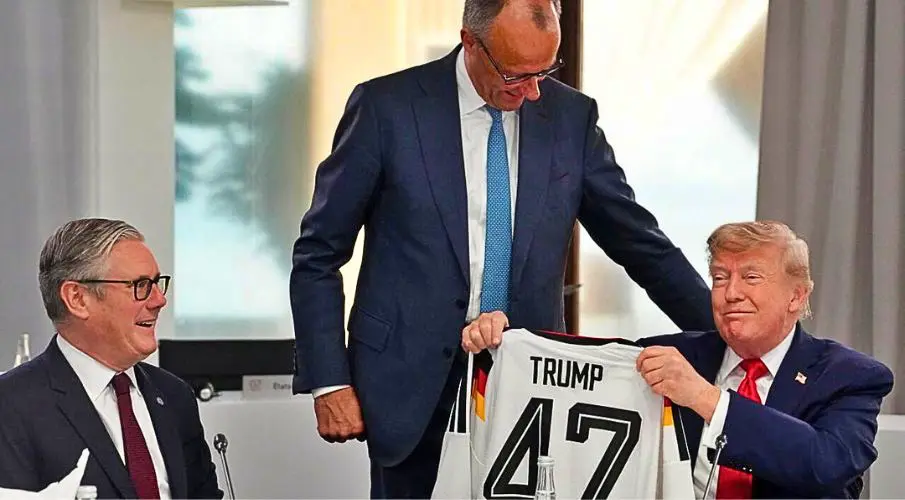
After the bitter rupture over the Iran war, Greenland, and the troop withdrawal, Europe’s heads of government are courting the American president again at the G7 summit in Évian-les-Bains, with a jersey, compliments, and a dinner at Versailles. They have realized that no other plan remains to them!
When Chancellor Friedrich Merz handed the president a soccer jersey with the number forty-seven on Tuesday morning, it was a gesture of the kind a foreign statesman might have made during Trump’s first term, flattering and conciliatory, calculated entirely to please the other side. Only this time, behind Merz stood a bitter period in which he and other European leaders had condemned the war in Iran and in doing so provoked Trump into threatening to withdraw part of the American troops from the continent.
Europe’s alliance with the United States may still have been hanging in the balance, yet on the first full day of the summit in the Alpine spa town, the leaders showed that they remained willing to be polite. For all the quarrels of the past year, they seem to have reached the conclusion that the best way to deal with a stubborn president is to court him, especially because they still need him on sensitive matters such as the war in Ukraine. We are on the same team, Merz wrote on social media and offered belated birthday wishes for his eightieth birthday.
Just a week ago, such words would have sounded unlikely. The dispute over Iran and Trump’s threat to annex Greenland, along with his constant criticism of the heart of Europe, had convinced some that America was no longer an ally and, in certain cases, even a danger. Now, however, at least the outline of peace with Iran exists, and Europe’s leadership is returning to flattery. This is how diplomacy delivers results, said Ursula von der Leyen, President of the European Commission, congratulating Trump on the framework agreement that would reopen the Strait of Hormuz and lower oil prices and perhaps, in the end, even put an end to Iran’s pursuit of a bomb.
The positive mood was hardly surprising. Even without an agreement, analysts said, the other six members of the Group of Seven, representing the advanced industrial economies, would have worked to prevent the meeting from collapsing into conflict. Quietly, said Jeremy Shapiro of the European Council on Foreign Relations, a think tank with offices in Berlin and London, Europeans had realized that they could not simply wait out Trump and that something fundamental had changed in transatlantic relations. Yet the rupture, he added, left them with no alternative plan, and so they had to be cordial toward Trump.
Trump complicated the calculation by announcing his agreement on the eve of the summit. If a final agreement between the United States and Iran were to emerge, which remains a very large if given all the uncertainties, it would provide relief for European economies suffering from disrupted oil and gas supplies. Three months of hostility had placed Europe’s leaders in an almost impossible position, squeezed between a president who criticized them for insufficient support while simultaneously dismissing their possible contribution, and domestic populations that largely oppose the war and are increasingly frustrated by its economic consequences.
Macron and British Prime Minister Keir Starmer said that once the ceasefire holds, they would quickly send military equipment to help secure passage through the Strait of Hormuz. Where they had capabilities, with mine clearing being the obvious example, they wanted coordinated action with the United States and others, Starmer said, in order to reopen the strait as quickly as possible. Macron, the host, set the tone for the diplomacy and invited Trump to dinner at Versailles on Wednesday, in the palace of the French kings, to mark the two hundred and fiftieth anniversary of American independence. It came from the same page of his playbook as during Trump’s first term, when he invited him to a military parade on the Champs-Élysées. Once again the approach appeared successful because Trump, whose preference for buildings filled with gold is well known, spoke enthusiastically about Versailles’ gilded decoration. He said he had planned to leave that afternoon, but then the French president, a very nice man, invited him to dinner at Versailles. Versailles is not gold leaf, Trump said. Versailles is the real thing.
However courteous the exchanges appeared, there was little indication they had changed Trump’s position on Ukraine. This is not America’s war, he repeated. We have nothing to do with it except selling weapons, and we are thousands of miles away.
Beneath the courtesy, more subtle fractures appeared. Trump did not meet privately with Starmer, leading the British prime minister to insist that he had not been slighted. By contrast, Trump met separately with the rulers of the Emirates and Qatar, Sheikh Mohamed bin Zayed Al Nahyan and Sheikh Tamim bin Hamad Al Thani, thanking them for their support during the Iran conflict with a warmth that seemed absent from his meetings with Europeans. Secretary of State Marco Rubio also attended the meeting with the Emirati ruler. When Sheikh Mohamed responded almost inaudibly, Trump joked that only a man of such wealth could speak so quietly and still command the room. He praised Sheikh Tamim for his courage and for Qatar’s billions in investment in the United States.

Trump spent much of the day defending his agreement with Iran, the details of which he still had not released. Reports that the United States had committed three hundred billion dollars of investment in Iran were rejected by him. We are not investing money and are not obligated to do so, he said. The agreement includes a promise that Iran will never possess a nuclear weapon, something Iran has long publicly stated, and he warned that unimaginable consequences would follow if that changed. That, he said, was why he became involved and why he agreed to sign.
It is striking, in the opinion expressed here, how calmly and with how much dignity Zelenskyy appears in moments like these, even when he is demonstratively given the cold shoulder. Real strength is not shown by visibly rejecting others but by taking responsibility and showing respect. Something the author argues Trump will never learn.
That was the first day of Europe’s return to court. Independence, once won from kings, is celebrated in the palace of kings while paying tribute to a man who sees the gold there as the real thing. Warmth was reserved for those who pay, coolness for old friends, and the jersey bearing forty-seven became the most honest language of the day because it named the number that mattered. Those with no other plan call their powerlessness diplomacy and their flattery reason. But gifts do not resolve disputes, the war in Ukraine does not become America’s responsibility, and the threat of troop withdrawal remains. At the end of a courteous day stands the old lesson that a court remains peaceful only as long as the ruler feels flattered.
This spectacle leaves us uneasy. Those who respond to Trump’s behavior with flattery have already lost, no matter how brightly they imagine the future. Courtship does not buy respect, it buys delay, and the ruler accepts the gift while keeping the contempt. If we worked like the European Union, with jerseys and court dinners, most of those detained by ICE would still be in prison today, innocent and forgotten. We did not help them by courting those in power but by opposing them, with commitment and without fear. Courtesy is not a principle, and those who bow before power eventually lose both, their dignity and the cause for which they gave it up.
Updates – Kaizen News Brief
All current curated daily updates can be found in the Kaizen News Brief.
To the Kaizen News Brief In English


Danke für die Zusammenfassung des Tages beim G7.
Es ist zum Fremdschämen, wie sich die Staatsleute von EU und UK benommen haben.
Ist Ihnen in dem Jahr von Trumps Amtszeit immer noch nicht klar geworden, dass Schmeicheleien und Geschenke nicht funktionieren?
Trump ist ein Narzisst. Eigentlich auch ein Soziopath.
Er nimmt das alles an, weil er die Lobhudeleien braucht.
Aber deswegen braucht Niemand glauben, dass er damit Trumps Wohlwollen hat.
Trump entscheidet immer nur für Trump.
Heute Hü morgen Hott.
Dazu dementielle Desorientierung.
Dieses Schleimen hat nur einen Erfolg.
Trump fühlt sich bestätigt und macht weiter so.
Ich kann Deiner Zusammenfassung dazu zu 100% zustimmen.
…ja ein zirkus ist nichts dagegen, betrachtet man die politik, ein zirkus auf welttournee